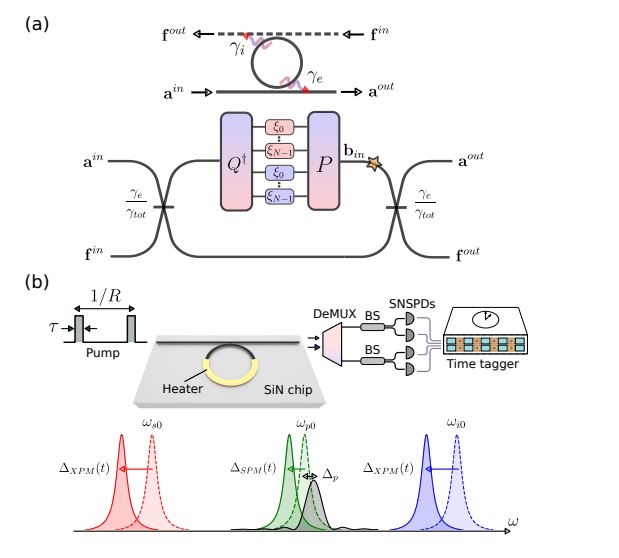
Squeezed light, a vital resource for advanced quantum technologies, typically emerges from tiny structures called microresonators when stimulated with intense light pulses, and researchers are continually seeking ways to improve its quality and efficiency. Emanuele Brusaschi, Marco Liscidini, and Matteo Galli, all from Università di Pavia, along with Daniele Bajoni and Massimo Borghi, now present a detailed investigation into the generation of squeezed light from a silicon nitride microresonator under pulsed excitation. Their work comprehensively maps how the characteristics of this squeezed light evolve with increasing power and varying pulse shapes, revealing previously unaddressed effects that can limit performance at high intensities. Crucially, the team not only identifies these limitations, but also proposes and demonstrates a practical error-correction strategy, paving the way for brighter and more reliable pulsed squeezed light sources for future quantum applications.
Pulsed Squeezed Light Dynamics in Microresonators
Scientists are investigating the temporal behaviour of squeezed light produced by exciting a silicon nitride microresonator with short, intense pulses of light, crucial for advancing quantum technologies. The team employs time-resolved measurements to characterise the squeezed light, revealing details about the nonlinear optical interactions that generate it, and demonstrating the potential of silicon nitride microresonators as efficient sources of non-classical light. This work provides insights into optimising pulse parameters and resonator designs to enhance squeezing performance and improve coherence times, essential for applications in quantum communication and computation.
Squeezed Light Generation in Photonic Circuits
This research details the theoretical and computational framework for generating and characterising highly squeezed states of light using integrated photonic resonators, specifically microcombs and microring resonators, aiming to create a scalable source of squeezed light for quantum information processing, sensing, and communication. Squeezed light reduces quantum fluctuations, enhancing measurement precision, and integrated photonics offers advantages in size, stability, and scalability. The generation of squeezed light relies on nonlinear optical processes, such as four-wave mixing, sensitive to pump power, resonator properties, and material characteristics. Researchers employ cascaded stimulated emission to enhance squeezing and generate highly squeezed states, while accurately modelling losses due to material absorption, scattering, and fabrication imperfections remains a major challenge.
Characterising squeezed light requires measuring not only intensity but also higher-order correlations, revealing its statistical properties. The team utilises numerical methods, including Qutip and finite element analysis, to simulate resonator behaviour and nonlinear processes, and employs statistical analysis tools to compare experimental data with theoretical predictions. This work has significant implications for scalability, achieving high squeezing levels, and advancing quantum information processing, metrology, and on-chip photonics.
Optimal Squeezed Light Generation in Silicon Nitride
This work presents a comprehensive characterisation of pulsed squeezed light generated within a silicon nitride microresonator, spanning from low to high parametric gain regimes. Researchers investigated how the generation rate and spectral purity of the squeezed light evolve with varying pump power, frequency detuning, and pulse duration, observing a local maximum in signal-idler generation rate and high spectral purity under specific conditions. A key finding is the identification of an optimal frequency detuning for each pump power, maximising both the generation rate and spectral purity of the squeezed light. Furthermore, the team demonstrated that using longer pulses, exceeding the cavity lifetime, can increase the generation rate without significantly compromising spectral purity. Addressing a challenge in accurately measuring the temporal intensity of the squeezed light at high gain, the researchers developed and validated an error-correction strategy utilising the statistical properties of multi-photon events to refine measurements obtained through time-resolved coincidence techniques. These results advance understanding of microresonators as sources of non-classical light, offering a practical strategy for optimising and characterising their performance in the context of quantum computing and sensing.
👉 More information
🗞 Time-resolved characterization of pulsed squeezed light from a strongly driven silicon nitride microresonator
🧠 ArXiv: https://arxiv.org/abs/2510.04300