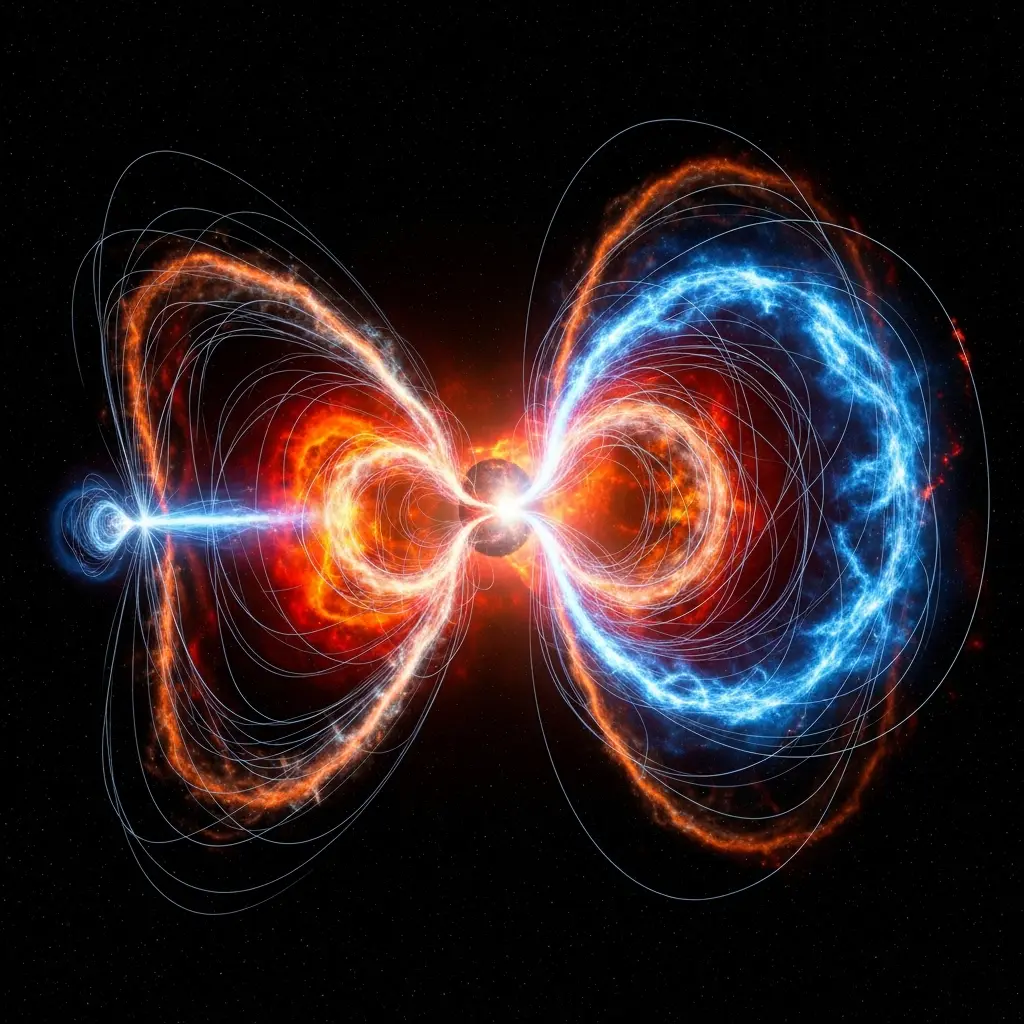
The energetic birth of a rapidly rotating, highly magnetized neutron star within a core-collapse supernova can trigger dramatic hydrodynamic instabilities. Mingxi Chen, Kazumi Kashiyama, and Masato Sato, from the Astronomical Institute, Tohoku University, and the University of Tokyo, investigated this phenomenon through multidimensional numerical studies, developing a framework to model the resulting ‘blowout’ of nascent wind bubbles. This research reveals how the interaction between the neutron star’s wind and the supernova ejecta dictates the observable characteristics of the explosion, linking specific neutron star properties to distinct light curves. The team demonstrates that blowout conditions depend critically on the mass and energy of the ejecta, as well as the neutron star’s magnetic field strength and spin period, potentially explaining observations of superluminous supernovae like LSQ14bdq and precursors to hypernovae. These findings advocate for coordinated ultraviolet, optical, and X-ray observations to better understand the formation of the universe’s most energetic neutron stars.
Scientists have demonstrated a framework for understanding the dynamics of pulsar-driven supernovae, revealing how energy injected by a rapidly spinning, highly magnetized neutron star can shape the resulting explosion and its observable characteristics. This research reveals how the interaction between the neutron star’s wind and the supernova ejecta dictates the observable characteristics of the explosion, linking specific neutron star properties to distinct light curves. The team constructed a semi-analytic model, grounded in multidimensional numerical studies, to trace the evolution of a nascent neutron star wind bubble as it interacts with the surrounding supernova ejecta.
This work establishes a direct link between the properties of the neutron star, specifically its magnetic field strength and spin period, and the resulting light curves observed across multiple wavelengths. The study unveils that a “blowout” phenomenon, driven by hydrodynamic instabilities, occurs when the neutron star’s energy injection surpasses a critical threshold. For stripped-envelope supernovae with an ejecta mass of 10 solar masses and an explosion energy of 10 51 erg, blowout is predicted for neutron stars possessing magnetic field strengths greater than 10 13 Gauss and spin periods less than a few milliseconds. The team’s calculations show that weaker magnetic fields, below 10 14 Gauss, generate luminous, double-peaked ultraviolet/optical light curves reminiscent of the superluminous supernova LSQ14bdq.
Conversely, stronger magnetic fields exceeding 10 14 Gauss result in hypernovae, characterized by X-ray blowout precursors. The research extends to weaker, lower-mass supernova explosions, such as those from ultra-stripped supernovae and accretion- or merger-induced collapse events, where blowout is more easily achieved across a wider range of neutron star parameters. These events are predicted to produce fast X-ray transients with durations of 10 2 to 4 seconds and peak luminosities of 10 42 to 10 48 erg s -1 . This breakthrough reveals a detailed mapping of blowout conditions based on ejecta and neutron star parameters, and provides survey-ready multi-band light curves for comparison with observational data.
By linking the central engine’s properties to observable
By linking the central engine’s properties to observable signatures, the study opens new avenues for constraining the formation of the most energetic neutron stars in the universe. The findings strongly encourage coordinated observations across ultraviolet, optical, and X-ray wavelengths to further refine understanding of these powerful cosmic events and the birth of magnetars. Recent research has focused on understanding the origin and properties of relativistic outflows, material ejected at speeds approaching the speed of light, observed in some supernovae. These outflows, particularly those associated with stripped-envelope supernovae, are thought to be powered by magnetohydrodynamic processes linked to the central engine formed after core collapse.
Researchers are employing a combination of theoretical modeling, numerical simulations, and observational data across the electromagnetic spectrum to dissect this complex phenomenon. Metzger et al. (2011) proposed that rapidly rotating, highly magnetized neutron stars (magnetars) formed during core collapse can launch powerful, collimated outflows. Further refinement of this model, incorporating detailed magnetohydrodynamic simulations, has allowed scientists to predict the expected luminosity and duration of these outflows, providing testable predictions for observations. Observations of early-time emission, particularly in the first few hours and days after a supernova explosion, provide a direct window into the interaction between the outflow and the circumstellar medium.
Analysis of light curves and spectra reveals evidence of shock heating and the composition of the ejected material, allowing scientists to infer the density profile of the circumstellar medium and the energy of the outflow. Furthermore, the detection of non-thermal emission, particularly radio and X-ray emission, provides strong evidence for relativistic particles accelerated within the outflow. Kashiyama & Murase (2017) demonstrated that the observed non-thermal emission can be explained by synchrotron radiation from electrons accelerated in the outflow’s magnetic field. Murase et al. (2021) expanded on this, proposing that these relativistic outflows could even contribute to the observed high-energy neutrino flux.
Recent work has also focused on the impact of circumstellar interaction on the observed supernova properties. Matzner & McKee (1999) highlighted the importance of pre-supernova mass loss in shaping the supernova environment. Orellana & Bersten (2022) demonstrated how the density structure of the circumstellar medium, created by pre-SN mass loss, significantly influences the observed light curves and spectra. This interaction can also lead to the formation of a dense shell of material, which can further modify the outflow’s propagation and emission. Advanced numerical simulations are crucial for integrating these theoretical insights and observational constraints.
Researchers are employing sophisticated codes to model the entire process, from the core collapse and magnetar formation to the launch and propagation of the relativistic outflow and its interaction with the circumstellar medium. These simulations allow scientists to explore the parameter space of outflow properties and identify the key factors that determine the observed supernova characteristics. Scientists have established a framework to model the dynamics following a ‘blowout’ event in supernovae, driven by rapidly spinning, highly magnetized neutron stars. The research details how energy injected by these nascent neutron stars interacts with surrounding supernova ejecta, creating observable signatures in multi-wavelength light curves.
Experiments reveal that for stripped-envelope supernovae with an
Experiments reveal that for stripped-envelope supernovae with an ejecta mass of 3 solar masses and an explosion energy of 10 51 ergs, blowout occurs in neutron stars possessing magnetic field strengths of 10 14 Gauss and spin periods of 10 milliseconds. The team measured that weaker magnetic field cases, around 10 13 Gauss, produce luminous, double-peaked ultraviolet/optical light curves, mirroring observations of the superluminous supernova LSQ14bdq. Conversely, stronger magnetic fields exceeding 10 14 Gauss result in hypernovae, preceded by detectable X-ray emission from the blowout phase. The study constructs a semi-analytic model, guided by relativistic hydrodynamics simulations, to follow the post-blowout dynamics and radiative evolution.
Results demonstrate a near radius-independent kinetic-energy flux, establishing a crucial constraint for the model. This work provides a means to link observable emission with supernova ejecta properties and neutron star parameters. This breakthrough delivers a pathway for interpreting observational data and constraining the formation of the most energetic neutron stars in the universe. The research encourages coordinated observations across ultraviolet, optical, and X-ray wavelengths to further refine understanding of these energetic events. Scientists achieved a framework capable of surveying light curves and mapping blowout conditions by scanning ejecta and neutron star parameters, offering a powerful tool for future investigations into stellar explosions and the birth of magnetars. Through multidimensional numerical studies and semi-analytic modelling, the authors demonstrate how the conditions for blowout, dependent on ejecta mass, explosion energy, neutron star magnetic field strength, and spin period, influence the resulting light curves. The work successfully reproduces observed characteristics.
🗞 Blowouts of Nascent Wind Bubbles in Pulsar-Driven Supernovae
🧠 ArXiv: https://arxiv.org/abs/2601.09552