

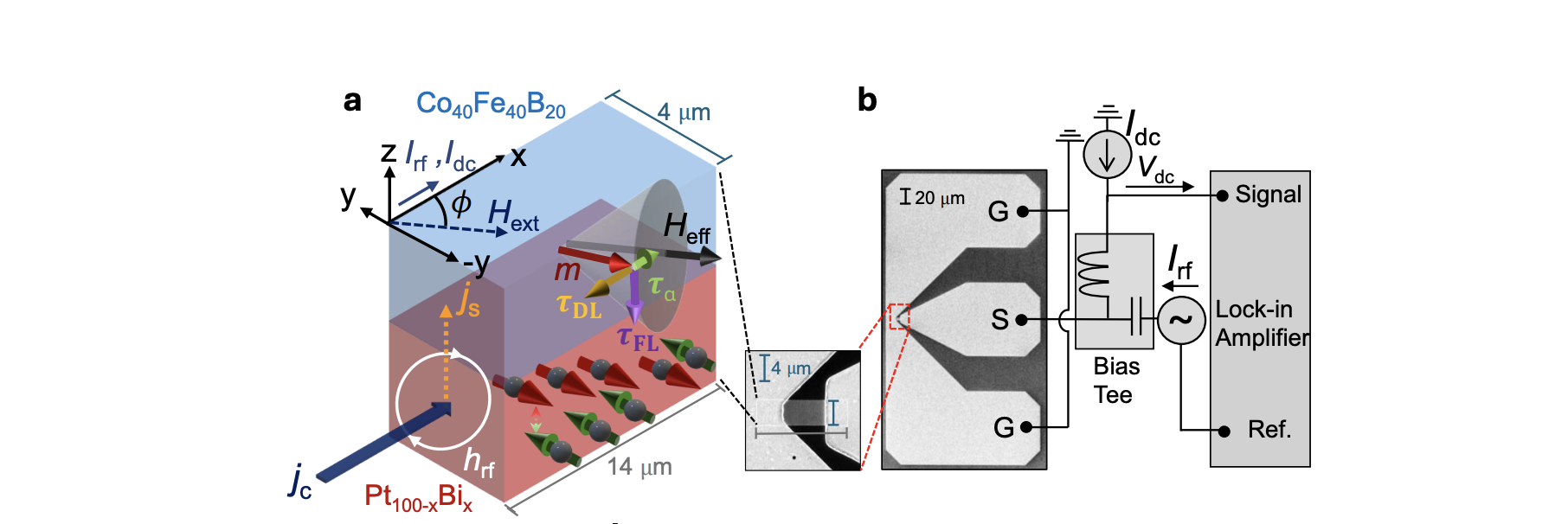
Researchers are actively pursuing energy-efficient nanoscale devices using spin-orbit torque-driven oscillators, and a new study demonstrates a significant advance in this field. Utkarsh Shashank, Akash Kumar, and colleagues from the University of Gothenburg, alongside collaborators at the University of Greifswald and Chalmers University of Technology, have investigated alloys of platinum and bismuth as a means to boost the performance of these oscillators. The team’s work reveals that incorporating bismuth into platinum dramatically enhances the spin Hall effect, a crucial property for reducing the energy needed to initiate and sustain oscillations. This enhancement, coupled with a substantial reduction in the current threshold required for operation, positions platinum-bismuth alloys as a promising material for next-generation microwave devices and magnetic random access memory, offering a pathway towards significantly lower energy consumption.
Platinum and Tantalum Spin Hall Effect Studies
Research in spin-orbitronics encompasses a broad range of materials and device structures, all aimed at harnessing the Spin Hall Effect (SHE) and Spin-Orbit Torque (SOT) for advanced applications. The Spin Hall Effect generates spin currents from charge currents, while SOT utilizes these spin currents to manipulate magnetic materials. Platinum and tantalum remain heavily studied materials due to their strong spin-orbit coupling, with ongoing research focused on optimizing film composition and structure to maximize SHE efficiency. Investigations extend to tungsten, copper, bismuth, and heavy rare earth alloys, each offering unique properties for enhancing charge-spin conversion and SOT effects.
Researchers actively explore alloys such as platinum-aluminum and tantalum-oxygen, manipulating their composition to fine-tune the Spin Hall Effect and optimize SOT performance. Combinations like copper-platinum and platinum-bismuth are also under scrutiny, revealing insights into extrinsic spin Hall effects and giant inverse spin Hall effects, while nitrogen-platinum alloys offer another avenue for controlling charge-spin interconversion. Device development centers around magnetic bilayers and trilayers, such as cobalt-iron-boron over platinum, and tantalum over cobalt-iron-boron over magnesium oxide. Understanding interface effects is crucial for maximizing SOT efficiency and controlling the direction of the torque.
Researchers also investigate related phenomena like spin pumping, spin rectification, and the broader field of spin-orbitronics, which aims to leverage spin-orbit coupling for information processing and storage. Optimizing these devices requires precise control over film deposition techniques, with sputtering being a common method. Material characterization relies on techniques like X-ray Photoelectron Spectroscopy, X-ray Diffraction, and Transmission Electron Microscopy to analyze film composition, structure, and quality. Ferromagnetic Resonance is a key technique for measuring SOT parameters and understanding magnetization dynamics, while temperature dependence studies reveal how these properties change with temperature.
Reducing magnetic damping in materials like cobalt-iron-boron improves device performance, and researchers are developing voltage-gated devices where SOT is controlled by an applied voltage. Specific device types under development include Spin Hall Nano-Oscillators (SHNOs), which are constriction-based oscillators driven by SOT, and magnetic Random Access Memory (MRAM) devices, where SOT is explored as a switching mechanism. Researchers are also investigating the potential of SOT to generate terahertz radiation. Advanced concepts include exploring topological materials, utilizing the Rashba effect for spin manipulation, and disentangling the contributions of extrinsic and bulk mechanisms to the Spin Hall Effect. In summary, this research represents a comprehensive effort to advance the field of spin-orbitronics, focusing on materials, device structures, and optimization techniques to achieve efficient and controllable spin-orbit torque effects for future spintronic applications.
🗞 Bulk spin-orbit torque-driven spin Hall nano-oscillators using PtBi alloys
🧠 DOI: https://doi.org/10.48550/arXiv.2507.10219


