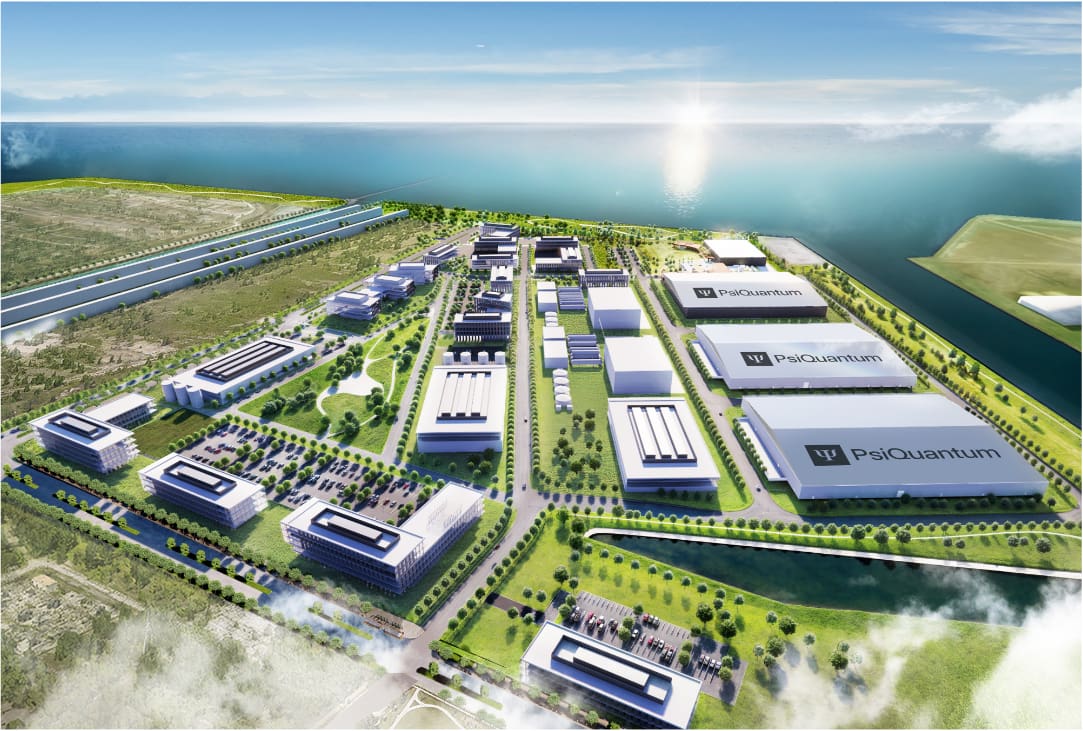
Breaking ground on the Illinois Quantum and Microelectronics Park (IQMP) in Chicago marks the first step toward a million‑qubit, fault‑tolerant quantum computer in the United States. The ceremony, attended by Governor JB Pritzker, Mayor Brandon Johnson, and a host of federal and local officials, underscored a partnership that blends public funding, private capital, and academic expertise. PsiQuantum, a Palo Alto‑based startup, will anchor the campus with its photonic‑based architecture, a choice that promises to sidestep many of the manufacturing bottlenecks that have stalled other quantum approaches. As the nation’s largest quantum‑computing project takes shape, the event signals a broader shift: quantum technology is no longer a distant laboratory curiosity but a concrete economic engine for a city’s South Side.
Building a Quantum Ecosystem on the South Side
The IQMP represents more than a single company’s ambition; it is a planned cluster that will host a range of firms and research groups. Related Midwest, CRG, and Clayco are already engaged in constructing the first intermediate‑scale test system, while the site’s design will accommodate future expansion across additional acres. By situating the facility on the former U.S. Steel South Works site, the project repurposes industrial land into a high‑tech hub, echoing Chicago’s tradition of industrial reinvention. The park will also support the development of a new Advocate Health hospital and expanded lakefront amenities, illustrating how quantum infrastructure can dovetail with community revitalisation. Local officials have framed the campus as a catalyst for new jobs, educational pathways, and a broader economic uplift that reaches beyond the tech sector.
Photonic Architecture: A Manufacturing‑Friendly Path
PsiQuantum’s choice of photonics sets it apart from superconducting and trapped‑ion competitors. By using silicon‑based chips that can be mass‑produced in existing semiconductor fabs, the company sidesteps the need for exotic materials or bespoke fabrication lines. Photonic qubits travel along conventional telecom fibre, allowing the system to tap into familiar cooling and networking infrastructure. In the next phase, the company will construct a test system that will undergo rigorous evaluation by the Defense Advanced Research Projects Agency (DARPA) as part of the Quantum Benchmarking Initiative. Success in this stage will validate the scalability of PsiQuantum’s error‑correction scheme, a critical step toward achieving the million‑qubit target. The approach also promises a more modular architecture, enabling incremental upgrades and faster integration of new technologies.
Economic Stakes and Political Momentum
The project’s funding story is as compelling as its technical narrative. A Series E round that raised over a billion dollars not only finances the construction of the Chicago campus but also supports a parallel facility in Brisbane, Australia. This international footprint signals confidence that the technology can be deployed in multiple markets. Political leaders have framed the investment as a strategic advantage: Governor Pritzker highlighted the potential for Illinois to become a global quantum hub, while Senators Durbin and Duckworth emphasized national security and health‑care applications. The bipartisan endorsement reflects a growing consensus that quantum computing will be a key driver of future economic growth, and that public‑private partnerships are essential to bring the technology to scale.
Looking Ahead
As the construction crews begin to lay foundations, the broader community watches with anticipation. The next few years will test whether the photonic platform can meet its promised milestones and whether the surrounding ecosystem can absorb the influx of talent and capital. Should PsiQuantum succeed, the million‑qubit machine could accelerate breakthroughs in drug discovery, materials science, and cryptography, offering a tangible return on the state’s investment. For Chicago, the IQMP could become a beacon that attracts additional high‑tech firms, reshapes the local job market, and redefines the city’s identity from industrial to innovation‑driven. In the same way that the steel mills once defined the South Side, the quantum lab may soon define its next chapter.