

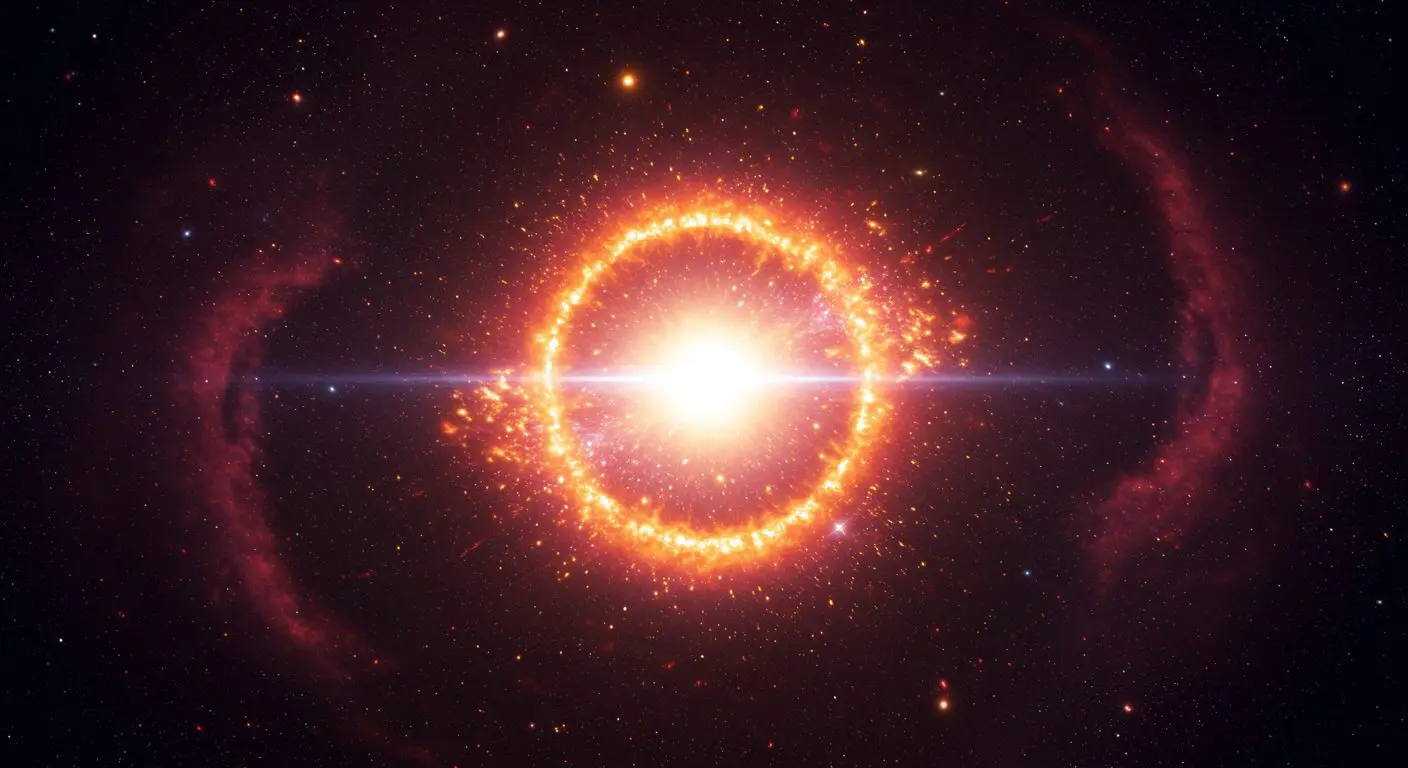
The earliest moments of the universe, specifically the initial singularity theorised to be the Big Bang, present a persistent challenge to physicists attempting to reconcile general relativity with quantum mechanics. Classical general relativity predicts a singularity – a point of infinite density and curvature – where the laws of physics break down. However, quantum cosmology seeks to describe the universe at its very beginning using quantum principles, potentially resolving this singularity. Recent research, published under the title ‘Few-grid-point simulations of Big Bang singularity in quantum cosmology’, explores this problem through the analysis of exactly solvable models in quantum mechanics. Miloslav Znojil, affiliated with both the Czech Academy of Sciences, Nuclear Physics Institute, and the Department of Physics at the University of Hradec Králové, leads this investigation, utilising a mathematical approach involving pseudo-Hermitian quantum mechanics – a formalism extending standard quantum mechanics to encompass non-Hermitian Hamiltonians – and Kato’s exceptional-point theory, which deals with singularities in quantum systems, to model the Big Bang and examine the behaviour of physical observables near this initial point.
The study focuses on whether a point-like singularity is a viable description, and the implications for the universe’s subsequent evolution. Current cosmological models encounter difficulties with the singularity predicted at the universe’s origin, motivating exploration of theoretical frameworks that reconcile general relativity with quantum mechanics. Concentrated research now investigates non-Hermitian quantum systems and parity-time (PT) symmetry, offering potential insights into fundamental physics and the very earliest moments of cosmic existence.
Researchers actively investigate the mathematical foundations of non-Hermitian quantum mechanics, focusing on the physical implications and computational methods associated with these systems. Unlike traditional, Hermitian Hamiltonians – operators describing the total energy of a system – non-Hermitian counterparts do not necessarily guarantee real energy eigenvalues, which represent measurable energy levels. However, these systems can describe physically realisable scenarios when PT symmetry is preserved. PT symmetry requires that the Hamiltonian remains unchanged under combined parity (spatial inversion) and time reversal transformations. Bender and Boettcher’s work provides a foundational review of PT-symmetric quantum mechanics, popularising the concept and demonstrating the possibility of obtaining real spectra, meaning real, measurable energy levels, even with a non-Hermitian Hamiltonian.
Researchers employ sophisticated mathematical tools, such asKrein spaces,
Researchers employ sophisticated mathematical tools, such as Krein spaces, to analyse these systems. Krein spaces extend the conventional Hilbert space – a complex vector space central to quantum mechanics – to effectively handle non-Hermitian operators. Albeverio and Kuzhel detail the application of Krein spaces, providing a rigorous mathematical foundation for understanding non-Hermitian quantum mechanics. Furthermore, the investigation of exceptional points – singularities where the Hamiltonian is non-diagonalizable – forms a central theme. These points represent a breakdown in the usual notion of eigenvalues and eigenvectors, and Berry’s foundational work elucidates the physics of these points and their implications for system behaviour.
Experimental verification of PT symmetry extends beyond theoretical considerations. Ruter et al. demonstrated the observation of PT-symmetric behaviour in an optical system, providing tangible evidence of the phenomenon. This success, alongside comprehensive reviews like Christodoulides and Yang’s work, solidifies the field’s growing prominence and suggests potential applications in novel device development. The connection between non-Hermitian Hamiltonians and open quantum systems – systems interacting with their environment – is also actively explored, as demonstrated by Rotter, broadening the scope of research and linking it to observable physical phenomena.
This research applies these principles to cosmology, specifically examining the singularity at the universe’s origin. Researchers propose a hypothetical identification of the “time of the Big Bang” with an exceptional point, potentially resolving the singularity problem. The singularity, a point of infinite density and curvature, is problematic for current models. Identifying it with an exceptional point suggests a breakdown of conventional physics at that moment, potentially avoiding the need for infinite values. They utilise exactly solvable pseudo-Hermitian models – models that approximate Hermitian behaviour – to support the acceptability of a point-like form of the Big Bang, offering a novel approach to understanding the universe’s origin. Analysis of singular values of observables – physical quantities that can be measured – proves useful in understanding the ambiguity of the singularity’s unfolding after the Big Bang, offering a new perspective on the earliest moments of the universe.
👉 More information🗞Few-grid-point simulations of Big Bang singularity
🗞 Few-grid-point simulations of Big Bang singularity in quantum cosmology
🧠 DOI: https://doi.org/10.48550/arXiv.2506.14848


