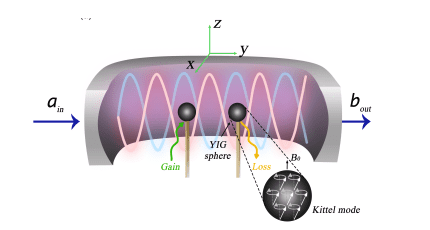
The pursuit of stable and controllable hybrid light-matter states faces a fundamental challenge, as energy loss typically limits the performance of these systems. Xin Huang, Jingyu Liu, and Shirong Lin, from Great Bay University, and their colleagues address this issue by exploring a new approach to controlling magnon-polariton interactions, where energy gain balances energy loss. Their research introduces a theoretical model demonstrating how carefully tuned interactions between light and magnetic excitations, known as magnons, can overcome these limitations. The team reveals a direct link between the system’s symmetry and the strength of its coupling, opening up possibilities for designing spintronic devices with enhanced control over hybrid states and potentially leading to advances in information storage and processing.
Currently, with the emergence of tunable external gain at the macroscopic scale, research focuses on gain-loss balanced non-Hermitian systems, shifting away from purely lossy systems. This work proposes a model incorporating both magnon and cavity modes, coupled via a phase-dependent interaction, allowing detailed investigation of the energy spectrum. The research links the energy spectrum to phase transitions, observing exceptional points when symmetry breaks, and identifies both level attraction and level repulsion phenomena. Level attraction corresponds to multiple phase transitions and manifests as a distinctive energy spectrum, while level repulsion corresponds to fewer transitions, with the repulsive gap dependent on the coupling phase.
Magnon-Photon Coupling in Non-Hermitian Cavities
This research sits at the intersection of several exciting fields, including cavity spintronics, non-Hermitian physics, quantum optics, magnonics, and PT-symmetry breaking. Cavity spintronics forms the central theme, involving the coupling of magnons, spin waves in magnetic materials, to photons within optical or microwave cavities. The goal is to control and manipulate spin information using light, and vice versa. The research explicitly deals with non-Hermitian systems, where energy can be gained or lost, leading to unusual phenomena. The use of cavities and the interaction of light and matter are core to quantum electrodynamics, while magnonics focuses on the manipulation of spin waves for information processing.
PT-symmetry breaking involves disrupting the balance between gain and loss, leading to phase transitions and unique optical properties. The research aims to achieve strong coupling between magnons and photons, where the interaction energy exceeds the decay rates of both, crucial for realizing quantum effects. The research investigates a system where magnons are strongly coupled to photons within a cavity, designed to be non-Hermitian with both gain and loss mechanisms. Researchers are exploring how to control the interaction between magnons and photons in this regime to achieve enhanced light-matter interactions and potentially realize novel quantum phenomena. Specifically, the work develops a theoretical framework to describe the system, investigates PT-symmetry breaking to control the magnon-photon interaction, and analyzes the transmission spectrum to understand light propagation and identify key features. This advances cavity spintronics, explores the potential of non-Hermitian physics, and opens new possibilities for quantum technologies, with potential applications including quantum information processing, quantum sensing, optical isolators, and magnon-based logic devices.
Gain and Loss Control Creates Novel Bands
Researchers have demonstrated a new level of control over interactions between cavity modes and magnons, paving the way for advancements in spintronic devices and signal processing. Their work focuses on systems where energy can both be gained and lost, known as non-Hermitian systems, moving beyond traditional approaches that typically experience energy dissipation. By carefully balancing these gains and losses, the team has achieved unprecedented control over the system’s behavior and its energy spectrum. The research reveals that the interplay between gain and loss can lead to unique phenomena, including the attraction and repulsion of energy levels.
This control is achieved through a model where the system’s properties are dictated by the balance between gain and loss, and the coupling between the cavity and magnon components. Importantly, researchers discovered that the phase of the coupling between the cavity and magnon modes dramatically influences the system’s behavior. By altering this phase, they can switch between two distinct regimes: dissipative coupling, where energy is lost, and coherent coupling, where energy is conserved. This transition occurs without changing the overall strength of the gain and loss, demonstrating a new degree of freedom for controlling these hybrid systems. In the coherent coupling regime, the system exhibits a wider range of frequencies over which signals can be transmitted, potentially leading to more efficient signal processing and quantum information transfer. Furthermore, manipulating the coupling phase can create wider ranges of frequencies where level attraction occurs, enhancing the system’s responsiveness and tunability.
Non-Hermiticity Drives Magnon-Cavity Coupling Transitions
This research constructs a model incorporating both gain and loss to investigate the relationship between its energy spectrum and phase transitions within cavity magnon systems. The team demonstrates that the system undergoes multiple phase transitions as the magnon frequency increases, linked to the emergence of exceptional points where standard physical properties break down. They identify a correlation between the system’s symmetry and the coupling between magnons and cavities, revealing that symmetry breaking corresponds to a transition from coherent to dissipative coupling modes. The study establishes a clear connection between the system’s phase diagram, defined by non-Hermiticity and coupling phase, and the nature of coupling between magnons and cavities; real domains indicate coherent coupling, while complex domains signify dissipative coupling.
This allows for precise control of coherent coupling gaps by tuning the coupling phase, expanding the parameter space for transitions and potentially enabling the exploration of more complex phenomena. The authors acknowledge that their model provides a theoretical framework, and future work could focus on experimental validation and exploring the implications of these findings in real-world spintronic devices. This research provides crucial insights for manipulating energy levels and coupling modes in quantum systems, offering a pathway towards enhanced control in cavity magnon systems.
👉 More information
🗞 Coupling phase enabled level transitions in pseudo-Hermitian magnon-polariton systems
🧠 ArXiv: https://arxiv.org/abs/2508.04298