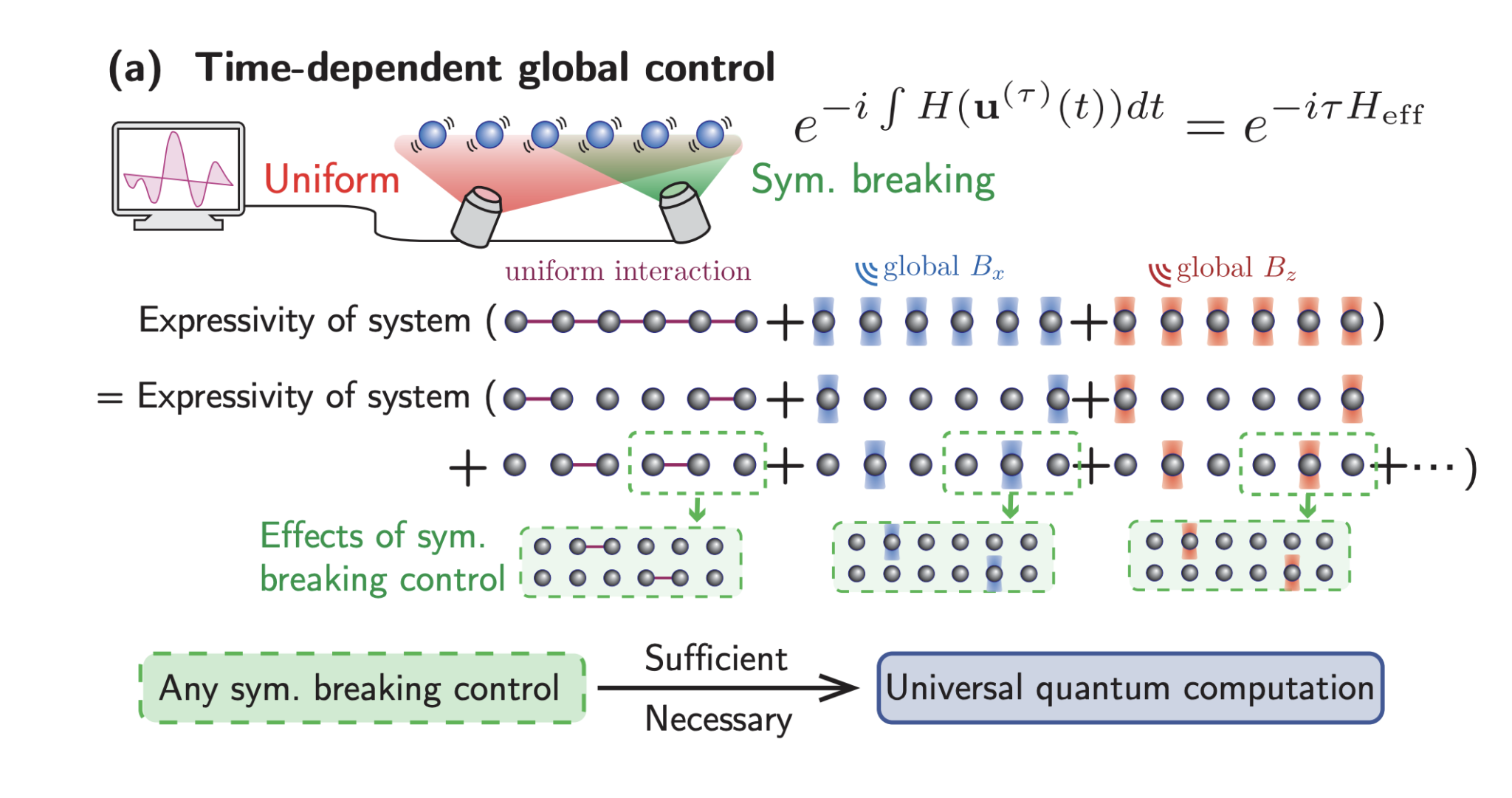
The quest to simulate complex physical systems drives innovation in quantum technologies, and researchers are now exploring the limits of what’s possible with analog quantum simulators. Hong-Ye Hu, Abigail McClain Gomez, and Liyuan Chen, alongside colleagues including Aaron Trowbridge and Andy J. Goldschmidt, demonstrate a crucial step towards building truly versatile simulators capable of tackling a wider range of problems. Their work establishes the theoretical conditions for achieving ‘universal dynamics’, the ability to simulate any physical process, using only global control over the system, and importantly, translates this theory into a practical experimental framework. By introducing a new technique for direct optimal control, the team successfully engineers complex interactions within a Rydberg atom array, overcoming limitations imposed by real-world hardware and confirming the expressivity of their approach through the observation of symmetry-protected edge modes, ultimately paving the way for more powerful and adaptable quantum simulation platforms.
Analog quantum simulators, systems that mimic the behavior of quantum systems, have emerged as powerful tools for exploring complex quantum phenomena. Recent advances, such as controlling thousands of atoms, demonstrate the growing potential of these platforms for practical applications.
Rydberg Atoms Simulate Topological Edge States
Researchers have successfully demonstrated the ability to simulate complex quantum systems using arrays of Rydberg atoms. The primary goal was to experimentally realize and control a one-dimensional topological phase of matter, specifically simulating the dynamics of a ZXZ Hamiltonian, which supports protected quantum states known as edge states localized at the boundaries of the system. This was achieved by precisely controlling the interactions between the Rydberg atoms using shaped laser pulses, utilizing a commercially available platform and carefully designed pulses. The team employed quantum optimal control techniques, comparing direct and indirect methods like GRAPE, and successfully engineered the interactions to simulate the ZXZ Hamiltonian, observing signatures of topological edge states, including high atom density at boundaries and strong correlations. Direct optimization methods generally outperformed indirect methods, and the system showed robustness to control errors, representing a step towards more robust quantum information processing systems.
Universal Quantum Simulation with Global Control Pulses
Researchers have established a fundamental principle for universal quantum simulation: globally-controlled analog simulators can achieve universal dynamics, capable of simulating a wide range of physical systems. This breakthrough extends possibilities for exploring complex phenomena with platforms like ultracold atoms in optical superlattices, requiring specific control fields, including uniform and linearly-gradient magnetic fields for particles with spin, expanding previous control sets. Building on this framework, scientists experimentally demonstrated the ability to engineer effective interactions beyond hardware capabilities. They successfully realized three-body interactions with Rydberg atom arrays using a new control technique called direct quantum optimal control, overcoming limitations and accounting for atom position fluctuations, identifying smooth, short-duration pulses for high-fidelity dynamics. This method allows for the creation of complex Hamiltonians, enabling simulation of systems like the two-dimensional Fermi-Hubbard model, a candidate for high-temperature superconductivity, and observing dynamical signatures of symmetry-protected edge modes.
Universal Dynamics with Controlled Analog Simulators
This research establishes a crucial theoretical result: globally-controlled analog simulators can achieve universal dynamics, capable of simulating a wide range of physical systems, for both fermions and bosons, including those realized with ultracold atoms in optical superlattices. Importantly, researchers moved beyond theory by introducing direct optimal control, allowing for the synthesis of complex interactions while accounting for real-world hardware limitations. The practical power of this approach was demonstrated by successfully engineering three-body interactions and observing dynamics on a Rydberg atom array, including signatures of symmetry-protected edge modes, confirming the expressivity and feasibility of the new control framework, even with challenges like atom position fluctuations. While acknowledging the computational cost associated with the method, particularly for complex systems, they highlight its advantage in reducing optimization variables, suggesting future work could refine these techniques to expand the scale and complexity of simulations.
🗞 Universal Dynamics with Globally Controlled Analog Quantum Simulators
🧠 ArXiv: https://arxiv.org/abs/2508.19075