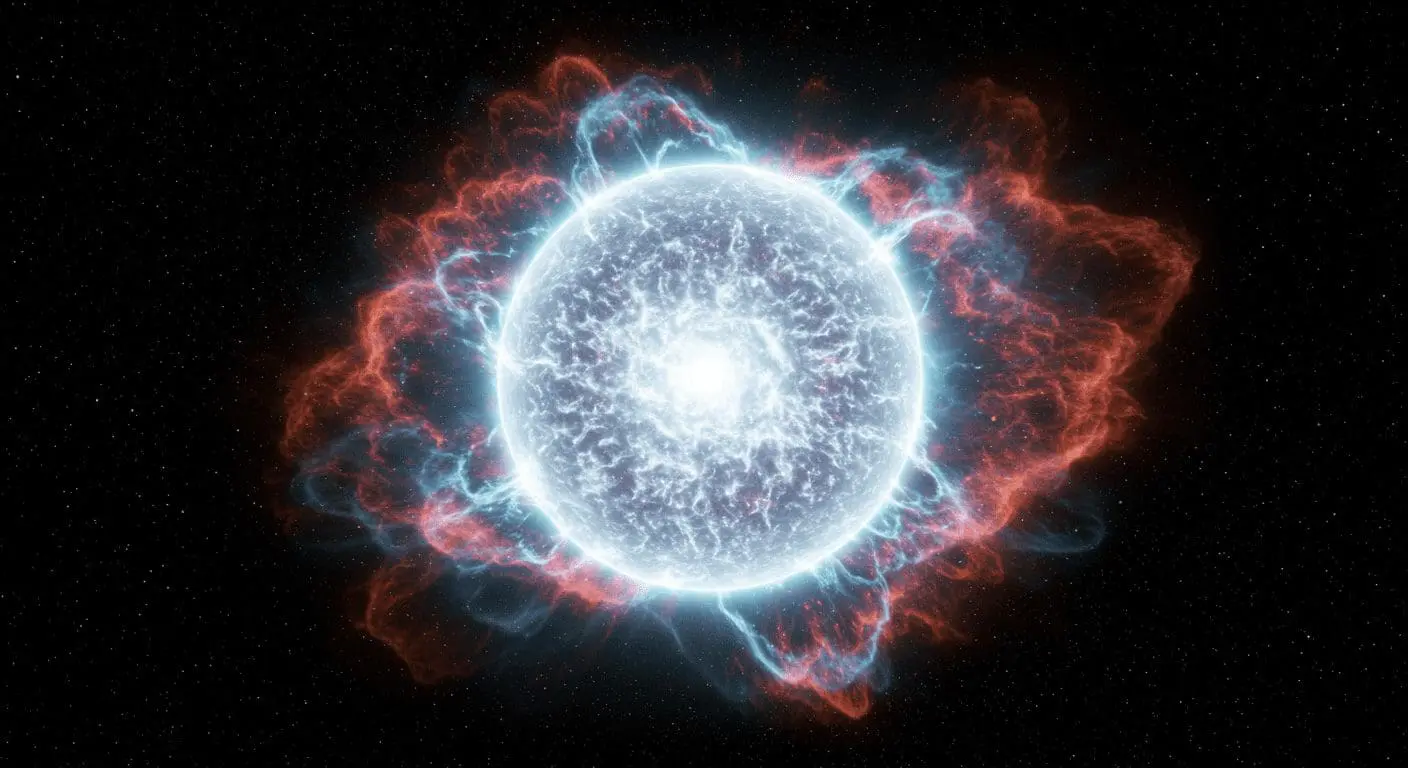
On April 24, 2025, researchers K.H. Thong and A. Melatos published a Flux tube clustering study from the magnetic coupling of adjacent type-I and II superconductors in a neutron star: persistent gravitational radiation. The study detailed how the interaction between different types of superconductors in neutron stars leads to clustered flux tubes that emit detectable gravitational waves, potentially within the reach of current interferometric detectors.
This study refines previous models of pulsar proton superconductors by incorporating magnetic repulsion. It shows that flux tubes in type-I and II regions cluster with separations 2-7 times smaller than isolated tubes. Neutron vortices pin around these clusters, emitting gravitational radiation with strain exceeding uniformly distributed vortices by a factor proportional to the number of pinned vortices per flux tree. This enhanced strain brings emissions close to detectability by current interferometric detectors when flux branching forms fewer, larger flux trees.
Neutron stars are among the most extreme objects in the universe, characterised by their intense magnetic fields and superfluid interiors. The magnetic field lines traverse the neutron star’s crust through narrow channels known as flux tubes. These structures play a crucial role in shaping the star’s magnetic environment.
Traditionally, models assumed that flux tubes were uniformly distributed across the neutron star’s surface, following a Poisson distribution. However, this approach neglected a vital phenomenon: clustering. Flux tubes do not distribute randomly but tend to form groups due to magnetic interactions and the properties of the superfluid interior.
To address this gap, researchers employed a Matérn cluster process, a statistical method that accounts for the spatial aggregation of points. This allowed them to model how flux tubes group together, influenced by magnetic field strength and superfluid viscosity. Additionally, they utilised Campbell’s theorem to analyse the second moment measure, enabling the calculation of variance in flux tube distribution across different regions.
The findings enhance our understanding of neutron star dynamics, particularly phenomena like pulsar glitches—sudden changes in rotation rate thought to result from interactions between clustered flux tubes and the superfluid interior. The model also offers insights into how magnetic fields evolve, influencing thermal properties and emissions.
👉 More information
🗞 Flux tube clustering from magnetic coupling of adjacent type-I and -II superconductors in a neutron star: persistent gravitational radiation
🧠 DOI: https://doi.org/10.48550/arXiv.2504.17746