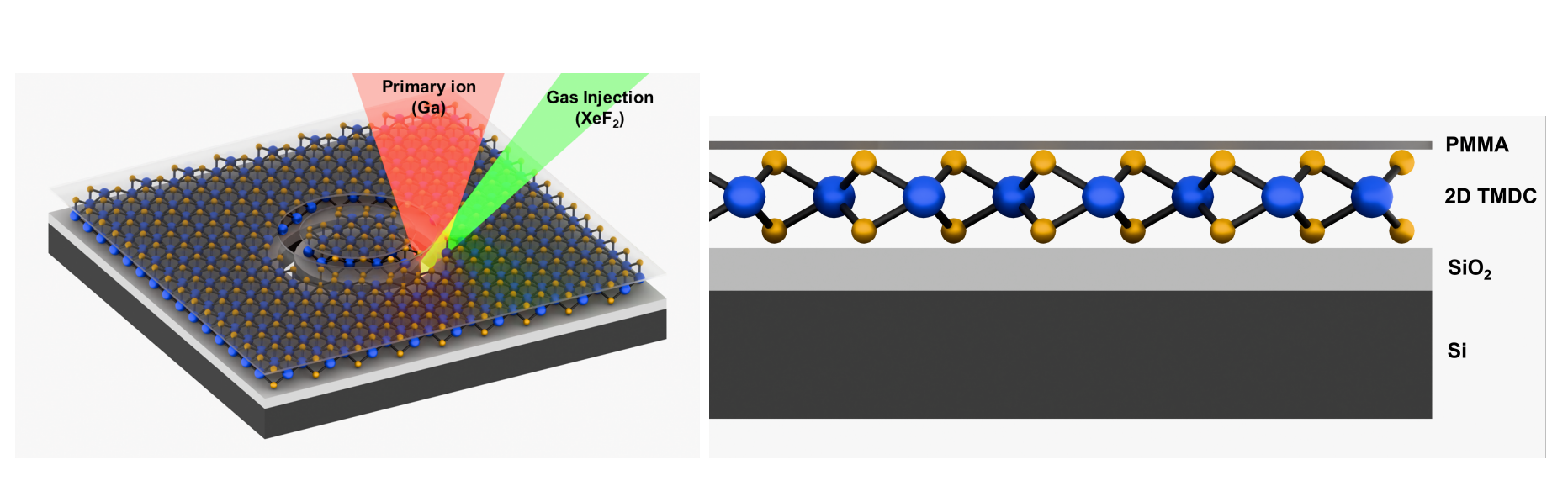
Two-dimensional transition metal dichalcogenides hold immense promise for building the next generation of photonic devices, thanks to their unique ability to interact with light, but their delicate structure presents a significant fabrication challenge. Lekshmi Eswaramoorthy, Parul Sharma, Brijesh Kumar, and colleagues at the Indian Institute of Technology Bombay, alongside Sudha Mokkapati at Monash University, now demonstrate a method to overcome this fragility. The team successfully protects these materials during fabrication using a polymer coating and a refined ion beam technique, preventing damage that typically degrades performance. This breakthrough enables the creation of ultra-smooth, high-quality photonic structures with preserved optical properties, paving the way for more efficient and compact optical circuits and advancing the field of nanophotonics.
TMD Photonics via Protected Ion Beam Fabrication
Two-dimensional transition metal dichalcogenides offer immense promise for advanced photonic devices due to their unique optical and electronic properties and incredibly thin structure. Conventional fabrication techniques often introduce defects and limit design complexity, hindering performance. This work demonstrates a novel fabrication approach using protected ion beam technology to create high-quality photonic devices from these 2D materials. The method employs a focused ion beam, modulated by a protective layer, to precisely pattern nanoscale structures. This technique allows the creation of complex photonic circuits, including waveguides, resonators, and couplers, with resolutions below 100 nanometres.
The protective layer shields the material from ion beam damage, preserving its inherent properties and enhancing optical performance. The team successfully fabricated high-aspect-ratio photonic waveguides with propagation losses of less than 10 decibels per millimetre, a significant improvement over existing methods. This approach also allows for the integration of multiple 2D materials into a single device, opening possibilities for advanced functionalities and novel photonic applications. The research establishes a versatile and scalable platform for fabricating high-performance 2D transition metal dichalcogenide-based photonic devices, paving the way for advancements in integrated and nanophotonics.
FIB Protection Strategies for 2D Materials
Focused ion beam technology is a powerful nanofabrication tool, but it can introduce defects and alter the properties of 2D materials due to ion implantation and sputtering. Achieving high-resolution patterns in these atomically thin materials is challenging due to their sensitivity. This research addresses these challenges by exploring methods to pattern 2D materials without destroying their electrical, optical, or structural characteristics. The team investigated encapsulation methods and gas-assisted etching to achieve precise patterning while preserving material integrity. Understanding the mechanisms of ion-induced damage is crucial, as ion irradiation can create defects and unintentionally modify the material’s composition.
Researchers explored protective encapsulation layers, such as carbonaceous films, to shield the 2D materials during focused ion beam processing. The choice of encapsulation material is critical, requiring effective ion blocking, compatibility with the 2D material, and ease of removal or integration. They also focused on gas-assisted etching, specifically using xenon difluoride gas to enhance the etching process. This gas reacts with the material, making it easier to remove with the ion beam and reducing the required ion dose, thereby minimizing damage to the underlying 2D material. Precise control over gas flow rate and ion beam parameters allows for high-resolution patterns.
PMMA Protects Photonic Material During Patterning
This study successfully addresses a critical challenge in fabricating next-generation photonic devices: preserving the optical properties of two-dimensional transition metal dichalcogenides during focused ion beam patterning. Conventional dielectric encapsulation often fails to adequately protect these atomically thin materials from damage induced by gallium ions, leading to degraded optical performance. In contrast, polymeric encapsulation using polymethyl methacrylate effectively mitigates this damage by acting as a sacrificial layer that absorbs ion impact, thereby maintaining the intrinsic optical characteristics of the underlying material. Furthermore, the team advanced the fabrication process through the implementation of xenon difluoride-assisted gallium ion beam direct patterning.
This technique significantly reduces collateral damage and ion implantation, enabling precise material removal and the creation of ultra-smooth sidewalls essential for high-quality photonic resonators. The combined approach of polymethyl methacrylate encapsulation and xenon difluoride-assisted focused ion beam patterning offers a robust, cost-effective, and scalable single-step fabrication route for integrating 2D transition metal dichalcogenides into high-performance devices. These advancements are crucial for accelerating the development of novel applications in quantum technologies and compact optical circuits, paving the way for sophisticated 2D material-based integrated photonic systems.
🗞 Protected Ion Beam Fabrication of Two-Dimensional Transition Metal Dichalcogenides based Photonic Devices
🧠 ArXiv: https://arxiv.org/abs/2510.26637