

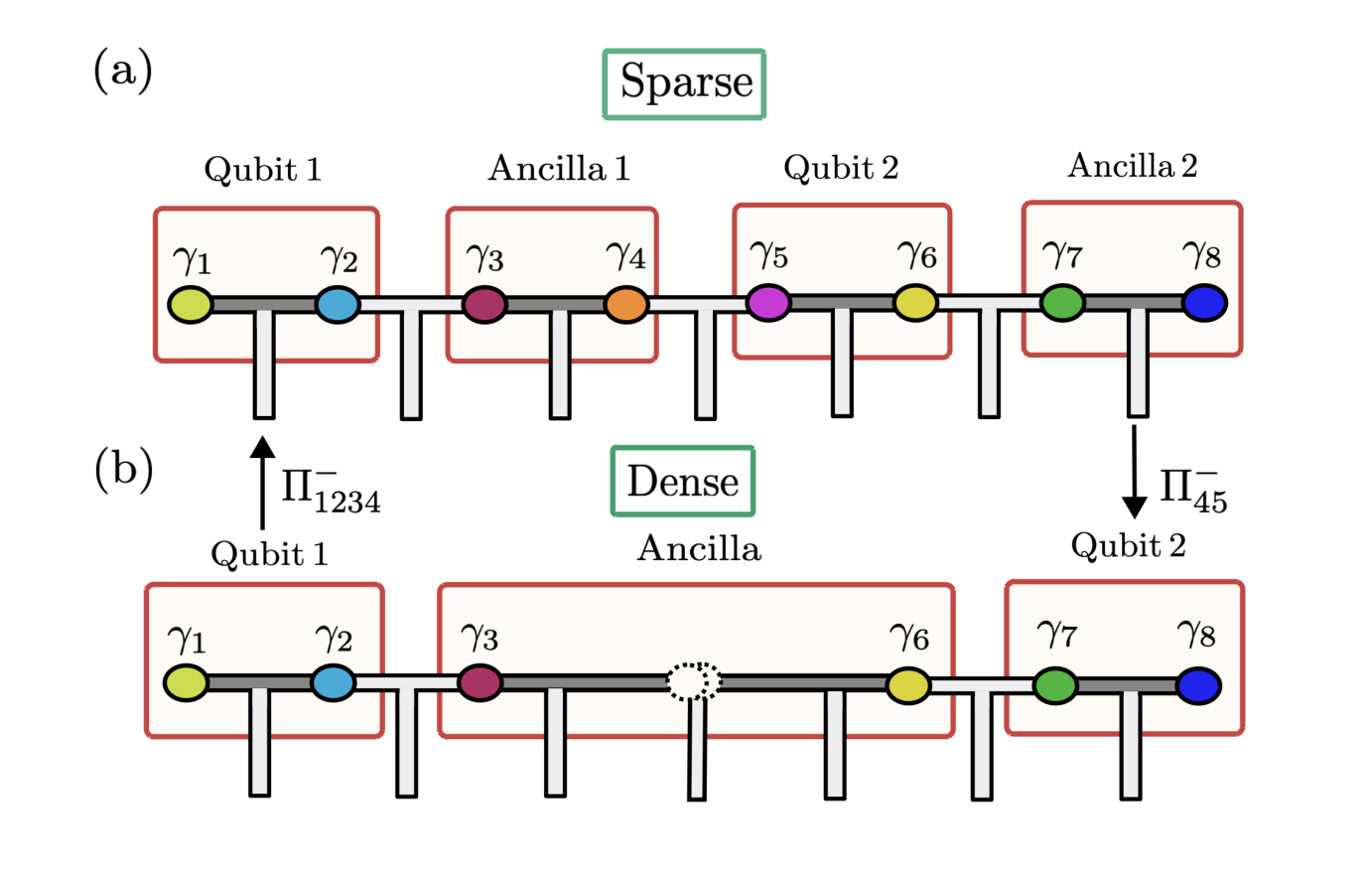
Topological quantum computing represents a promising path towards stable and reliable quantum computation, as it encodes information in exotic particles called anyons which are naturally resistant to errors. Researchers Themba Hodge, Philipp Frey, and Stephan Rachel, all from the University of Melbourne, have now overcome a significant hurdle in scaling up this technology beyond just a few qubits. Their work demonstrates how to perform universal quantum computations with any number of qubits by incorporating projective measurements, a technique that allows the system to switch between different qubit encodings. This advancement enables the creation of complex quantum circuits, achieving over 99% fidelity on five qubits and successfully scaling the method to ten qubits, bringing fault-tolerant quantum computing a step closer to reality.
Overcoming Limitations: Introducing Projective Measurements
Scaling computations beyond two qubits presents significant challenges, as straightforward extensions of braiding-based gates are insufficient to support the full range of quantum operations. To address this limitation, the research incorporates projective measurements, which enable transitions between different qubit encodings and restore computational universality. The team performs many-body simulations of braiding dynamics, augmented with measurement-based switching, explicitly preparing the Bell state for systems of two qubits and the GHZ state for systems of five qubits.
Majorana Zero Modes for Robust Qubits
Background and Architectures for Topological Quantum Computation
Quantum computation aims to build computers that harness the principles of quantum mechanics, such as superposition and entanglement, to solve problems intractable for classical computers. Topological quantum computation is a particularly promising approach, encoding quantum information in the topological properties of exotic states of matter, making it inherently resistant to noise. Majorana zero modes are quasiparticles, emergent excitations, that are their own antiparticles and are central to this research. MZMs arise in certain materials and, crucially, are non-Abelian anyons, meaning that exchanging two MZMs alters the quantum state of the system depending on the path taken.
Topological Gates: Simulating Operations with Exotic Anyons
This braiding operation forms the basis for quantum gates in topological quantum computation. The research focuses on simulating the braiding of MZMs to demonstrate the feasibility of TQC, employing sophisticated numerical techniques to model interacting MZMs. The core innovation lies in the use of projective measurements, which dramatically reduce computational complexity by measuring the system at specific points to project the state onto a well-defined subspace. This allows researchers to simulate braiding without directly modelling the complex dynamics of MZMs. The team calculates the overlap matrix between initial and final states after braiding, providing information about the accuracy of the quantum gate. The simulations demonstrate that TQC based on MZMs is, in principle, feasible, and that the method is potentially scalable to larger numbers of qubits. While creating materials hosting MZMs and precisely controlling them remain significant challenges, this research represents a substantial step towards building a robust and scalable quantum computer based on topological principles.
Achieving Universal Quantum Computation via Measurement
Projective Measurements Enable Universal Topological Quantum Computation
Enabling Universal Operations Through Projective Measurements
Researchers have achieved a significant breakthrough in topological quantum computing, demonstrating a pathway towards building more robust and scalable quantum processors. Their work addresses a critical limitation in the field, the difficulty of performing universal quantum computations using only the natural braiding of particles known as Majorana zero modes. To overcome this challenge, the team incorporated projective measurements, effectively switching between different ways of encoding quantum information. This allows for transitions between qubit encodings, restoring the ability to perform any quantum computation.
Demonstrated High Fidelity: Complex Multi-Qubit States
They successfully prepared complex quantum states, including the Bell state with two qubits and the more complex GHZ state with five qubits, demonstrating precise control over the system. Notably, they executed a random unitary circuit on five qubits with a fidelity exceeding 99%, indicating a high degree of accuracy in performing complex calculations. The research highlights the intrinsic fault tolerance of this approach, showing that the system maintains over 99% fidelity even with moderate levels of disorder. This resilience to imperfections is crucial for building practical quantum computers, as real-world systems are inevitably affected by noise and disturbances. Furthermore, the team extended their simulations to a ten-qubit system, showcasing the scalability of their techniques and paving the way for larger, more powerful quantum processors. This work represents a substantial step forward in topological quantum computing, offering a promising route to overcome key limitations and realize the potential of this error-resistant approach to quantum computation.
Braiding and Measurement Enable Fault Tolerance
Pathways to Scale: Intrinsic Error Correction and Robustness
Demonstrating Scalability and Intrinsic Error Correction
This research demonstrates a pathway towards building more robust quantum computers using exotic states of matter known as non-Abelian anyons. The team addressed a fundamental challenge in scaling up these systems, the limited range of operations possible with standard braiding techniques, by incorporating projective measurements. These measurements allow for transitions between different qubit encodings, effectively restoring the ability to perform any quantum calculation. Simulations show successful implementation of complex quantum circuits, including a random circuit with ten qubits, achieving high fidelity exceeding 99% even with moderate levels of disorder.
The key finding is that this combination of braiding and projective measurements provides intrinsic fault tolerance, meaning the system is naturally resistant to errors. The simulations confirm that the fidelity of calculations remains high despite the presence of imperfections, a crucial step towards practical quantum computation. While the current work relies on simulations, the results strongly suggest that this architecture offers a viable route to building scalable and reliable quantum computers.
🗞 Projective Measurements: Topological Quantum Computing with an Arbitrary Number of Qubits
🧠 ArXiv: https://arxiv.org/abs/2508.10107


