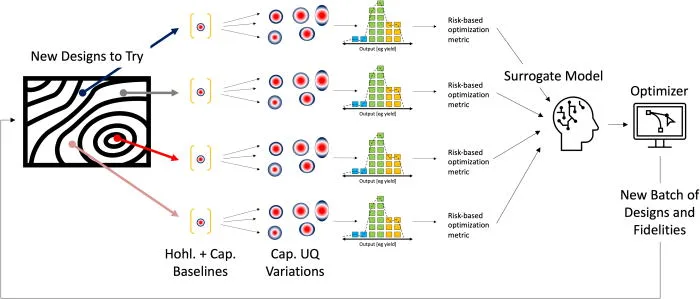
Project ICECap, led by researchers from the Lawrence Livermore National Laboratory, is a high-performance computing initiative that aims to leverage the power of exascale computing to revolutionize the design and optimization of inertial confinement fusion (ICF) systems. The project, which was presented at the 4th International Conference on Data-Driven Plasma Science, could potentially lead to breakthroughs in various fields, from nuclear fusion to materials science to astrophysics. However, the project faces significant challenges, including the unprecedented scale of computational power required and the complexity of the systems being studied.
What is Project ICECap?
Project ICECap is a high-performance computing initiative that has entered the Exascale Age. This means it is capable of performing over 10^18 floating point operations per second. The project is led by a team of researchers from the Lawrence Livermore National Laboratory in Livermore, California. The team includes J. Luc Peterson, Tim Bender, Robert Blake, NaiYuan Chiang, M. Giselle Fernández-Godino, Bryan Garcia, Andrew Gillette, Brian Gunnarson, Cooper Hansen, Judy Hill, Kelli Humbird, Bogdan Kustowski, Irene Kim, Joe Koning, Eugene Kur, Steve Langer, Ryan Lee, Katie Lewis, Alister Maguire, Jose Milovich, Yamen Mubarka, Renee Olson, Jay Salmonson, Chris Schroeder, Brian Spears, Jayaraman Thiagarajan, Ryan Tran, Jingyi Wang, and Chris Weber.
The project was presented at the 4th International Conference on Data-Driven Plasma Science and is part of a special collection of papers from the conference. The paper was submitted on 23rd February 2024, accepted on 31st May 2024, and published online on 18th June 2024.
What is the Exascale Age?
The Exascale Age refers to the era of computing where machines are capable of performing over 10^18 floating point operations per second. This level of computational power is unprecedented and has the potential to revolutionize the detailed, in-depth study of highly complex science and engineering systems.
One such exascale computer is El Capitan, the National Nuclear Security Administration’s first. These computers are not just about performing “whole machine hero simulations”, but they could also enable new paradigms in digital design by making petascale hero runs routine. This means that problems in complex system design, optimization, model exploration, and scientific discovery that are currently untenable could all become possible.
What is the Goal of Project ICECap?
Project ICECap is motivated by the challenge of uncovering the next generation of robust, high-yield inertial confinement fusion (ICF) designs. ICF is a type of nuclear fusion where nuclear fuel is heated and compressed using high-energy lasers or ion beams. The goal is to achieve a state where nuclear fusion reactions can occur, releasing a large amount of energy.
The project aims to leverage the power of exascale computing to revolutionize the design and optimization of these ICF systems. By making petascale hero runs routine, the project hopes to tackle currently untenable problems in complex system design, optimization, model exploration, and scientific discovery.
How Does Project ICECap Plan to Achieve Its Goals?
The team behind Project ICECap plans to leverage the power of exascale computing to revolutionize the design and optimization of ICF systems. This involves performing over 10^18 floating point operations per second, a level of computational power that is unprecedented.
By making petascale hero runs routine, the team hopes to tackle currently untenable problems in complex system design, optimization, model exploration, and scientific discovery. This could potentially lead to the uncovering of the next generation of robust, high-yield ICF designs.
What are the Potential Implications of Project ICECap?
The potential implications of Project ICECap are vast. If successful, the project could revolutionize the detailed, in-depth study of highly complex science and engineering systems. This could lead to breakthroughs in a variety of fields, from nuclear fusion to materials science to astrophysics.
Furthermore, by making petascale hero runs routine, the project could enable new paradigms in digital design. This could lead to advancements in complex system design, optimization, model exploration, and scientific discovery. In other words, problems that are currently untenable could become possible to solve.
What are the Challenges Facing Project ICECap?
Despite the potential benefits, Project ICECap also faces significant challenges. The sheer scale of the computational power required is unprecedented, and harnessing this power effectively and efficiently is a major task.
Furthermore, the complexity of the systems being studied, such as ICF designs, means that the project will need to develop new methods and approaches for system design, optimization, model exploration, and scientific discovery. Overcoming these challenges will be key to the success of the project.
What is the Future of Project ICECap?
The future of Project ICECap is promising, but also uncertain. The project has the potential to revolutionize the study of complex science and engineering systems and enable new paradigms in digital design. However, the challenges facing the project are significant and overcoming them will require innovative approaches and methods.
If successful, the project could lead to the uncovering of the next generation of robust, high-yield ICF designs. This could have far-reaching implications for a variety of fields, from nuclear fusion to materials science to astrophysics. However, much work remains to be done, and the success of the project is by no means guaranteed.
Publication details: “Toward digital design at the exascale: An overview of project ICECap”
Publication Date: 2024-06-01
Authors: J. L. Peterson, Tim Bender, Robert R. Blake, Nai-Yuan Chiang, et al.
Source: Physics of plasmas
DOI: https://doi.org/10.1063/5.0205054