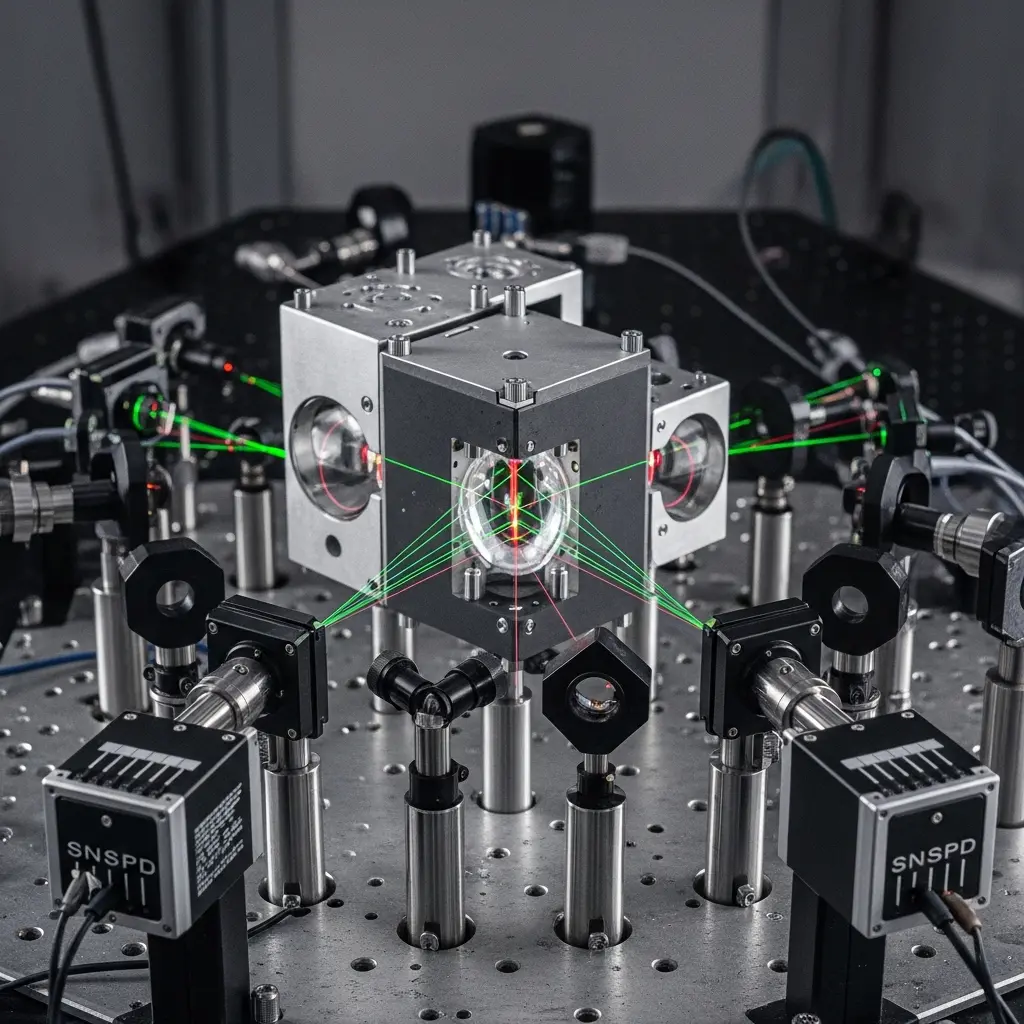
Secure communication relies on robust cryptographic keys, and researchers continually seek methods to generate these keys with guaranteed security, a challenge now addressed by Marcel Kokorsch and Guido Dietl from the University of Würzburg. Their work investigates the complete process of transforming entangled quantum states into secure cryptographic keys, moving beyond individual steps to consider the entire chain of operations. The team develops a unified framework that quantifies how the quality and amount of initial entanglement impacts the final key generation rate, revealing optimal strategies for entanglement processing and distillation. This holistic approach, built upon established protocols, provides a crucial advance in entanglement-based key distribution, offering a pathway to more efficient and secure communication networks.
Analyzing Components for Maximum Key Rate
Analyzing preprocessing for enhanced secure key rates
The study investigates how mechanical preprocessing, specifically entanglement distillation, impacts the ultimate key rate, alongside the quantum measurements and subsequent classical post-processing required to establish secure communication. Researchers base their work on established principles of quantum mechanics and utilize theoretical frameworks defining key capacity limits, ultimately proving which measurement bases are necessary to achieve this capacity when using Werner states. The methodology begins with generating entangled links between two parties, Alice and Bob, while accounting for the possibility of an eavesdropper.
Utilizing Entanglement Distillation for State Refining
Scientists then employ entanglement distillation, a process of refining multiple noisy quantum states into fewer, less noisy states, to enhance the quality of the entanglement. This distillation process is central to the work, as researchers aim to determine the optimal amount of distillation needed before measurement. The team meticulously models the entire system, including the quantum mechanical preprocessing, the measurement of quantum states to extract correlated bit strings, and the classical post-processing needed to transform these correlations into a usable secure key.
Entanglement Distillation Maximizes Secure Key Rates
Developing the comprehensive quantum key processing framework
Processing Framework for Quantum Key Distribution
Scientists have developed a comprehensive framework for processing entangled quantum states within quantum key distribution protocols, achieving significant advances in secure communication. The work investigates the entire processing chain, from initial entanglement generation to final key creation, and establishes a unified formalism for quantifying the relationship between the quality and quantity of entangled states. Researchers meticulously analyzed how quantum mechanical preprocessing, specifically entanglement distillation, impacts the final secure key rate, alongside the processing of quantum states via measurements and subsequent classical postprocessing. The team proved that specific measurement bases are crucial for achieving the theoretical capacity limits when dealing with Werner states, a key advancement in maximizing key generation efficiency. Experiments revealed a new processing strategy that, in certain scenarios, outperforms commonly used methods, demonstrating the potential for improved performance in real-world applications. Furthermore, the study answers a critical question regarding optimal entanglement distillation, determining the ideal balance between reducing noise and maintaining sufficient entangled states for key generation.
Entanglement Distillation and Key Rate Optimisation
Synthesizing the entire process of key generation
This research presents a comprehensive analysis of entanglement-based quantum key distribution, focusing on the entire process from entangled state distribution to secure key generation. The team investigated how each stage, entanglement distillation, measurement processing, and classical post-processing, impacts the final key rate, developing a unified framework to quantify the relationship between entangled state quality and key generation capacity. A key achievement is the identification of optimal measurement bases for achieving maximum key distillation capacity, specifically proven for Werner states, and extending to Bell diagonal states under certain conditions. Furthermore, the researchers propose a novel processing strategy that, in specific scenarios, outperforms existing methods, and provide a means of bounding the results to efficiently determine the optimal amount of entanglement distillation required. This work addresses fundamental questions regarding the efficiency of quantum key distribution protocols and provides a robust formalism for evaluating their performance. While acknowledging that definitive statements regarding processing strategy effectiveness are limited when dealing with Bell diagonal states, the team identifies areas for future investigation, including solving the optimization problem to identify the truly optimal processing strategy and investigating the influence of state shape on results.
🗞 Processing Entangled Links Into Secure Cryptographic Keys
🧠 ArXiv: https://arxiv.org/abs/2511.18913