

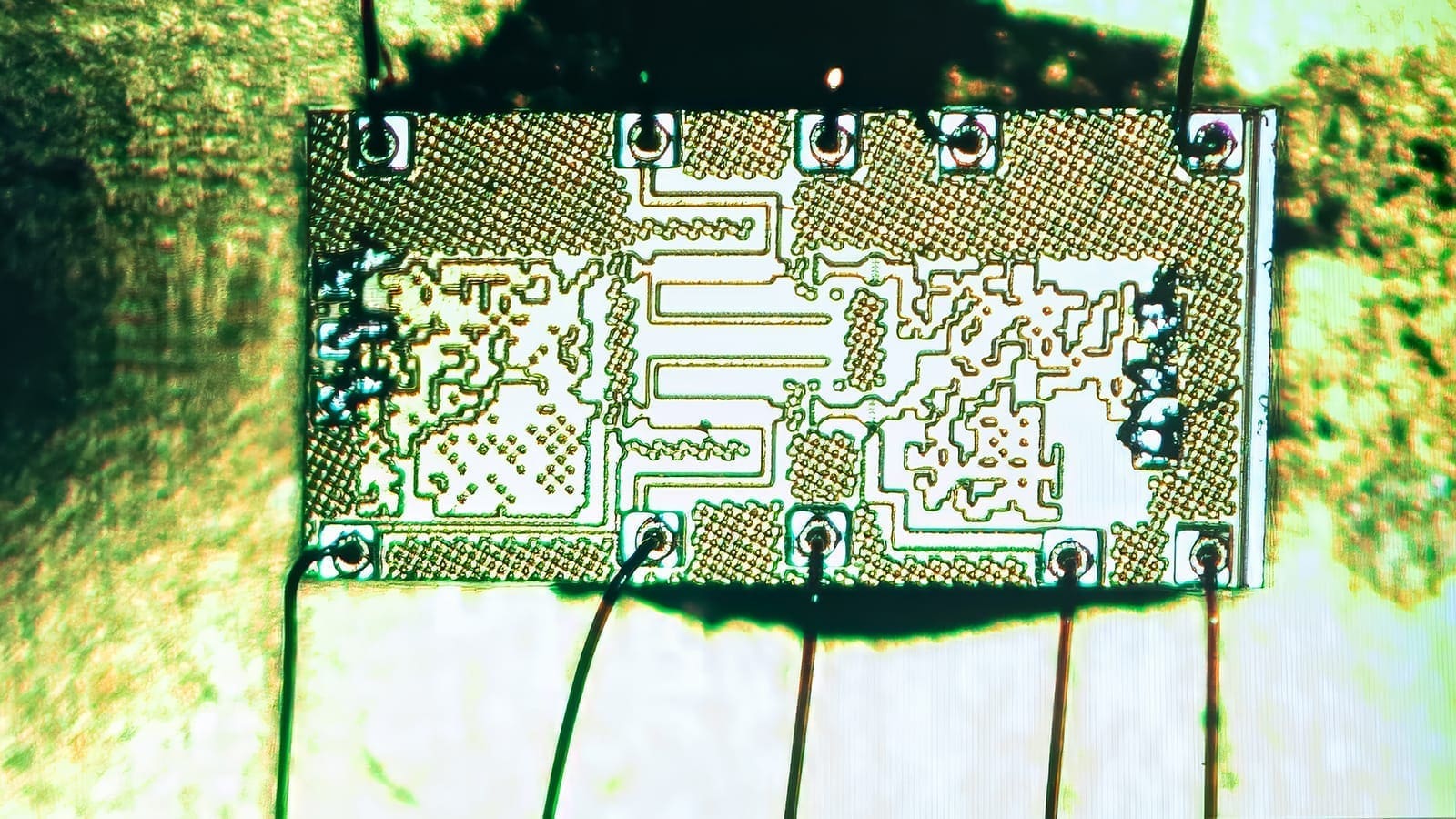
Researchers at Princeton Engineering and the Indian Institute of Technology have made a notable advancement in designing specialized microchips for wireless technology using artificial intelligence. Led by Professor Kaushik Sengupta, the team has developed an AI system that can create complicated electromagnetic structures and associated circuits in microchips, reducing design time from weeks to hours. This innovation has the potential to improve wireless speed and performance.
The AI has also produced unusual patterns of circuitry that offer marked improvements over standard chips. According to Sengupta, these new designs are complex and often unintuitive, but can work better than traditional designs. Uday Khankhoje, a co-author and associate professor of electrical engineering at IIT Madras, notes that this technique not only delivers efficiency but also promises to unlock new approaches to design challenges. The research was published in the journal Nature Communications and was supported by organizations including the Air Force Office of Scientific Research and Princeton University.
Introduction to AI-Driven Chip Design
The design of specialized microchips that manage signals at the cutting edge of wireless technology is a complex and time-consuming process. These chips are astounding works of miniaturization and engineering, but their development is often hindered by the high cost and lengthy design time. Recently, researchers at Princeton Engineering and the Indian Institute of Technology have made significant progress in harnessing artificial intelligence (AI) to slash the time and cost of designing new wireless chips. By leveraging AI, the researchers aim to discover new functionalities that can meet the expanding demands for better wireless speed and performance.
The AI system developed by the researchers creates complicated electromagnetic structures and associated circuits in microchips based on design parameters. This approach has been shown to reduce the design time from weeks to hours, making it a promising solution for the development of next-generation wireless chips. The AI-generated designs often feature unusual patterns of circuitry that are unlikely to be developed by human designers. However, these designs have been found to offer marked improvements over standard chips, demonstrating the potential of AI-driven chip design.
The use of AI in chip design is not limited to simply accelerating the design process. It also enables the exploration of new design spaces and the creation of high-performance devices that challenge traditional rules of thumb and human intuition. The researchers believe that this approach can lead to the development of more energy-efficient chips, as well as chips that can operate across a wider frequency range than currently possible. Furthermore, the AI system can synthesize complex structures in minutes, whereas conventional algorithms may take weeks.
The collaboration between human designers and AI systems is crucial for the success of this approach. While AI can generate innovative designs, it can also produce faulty arrangements that require human oversight to correct. The researchers emphasize that the goal of using AI in chip design is not to replace human designers but to enhance their productivity with new tools. By offloading mundane tasks to AI, human designers can focus on creating and inventing new things, leading to a more efficient and effective design process.
The Complexity of Wireless Chip Design
The design space for wireless chips is vast and complex, making it challenging for human designers to navigate. The circuitry in an advanced chip is incredibly small, with geometry so detailed that the number of possible configurations exceeds the number of atoms in the universe. This complexity makes it impossible for human designers to fully comprehend the design space, leading them to build chips from the bottom up, adding components as needed and adjusting the design as they build.
In contrast, the AI system views the chip as a single artifact, allowing it to approach the design challenge from a different perspective. This can lead to strange but effective arrangements that would be difficult or impossible for human designers to conceive. The AI system’s ability to explore new design spaces and create innovative designs is a key advantage of this approach.
Future Research Directions
The researchers have already used AI to discover and design complex electromagnetic structures that are co-designed with circuits to create broadband amplifiers. Future research will focus on linking multiple structures and designing entire wireless chips with the AI system. The potential applications of this technology are vast, ranging from improved wireless communication systems to advanced radar and gesture recognition technologies.
The development of AI-driven chip design is an exciting area of research that holds great promise for the future of wireless technology. As the researchers continue to refine their approach and explore new design spaces, we can expect to see significant advancements in the field. The collaboration between human designers and AI systems will be crucial for unlocking the full potential of this technology, leading to more efficient, effective, and innovative chip designs.
Conclusion
The use of AI in chip design is a rapidly evolving field that has the potential to revolutionize the development of wireless chips. By leveraging AI, researchers can slash the time and cost of designing new chips, while also exploring new design spaces and creating high-performance devices. The collaboration between human designers and AI systems is crucial for the success of this approach, allowing human designers to focus on creating and inventing new things while offloading mundane tasks to AI.
As research in this area continues to advance, we can expect to see significant improvements in wireless technology, from faster and more reliable communication systems to advanced radar and gesture recognition technologies. The potential applications of AI-driven chip design are vast, and the future of this field is exciting and full of promise.
External Link: Click Here For More


