Scientists are on the hunt for primordial black holes (PBHs), hypothetical objects that may have formed in the early universe before the first stars emerged. These enigmatic entities could hold the key to understanding dark matter, which makes up approximately 27% of the universe’s mass-energy density. Recent searches using gravitational waves have shed new light on PBHs, with researchers analyzing data from LIGO and Virgo to detect inspiraling compact objects that could be indicative of these mysterious black holes.
What are Primordial Black Holes, and Why are They Important in the Context of Dark Matter?
Primordial black holes (PBHs) are hypothetical objects that may have formed in the early universe before the first stars formed. They are considered as potential candidates for dark matter, which is a type of matter that does not emit, absorb, or reflect any electromagnetic radiation, making it invisible to our telescopes. The existence of PBHs would provide a unique window into the early universe and could help explain some of the observed phenomena in cosmology.
The detection of low-spinning black holes by LIGO, Virgo, and KAGRA has renewed interest in PBHs as dark matter candidates. Depending on when and how PBHs formed in the early universe, they could have any mass between 10^-18 and 10^9 solar masses (M) and could comprise a fraction f_PBH of all dark matter. This wide mass range necessitates different probes of PBHs, one of which is through gravitational wave emission.
How Can Gravitational Waves Help Constrain the Existence of Primordial Black Holes?
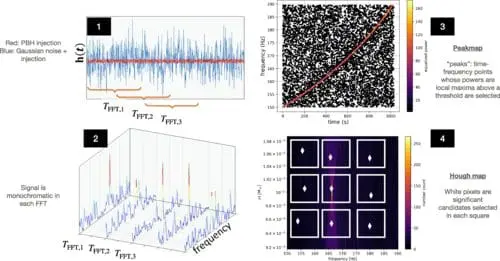
Gravitational waves from subsolar mass inspiraling compact objects would provide almost “smoking gun” evidence for primordial black holes. The Laser Interferometer Gravitational-Wave Observatory (LIGO) and Virgo have performed a search for inspiraling planetary-mass compact objects in equal-mass and highly asymmetric mass-ratio binaries using data from the first half of the third observing run.
Although no significant candidates were found, the search
Although no significant candidates were found, the search determined the maximum luminosity distance reachable with their search to be of O(100 kpc) and corresponding model-independent upper limits on the merger rate densities to be O(10^3-10^7 kpc^-3 yr^-1) for systems with chirp masses of O(10^-4-10^2 M), respectively.
What are the Implications of these Results for Primordial Black Hole Binaries?
The results from this search can be interpreted as arising from PBH binaries and constrain the fraction of dark matter that such objects could comprise. For equal-mass PBH binaries, it is found that these objects would compose less than 41% of DM for PBH masses of 10^-2-10^3 M, respectively.
For asymmetric binaries, assuming one black hole mass corresponds to a peak in the mass function at 25 M, a PBH dark matter fraction of 10%, and a second much lighter PBH, it is constrained that the mass function of the second PBH must be less than 1 for masses between 15-10^5 M and 2*10^4 M.
How Do these Results Complement Existing Constraints on Primordial Black Holes?
These constraints are robust enough to be applied to any PBH or exotic compact object binary formation models and complement existing microlensing results. The search performed by LIGO and Virgo provides a new probe of the existence of PBHs, which is independent of other observational methods.
The results from this search can be used in conjunction with other constraints on PBHs to better understand their potential role in the universe. For example, combining these results with existing microlensing constraints could provide a more complete picture of the mass function of PBHs.
What are the Future Prospects for Detecting Primordial Black Holes using Gravitational Waves?
The search performed by LIGO and Virgo demonstrates
The search performed by LIGO and Virgo demonstrates the potential of gravitational wave astronomy to constrain the existence of primordial black holes. As the sensitivity of gravitational wave detectors improves, it is likely that future searches will be able to probe even smaller masses and provide more stringent constraints on the existence of PBHs.
Furthermore, the upcoming generation of gravitational wave detectors, such as LIGO A+, Virgo+, and KAGRA+, will have improved sensitivities and duty cycles, which will enable them to detect even weaker signals from inspiraling compact objects. This could potentially lead to the detection of primordial black holes and provide a new window into the early universe.
How Can These Results be Used in Cosmological Models?
The constraints on PBHs obtained from this search can be used in cosmological models to better understand their potential role in the universe. For example, these results could be used to constrain models of inflation or other mechanisms that may have produced PBHs in the early universe.
Furthermore, the existence of PBHs could have implications for our understanding of dark matter and its role in the formation of structure in the universe. The constraints obtained from this search can be used in conjunction with other observational data to better understand the properties of dark matter and its potential connection to primordial black holes.
Publication Date: 2024-09-10
Authors: A. Miller, Nancy Aggarwal, Sébastien Clesse, F. De Lillo, et al.
Source: Physical Review Letters
DOI: https://doi.org/10.1103/physrevlett.133.111401