The behaviour of electrons in certain materials under extreme pressure is revealing new insights into the emergence of metallic conductivity, as demonstrated by research led by M. ElMassalami, S. Favre, and M. B. Silva Neto from the Instituto de Física, Universidade Federal do Rio de Janeiro. Their work investigates how pressure alters the electronic structure of a complex material, a charge-transfer perovskite, and identifies a critical pressure point where electrons transition from being confined to specific locations to moving more freely throughout the material. This transition, occurring at surprisingly low pressures, suggests that both the interactions between atoms and the material’s ability to transfer electrical charge increase under pressure, ultimately leading to enhanced conductivity. The findings are significant because they demonstrate a pathway to achieving metallicity in this class of materials without requiring dramatic structural changes, hinting at the potential for designing new materials with tailored electronic properties.
Perovskite Iron Oxides Under Extreme Pressure
Scientists extensively investigated perovskite iron oxides, focusing on their structural, electronic, and magnetic properties under pressure and varying compositions. This research explores how these materials behave when subjected to extreme conditions, revealing complex interactions between charge ordering, magnetism, and electrical conductivity. A central theme is the presence of charge ordering, where iron ions exhibit different formal valences due to electronic localization, and how pressure and composition influence this phenomenon. The research also examines the relationship between electronic structure, including band gaps and density of states, and the observed conductivity, with particular attention to the role of oxygen vacancies and doping with elements like strontium and lanthanum in tuning electrical behavior.
The interplay between charge ordering and magnetism is a key focus, with scientists investigating how pressure and composition affect magnetic ordering and transitions. A significant finding is the prevalence of hopping conductivity, where charge carriers move by jumping between localized states, particularly relevant in materials with charge ordering and influenced by the density of states near the Fermi level. Researchers utilized techniques like Mössbauer spectroscopy and X-ray diffraction to characterize the materials, with Mössbauer spectroscopy proving particularly useful for determining the valence state and local environment of iron ions. High pressure can induce transitions from charge-disproportionated antiferromagnetic states to charge-uniform ferromagnetic states, accompanied by changes in crystal structure and electronic properties.
Doping with strontium or lanthanum allows for tuning of the electronic structure and stabilization of different phases, with the concentration of dopant being critical for controlling charge ordering and conductivity. Oxygen vacancies also significantly influence conductivity and magnetic properties, while the localization of charge carriers consistently emerges as a dominant feature. Understanding the density of states near the Fermi level is crucial for controlling conductivity, and the research suggests the possibility of pressure-induced transitions where materials change from insulating to metallic states due to strong electron interactions. Strain, whether applied through pressure or epitaxial growth, plays an important role in tuning the properties of these perovskite oxides.
The research aims to understand and control the complex interplay between structure, electronic structure, magnetism, and conductivity in perovskite iron oxides, with the ultimate goal of designing materials with tailored properties for applications in magnetoelectronics, catalysis, sensors, and energy storage. Key conclusions highlight the dominance of charge ordering, the power of pressure and composition for tuning electronic structure, the prevalence of hopping conductivity, the importance of the density of states, and the promise of strain engineering. Future research directions include combining experimental results with theoretical calculations, growing high-quality thin films to control strain, utilizing advanced characterization techniques to probe electronic and magnetic dynamics, exploring new compositions, and developing prototype devices to demonstrate potential applications.
High-Pressure Structural Transition and Oxygen Content
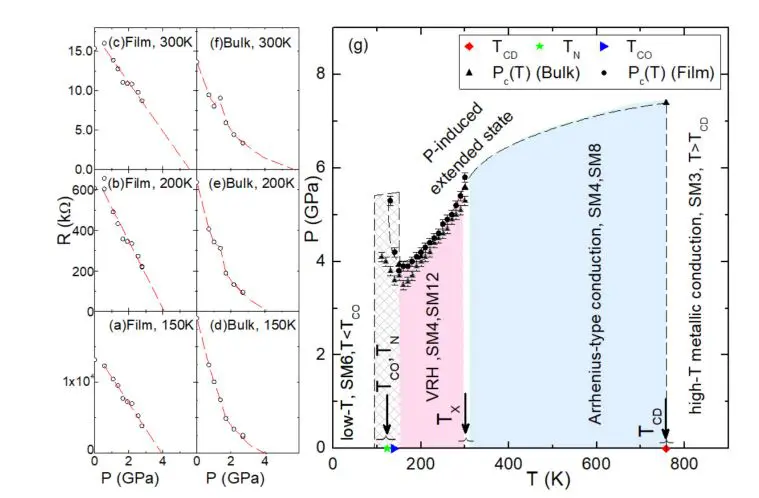
Scientists meticulously mapped the evolution of electrical resistance in a complex material to construct its pressure-temperature phase diagram, revealing a critical boundary separating states with localized and extended electronic behavior. The investigation began with synchrotron-based powder diffraction to analyze structural changes under pressure, reaching up to 30 GPa, and utilized ruby fluorescence to accurately calibrate pressure during experiments. To determine oxygen content, scientists established a calibration curve relating oxygen levels to the lattice parameter of the perovskite structure, allowing for precise quantification in both bulk and thin-film samples. Magnetization and DC susceptibility were measured using a sensitive magnetometer, probing magnetic properties across a wide temperature range and magnetic fields.
Electrical resistance measurements, conducted within a controlled environment, focused on the variable range hopping regime, revealing insulating behavior at lower temperatures and conduction at higher temperatures. Pressure-dependent resistance was measured using a piston-type pressure cell, reaching pressures up to 2. 8 GPa. This comprehensive approach enabled the team to correlate structural, magnetic, and electrical properties, revealing a critical point where the material transitions towards metallic behavior and suppressed antiferromagnetism, indicating proximity to a quantum critical point.
Pressure Induces Structural Changes, Metallic Tendencies
This research details a comprehensive investigation into the structural and electrical properties of LaBa₂Fe₃O₈₊δ under increasing pressure, revealing a pathway towards metallic behavior in this complex oxide. Scientists meticulously analyzed the material’s crystalline structure using X-ray diffraction, observing its stability in a perovskite form even under substantial pressure. Detailed analysis of room-temperature diffractograms at varying pressures demonstrated a shift in the peak positions, indicating compression of the crystal lattice. Measurements of lattice parameters confirmed a consistent decrease in size with increasing pressure, fitting a standard compressibility model.
Importantly, the team found no evidence of structural phase transitions up to 30 GPa, indicating the material maintains its fundamental perovskite structure even under extreme conditions. Further investigation of electrical resistance revealed a dramatic reduction in the activation energy for variable-range hopping conduction as pressure increased. Applying pressure significantly lowered this activation energy, demonstrating a clear pathway towards increased conductivity. The research establishes a critical role for pressure in promoting hole delocalization and broadening the oxygen-hole band, effectively reducing the ratio of the charge-disproportionation gap to the oxygen-hole bandwidth.
These findings suggest that LaBa₂Fe₃O₈₊δ is approaching a critical point where metallic conduction may become dominant, opening possibilities for novel electronic devices and a deeper understanding of strongly correlated electron systems. Electrical resistance measurements, conducted between 2 and 400 Kelvin and up to 2. 8 GPa, confirmed the variable-range hopping conduction mechanism and its sensitivity to applied pressure.
Pressure Drives Electronic Transition in Oxide
This research successfully mapped the pressure-temperature phase diagram for a complex iron-based oxide, revealing a critical boundary separating states with localized and extended electronic behavior. The team demonstrated that this transition to extended states occurs without structural distortion of the material, a notable finding given the high pressures typically required to induce such changes in similar compounds. The observed critical pressures are remarkably low compared to other iron-based perovskites, suggesting an inherent sensitivity to pressure due to the material’s small charge-transfer gap and broad electronic bandwidth. The investigation highlights the crucial role of mixed-valence iron and enhanced iron-oxygen hybridization in facilitating this pressure-driven transition. The researchers found that variations in temperature and pressure modify the charge-transfer.
🗞 Pressure-induced hole delocalization in the strongly correlated quasicubic charge-transfer perovskite d
🧠 ArXiv: https://arxiv.org/abs/2512.14314