An international team led by researchers at Penn State and Columbia University has developed a novel approach to maintaining unique quantum characteristics in three-dimensional (3D) materials. The discovery, published in Nature Materials on February 19th, could pave the way for harnessing quantum properties’ superior sensing and communication capabilities for real-world applications.
The team, led by Yinming Shao, an assistant professor of physics at Penn State, focused on quasiparticles known as excitons. Excitons have unique optical properties and can carry energy without an electrical charge. Due to their low binding energy, excitons are typically unstable in 3D semiconductors like silicon. However, the researchers discovered that they could achieve quantum confinement in a bulk material by harnessing the behaviors of magnetism, Van der Waals interactions, and excitons.
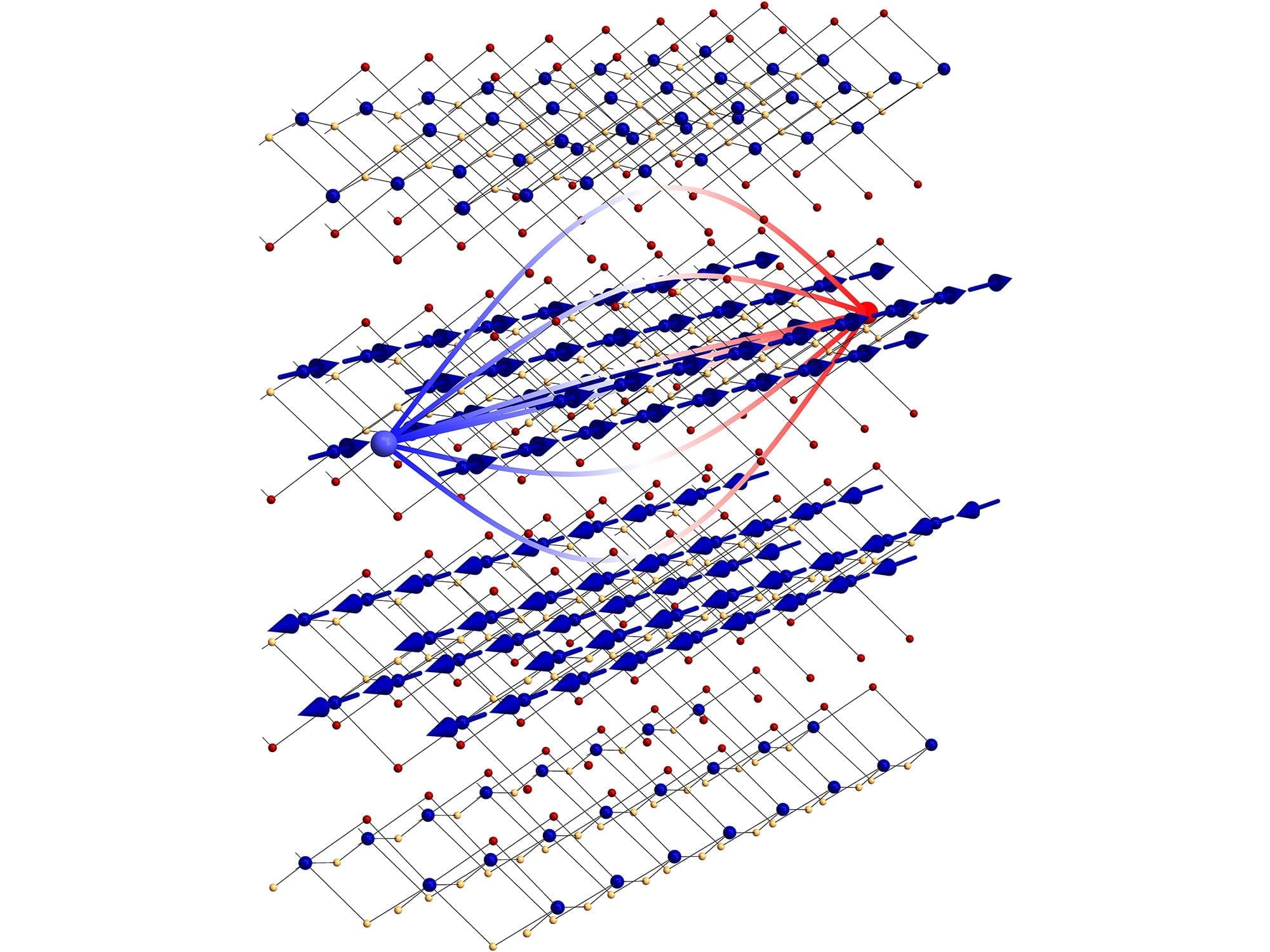
The key to this discovery was the antiferromagnetic ordering of the magnetic moments in the system’s particles, which ensured that each layer alternated its magnetic alignment, effectively canceling out a magnetic moment and rendering the material insensitive to external magnetic forces. This magnetic confinement held firm no matter how many layers were in the system and which layer they confined, including surface layers.
The aligned result came from harnessing the behaviors of magnetism, Van der Waals interactions, and excitons, according to Shao, to achieve quantum confinement with potential applications for advancing optical systems and quantum technologies. The research was supported by the U.S Department of Energy, the European Research Council, the U.S National Science Foundation, the Würzburg-Dresden Cluster of Excellence on Complexity and Topology in Quantum Matter, and the Emmy Noether Program.
The team has found a method to preserve the quantum properties of two-dimensional (2D) materials within three-dimensional (3D) structures, effectively bridging the gap between these previously disparate realms. This breakthrough, achieved by harnessing the behaviors of magnetism, Van der Waals interactions, and excitons, could pave the way for advancements in optical systems and quantum technologies.
At the heart of this discovery is a magnetic semiconductor material called Chromium Dioxide Selenide (CrO2Se), which exhibits antiferromagnetic ordering at low temperatures. In this state, the material’s magnetic moments align in a repeating pattern, with each layer alternating its magnetic alignment. This arrangement effectively confines excitons—quasiparticles that play a crucial role in quantum phenomena—to the layer with the same spin direction, much like cars on one-way streets.
The researchers, led by Dr. Jie Shan at Penn State, used optical spectroscopy techniques, theoretical modeling, and calculations to confirm that magnetic confinement held firm regardless of the number of layers in the system or the layer being confined, including surface layers. Their findings were corroborated by another research group from Germany, which was investigating the same quirk of magnetic semiconductors.
The aligned results from both groups demonstrate the potential for this approach to achieve quantum confinement, which could be applied to advance optical systems and quantum technologies. Dr. Shan completed his doctorate and postdoctoral fellowship at Columbia University, where he continues to work alongside other contributors on this groundbreaking research.
This discovery represents a significant leap forward in our understanding of quantum phenomena and their potential applications. By bridging the gap between 2D and 3D materials, researchers can now explore new avenues for developing quantum technologies that were previously unattainable. The implications of this work could have far-reaching consequences for fields as diverse as computing, communication, and sensing, ultimately propelling us closer to a future where the power of quantum mechanics is harnessed for everyday use.
External Link: Click Here For More