Understanding how quantum systems localise is a fundamental problem in condensed matter physics, with implications for diverse phenomena from disordered materials to topological insulators. David Guéry-Odelin (Université de Toulouse, CNRS) and François Impens (Universidade Federal Rio de Janeiro) present a significant advance in this field, proposing a generalised ‘localisation landscape’ that extends existing theory beyond conventional, static systems. Their work successfully predicts localisation behaviour in more complex scenarios, including non-Hermitian and periodically driven , or Floquet , quantum systems, even those lacking conventional eigenstates. This innovative approach, utilising a positive operator formalism, offers a unified framework for predicting localisation, and reveals connections between spectral instabilities, skin effects, and coherent destruction of tunneling. Validated against established models like the Hatano-Nelson chain and driven Aubry-André-Harper systems, the research establishes a powerful new tool for investigating localisation in both equilibrium and driven matter.
Generalizing the Filoche-Mayboroda Localization Landscape
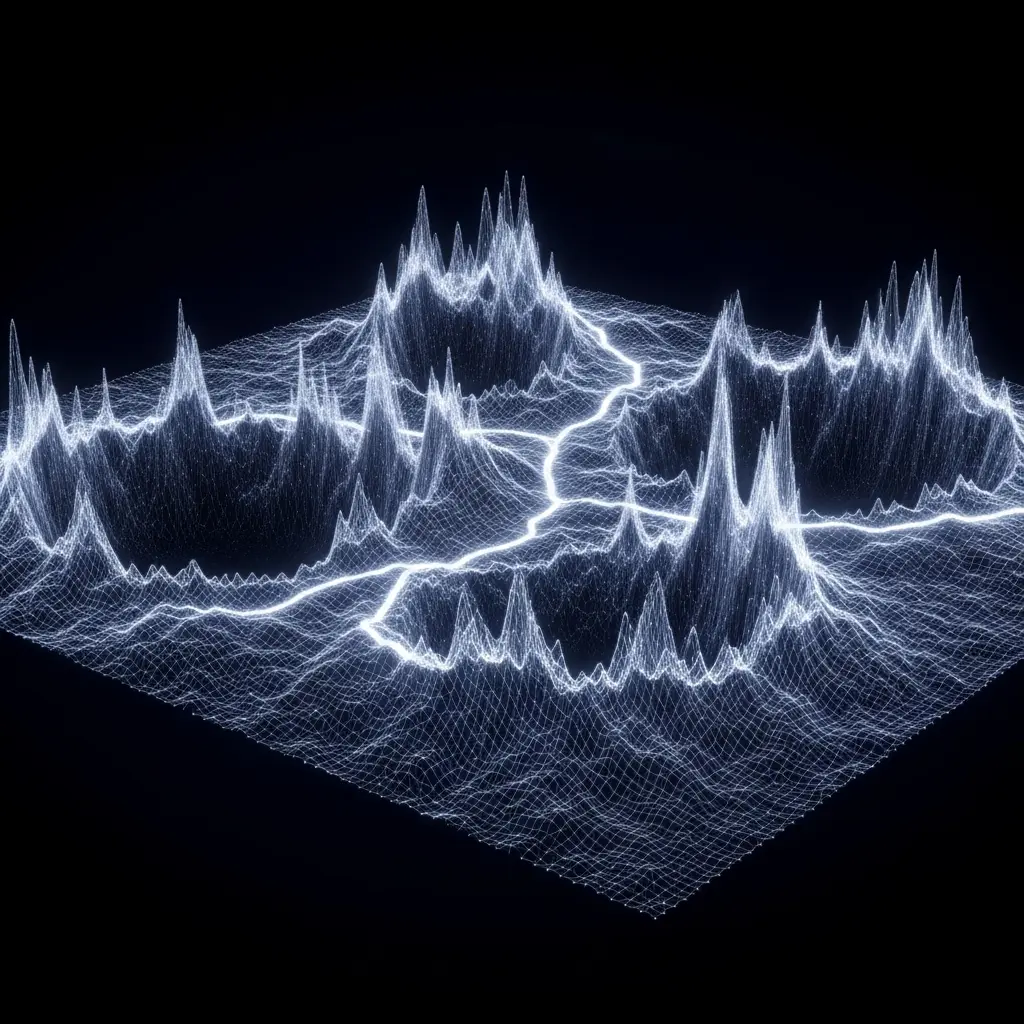
Scientists demonstrate a significant advancement in understanding quantum localization phenomena by generalizing the Filoche, Mayboroda localization landscape. This breakthrough extends the established theoretical framework beyond traditional limitations, encompassing non-Hermitian, Floquet, and topological quantum systems without requiring explicit calculation of system eigenstates. The research utilizes the positive operator H†H to construct a landscape that accurately predicts localization behavior across a wider range of physical scenarios, preserving geometric interpretability crucial for visualizing quantum confinement. Defining a generalized landscape, v(x), as the solution to the equation H†H v = 1, effectively maintains the essential properties of positivity and Hermiticity needed to infer localization even when the original Hamiltonian lacks these characteristics.
This approach allows for the prediction of localization in systems where conventional methods struggle, such as those exhibiting time-dependent or non-Hermitian behavior. Singular-value collapse within this landscape directly reveals spectral instabilities and the non-Hermitian skin effect, a phenomenon where eigenstates accumulate at system boundaries. The study unveils that the Sambe formulation is naturally captured within this generalized landscape, accurately describing coherent destruction of tunneling, while topological zero modes emerge directly from the landscape’s structure. Applications to the Hatano, Nelson chain, driven two-level systems, and driven Aubry, André, Harper models confirm the quantitative accuracy of this new framework.
The research establishes a unified predictor for localization in both equilibrium and driven quantum matter, offering a powerful tool for analyzing complex quantum systems. This work opens new avenues for designing and understanding materials with tailored quantum properties. The generalized landscape provides a computationally efficient method for predicting localization, scaling quasi-linearly with system size compared to the cubic scaling of full diagonalization. By directly linking geometric features of the landscape to spectral properties, the research offers a novel geometric diagnostic of resonant regimes, spectral instabilities, and localization phenomena associated with near-kernel modes of the Hamiltonian, promising advancements in fields ranging from condensed matter physics to metamaterial design.
Generalized Localization Landscape via Positive Operator Approach
The research pioneered a generalized localization landscape extending beyond traditional static, elliptic, and Hermitian systems while maintaining geometric interpretability. Scientists defined a landscape based on solving the equation H†H v = 1, utilizing the positive operator H†H to preserve essential features of localization even in non-Hermitian and Floquet systems. This approach bypasses limitations inherent in conventional landscape theory, which relies on the positivity and self-adjoint structure of operators. When applied to systems where H† = H, the generalized landscape becomes a smoothed version of the standard landscape, ensuring compatibility with established elliptic frameworks.
The study established a key inequality governing localization: any eigenmode φ(x) of H†H with eigenvalue λ = E2 ≥0 satisfies |φ(x)| ≤E2∥φ∥∞v(x), confining eigenmodes to regions defined by the valleys of v(x). To address non-invertible or defective operators, researchers implemented the Moore, Penrose pseudoinverse of H†H, preserving positivity and geometric interpretability. Experiments employed this methodology to investigate the Hatano, Nelson model, a system exhibiting non-Hermitian skin effects under open boundary conditions, where eigenstates accumulate at one edge for r 1. Calculating the average density ⟨|ψj|2⟩ by averaging over all normalized right eigenstates revealed macroscopic accumulation at the boundaries.
Researchers constructed the generalized landscape v = (H† HNHHN)+1, where the spatial dependence of |vj| defines an effective geometric field. Results demonstrate a pronounced peak in both the average density and landscape profile at the boundary corresponding to the skin effect, quantitatively confirming the model’s predictions. The landscape’s sensitivity to spectral gap closings, evidenced by the bound vmax ≤∥v∥2 ≤ √ d σmin(H)−2, provides a geometric diagnostic of resonant regimes and localization phenomena. This method achieves quasi-linear scaling, offering a computationally efficient alternative to traditional O(N3) diagonalization.
Positive Operator Landscape Predicts Quantum Localization
Scientists achieved a significant breakthrough in understanding localization phenomena in quantum systems through a generalized theoretical framework. The research team developed a landscape, constructed using the positive operator, that accurately predicts localization not only in static systems but also in non-Hermitian, Floquet, and systems lacking eigenstates. Singular-value collapse within this landscape directly corresponds to spectral instabilities and skin effects, while the Sambe formulation successfully captures coherent destruction of tunneling. The study demonstrates remarkable quantitative accuracy when applied to the Hatano, Nelson chain, driven two-level systems, and driven Aubry, André, Harper models, establishing a unified method for predicting localization in both equilibrium and driven matter.
Tests on bichromatic driving, with incommensurate frequencies of Ω2/Ω1 = √2, show the landscape extends naturally into quasiperiodic regimes by operating within an extended harmonic space. The resulting two-dimensional map displays well-separated regions of enhanced and suppressed landscape intensity, accurately predicting dynamical localization confirmed by time integration yielding minimal left-site population correlations exceeding 0.90. Investigations into a driven Aubry, André, Harper chain with time-periodic modulation revealed a Sambe-space inverse participation ratio exhibiting irregular fluctuations at low driving frequencies ω ≤4, transitioning to smooth behavior at higher frequencies. Measurements confirm that the maximal landscape amplitude vtot max(ω) displays corresponding peaks at low ω, indicating near-singularities linked to quasi-energy gap closings.
The Floquet density of states, obtained by folding Sambe eigenvalues, demonstrates spectral reorganization correlating with localization diagnostics. The work successfully recovers the ability to detect topological zero modes and pinpoint their location, with the landscape developing sharp peaks precisely where topological states localize. In the Su-Schrieffer-Heeger chain, the landscape verified behavior across topological, trivial, and domain wall configurations, accurately identifying boundary and interface modes. This generalized landscape offers a unified geometric framework for diagnosing localization, extending beyond standard methods and suggesting potential for inverse landscape engineering to control quantum matter.
Unified Landscape Predicts Quantum Localisation Phenomena
This work presents a generalized landscape for understanding localisation in quantum systems, extending the established Filoche-Mayboroda framework beyond conventional limitations. By employing a positive operator approach, researchers have developed a landscape capable of predicting localisation phenomena in non-Hermitian, Floquet, and systems lacking eigenstates. The landscape successfully captures key behaviours such as singular-value collapse, coherent destruction of tunneling, and the emergence of zero modes, offering a unified description of diverse physical scenarios. Validation of this landscape was achieved through quantitative agreement with numerical simulations performed on established models including Hatano-Nelson chains, driven two-level systems, the Aubry-André-Harper model, and the Su-Schrieffer-Heeger chain. This demonstrates the landscape’s predictive power across both equilibrium and driven systems. The authors acknowledge a limitation in the current scope, noting.
🗞 Localization Landscape in Non-Hermitian and Floquet quantum systems
🧠 ArXiv: https://arxiv.org/abs/2601.10451