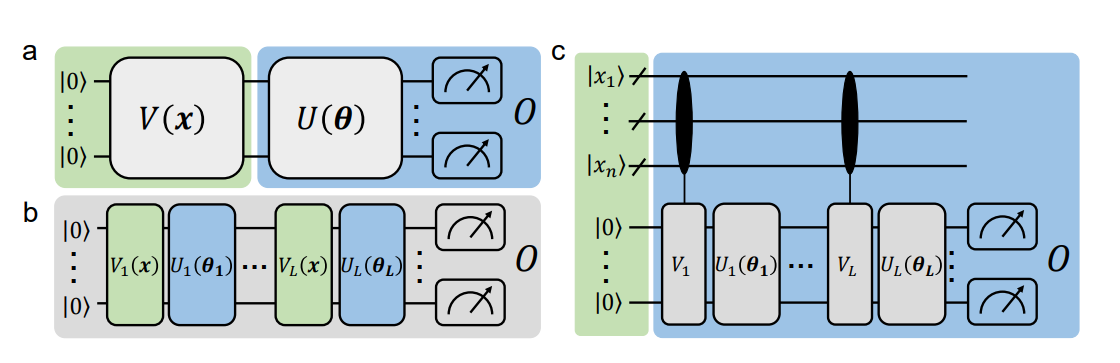
Accurately assessing the performance of quantum machine learning (QML) models represents a significant challenge in realising their potential, particularly when training data is limited, a common scenario in real-world applications. Qiuhao Chen, Yuling Jiao, Yinan Li, Xiliang Lu, and Jerry Zhijian Yang have now established a tight prediction error bound for optimal QML models, linking performance directly to the number of adjustable parameters and the size of the training dataset. This work advances the field by providing a theoretical framework for understanding the limitations and capabilities of these models, and by deriving new bounds for both data re-uploading and linear QML models. The team validates these findings through numerical simulations, demonstrating the practical implications for tasks such as function approximation and phase recognition, and paving the way for more robust and reliable quantum machine learning algorithms.
Quantum Machine Learning For Function Fitting and Classification
This research details experiments investigating the performance of quantum machine learning (QML) models on two key tasks: approximating mathematical functions and classifying quantum states. The QML model employed a data re-uploading quantum circuit, utilizing 20 single-qubit blocks, each with four trainable gates, and learned by minimizing the difference between its predictions and the target function using an Adam optimizer. For quantum state classification, scientists trained quantum convolutional neural networks (QCNNs) to distinguish between different quantum states, employing adaptive learning rates to improve the optimization process. These rigorous experimental designs and detailed model specifications demonstrate a commitment to practical implementation and a thorough understanding of QML principles.
The research highlights the importance of controlling randomness, employing adaptive optimization techniques, and building on existing work in the field. Future research could involve comparing QML models to classical algorithms, conducting more thorough hyperparameter tuning, and investigating how performance scales with data size and task complexity. Exploring implementation on actual quantum hardware and conducting detailed error analysis would further advance the field.
Quantum State Classification with Limited Data
Scientists investigated how well quantum machine learning (QML) models perform when trained with limited datasets, a crucial step towards advancing both quantum software and hardware. They trained quantum convolutional neural networks (QCNNs) to classify quantum states using a 9-qubit system, varying the number of training examples from 5 to 40 states. Researchers rigorously established theoretical findings by developing a novel packing number lower bound for QML models, demonstrating its equivalence to the covering number upper bound, and introduced an i. i. d. ghost sample set to facilitate analysis. These combined theoretical and computational approaches provide a deeper understanding of QML model performance with limited data, establishing results that hold independent interest within the field.
Quadratic Scaling of Quantum Machine Learning Error
This work presents a significant advancement in understanding the performance of quantum machine learning (QML) models, establishing a tight prediction error bound based on the number of trainable gates and the size of training sets. Researchers demonstrate that for data re-uploading QML models with T trainable quantum gates, the prediction error of the optimal model trained on a dataset of size N scales as T/N, representing a quadratic improvement over previous results. The team rigorously established both upper and lower bounds on prediction error through advanced statistical theory and Bayesian analysis, confirming the optimality of their derived bound with experiments involving the approximation of univariate analytic functions and the recognition of symmetry-protected topological phases. This achievement has practical implications, enabling the optimization of data-encoding quantum circuits and paving the way for implementing QML strategies with guaranteed performance. The research also establishes matching packing lower bounds and covering upper bounds for QML models, which may be of independent interest to the broader quantum computing community.
Limited Data Scaling in Quantum Machine Learning
This work presents a theoretical analysis of the performance of quantum machine learning (QML) models when trained on limited datasets, moving beyond traditional generalization error bounds. Researchers established a prediction error bound that scales with the number of trainable gates and the size of the training set, demonstrating that the prediction error scales linearly with the inverse of the training set size. The authors acknowledge that further investigation is needed to fully understand the behaviour of QML models, particularly concerning phenomena such as over-parameterization and the potential for optimization challenges like barren plateaus. Future work will focus on incorporating these considerations to provide a more complete theoretical framework for analysing QML models used in supervised learning tasks.
🗞 Near-optimal Prediction Error Estimation for Quantum Machine Learning Models
🧠 ArXiv: https://arxiv.org/abs/2510.18208