On April 11, 2025, researchers Yifan Li and colleagues published Multiparameter estimation with an array of entangled atomic sensors, detailing their experimental demonstration of enhanced precision in measuring multiple parameters using entangled atomic ensembles. This work advances quantum metrology by overcoming theoretical challenges and showing practical improvements over standard limits.
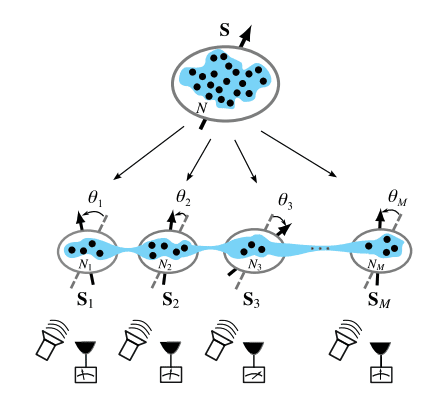
Researchers demonstrated multiparameter metrology using entangled atomic ensembles. By splitting a spin-squeezed ensemble into an array with inter-entanglement, they enhanced joint parameter estimation precision. Using optimal protocols, significant gains over standard limits were achieved in key tasks, advancing field arrays and imaging devices.
Quantum sensors operate on the principle of entanglement, where particles are interconnected in a manner that enhances measurement precision beyond classical capabilities. By dividing atoms into multiple groups and measuring each group separately using a Ramsey interferometer, researchers can detect phase shifts with greater accuracy. This method allows for extracting information through optimal linear combinations, effectively weighting contributions from each group to maximize sensitivity.
Experiments involving two and three groups demonstrated significant improvements over classical methods, achieving gains of several decibels. These results underscore the potential for enhanced precision in real-world applications, where even minor imbalances in atom distribution were manageable, showcasing the robustness of the approach.
The practicality of quantum sensors is evident in their ability to handle imperfect distributions, making them resilient against real-world inconsistencies. However, challenges such as long measurement times (e.g., 90 hours) and scalability need addressing for broader application. The method’s flexibility suggests potential for future research into more complex systems or alternative quantum states.
The success of this approach raises questions about its applicability to other quantum systems, such as photons or ions, potentially expanding sensor versatility. Additionally, understanding the exact mechanics by which entanglement reduces noise could provide deeper insights into quantum effects and their applications.
In conclusion, quantum sensors represent a significant advancement in measurement technology, offering enhanced precision through entanglement. This development not only validates theoretical predictions but also opens avenues for transformative technologies across various scientific domains.
👉 More information
🗞 Multiparameter estimation with an array of entangled atomic sensors
🧠 DOI: https://doi.org/10.48550/arXiv.2504.08677