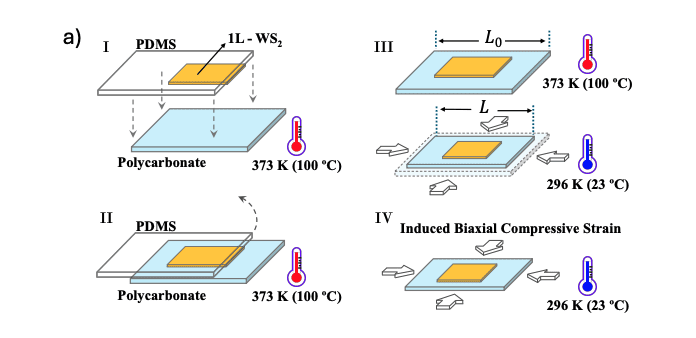
Strain engineering offers a powerful route to controlling the properties of two-dimensional materials, and researchers are continually seeking methods to precisely manipulate these materials at the nanoscale. Alvaro Cortes-Flores, Eudomar Henríquez-Guerra, and Lisa Almonte, all from BCMaterials, Basque Center for Materials, Applications and Nanostructures, alongside colleagues including Hao Li and Andres Castellanos-Gomez, now demonstrate a technique for inducing remarkably high levels of strain in single-layer tungsten diselenide. The team achieves this by carefully transferring the material onto a polymer substrate that is first stretched, then allowed to contract as it cools, effectively squeezing the material. This ‘hot-dry-transfer’ method generates compressive strain exceeding previously reported values, resulting in a substantial shift in the material’s optical properties, and opens new possibilities for designing and optimising 2D devices with tailored characteristics. The findings suggest a pathway towards more efficient strain control and a deeper understanding of how mechanical stress impacts the behaviour of these advanced materials.
This technique involves applying mechanical stress to these materials to precisely tune their electronic and optical characteristics, making them suitable for a wide range of applications in electronics, optoelectronics, and sensing. The focus lies on transition metal dichalcogenides, materials exhibiting unique properties when reduced to a single atomic layer. Polycarbonate serves as a key component in these experiments, functioning as a substrate to apply controlled strain.
Experiments are conducted at extremely low, cryogenic temperatures to understand how the materials behave under strain at different thermal conditions. Researchers employ spectroscopic techniques, including Raman spectroscopy to monitor changes in vibrational modes, and micro-reflectance and transmittance spectroscopy to analyze optical properties. Dynamic Mechanical Analysis and Differential Scanning Calorimetry are used to thoroughly characterize the polycarbonate substrate itself. A critical aspect of this research involves carefully considering the temperature dependence of both the two-dimensional materials and the polycarbonate substrate.
Differences in thermal expansion can lead to variations in strain at different temperatures, requiring precise control and analysis. The glass transition temperature of polycarbonate, the point at which it transitions from a rigid to a more pliable state, is a particularly important parameter. Accurately measuring the strain applied to the materials presents a significant challenge, demanding sophisticated techniques and careful calibration.
Pre-Strain and Cryogenic Compression of 2D Materials
Researchers have developed a novel technique for applying substantial compressive strain to two-dimensional materials, combining pre-straining with cryogenic cooling. This approach addresses the challenge of achieving large, uniform compressive strain at low temperatures, crucial for exploring specific quantum phenomena. The team deposits single layers of the material onto polymeric substrates that are first heated, stretching the polymer and creating a foundation for inducing strain as the system cools. As the heated substrate cools to room temperature, it contracts, compressing the material and initiating measurable strain.
This initial compression is amplified by further cooling the sample to extremely low, cryogenic temperatures, leveraging the continued contraction of the polymer. This two-stage process allows researchers to accumulate significantly larger total compressive strain than previously achievable. The method exploits the difference in thermal expansion between the polymer and the two-dimensional material, maximizing the strain induced by temperature changes. Careful consideration of the substrate’s mechanical properties, specifically its Young’s modulus, and how this changes with temperature, is crucial.
The team observed that the efficiency of strain transfer increased at cryogenic temperatures, attributing this to the polymer becoming more rigid, suggesting that selecting substrates with higher Young’s moduli at low temperatures is critical for maximizing strain transfer. By monitoring changes in the material’s excitonic energies, the researchers confirmed the successful application of unprecedented levels of compressive strain. This innovative approach expands the accessible range of compressive strain, offering a powerful tool for investigating how strain impacts the quantum properties of two-dimensional materials. The combination of pre-straining and cryogenic cooling, coupled with careful substrate selection, represents a significant advancement in the field of strain engineering, opening new avenues for tailoring the properties of these materials for advanced technological applications.
Large Strain Induces Significant Exciton Blueshift
Researchers have developed a new method for applying substantial compressive strain to two-dimensional materials, specifically single-layer tungsten diselenide (WS2), and have achieved results surpassing previous efforts. The team leveraged the differing thermal expansion rates between WS2 and polymeric substrates, employing a pre-straining technique to maximize the induced strain at cryogenic temperatures. By depositing WS2 onto a polymer that was first heated and then cooled, the contracting substrate effectively compressed the material, achieving a significant excitonic blueshift. This substantial strain induced a measurable shift in the material’s excitonic energies, confirming the successful application of significant compressive strain. This advancement expands the accessible range of compressive strain, offering a powerful tool for investigating how strain impacts the quantum properties of two-dimensional materials and opening new avenues for tailoring their properties for advanced technological applications.
🗞 Enhanced Biaxial Compressive Strain Tuning of 2D semiconductors via Hot Dry Transfer on Polymer Substrates
🧠 ArXiv: https://arxiv.org/abs/2507.22806