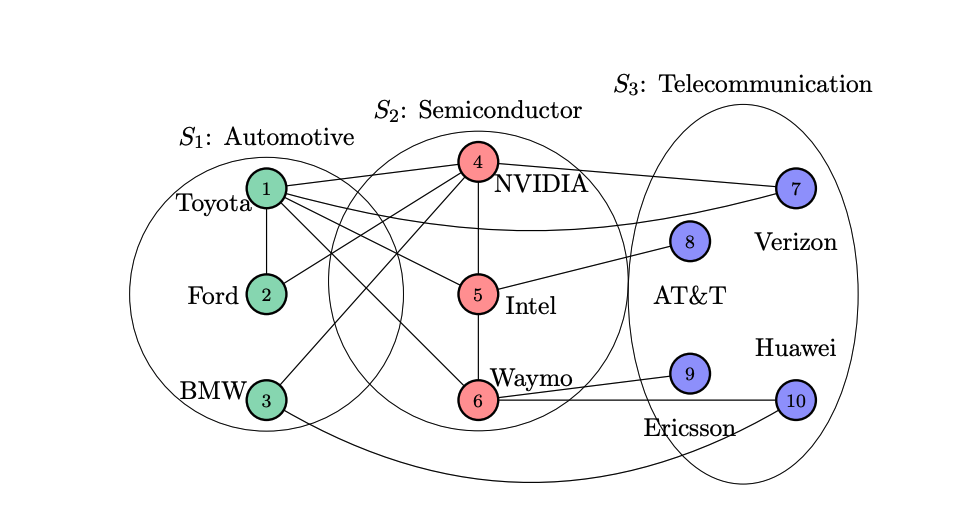
Understanding how power distributes within complex business networks is crucial for analysing modern markets, and a new study sheds light on this dynamic. Michele Aleandri of Luiss Guido Carli, alongside Francesco Ciardiello and Andrea Di Liddo from the University of Salerno, and colleagues, investigate power indices specifically designed for ‘sharing networks’ where companies compete within, but not across, different industries. The researchers develop a method to assess influence that combines a firm’s direct connections with its broader position within the network, accounting for the way value flows between sectors. This approach reveals that major companies tend to maintain stable influence when collaboration between sectors is limited, but also highlights an inherent instability in many sharing arrangements, as the core of these networks often lacks a stable equilibrium. Ultimately, this work provides a robust framework for understanding power dynamics in collaborative markets and offers insights into the conditions that foster stability or instability.
Technology Sharing, Competition and Value Distribution
Technological sharing networks are increasingly vital for innovation, facilitating the exchange of knowledge and capabilities between firms through agreements like technology licensing. These networks operate in a complex landscape where firms often collaborate within specific sectors but avoid direct competition across them, creating unique challenges for understanding how value is distributed and power is exercised. While strong intellectual property rights are crucial, they are often insufficient to drive widespread collaboration, necessitating alternative mechanisms like sublicensing. This research addresses the need for a formal way to measure a firm’s influence within these networks, recognizing that control over key technological channels can significantly reshape power dynamics.
The authors introduce a new family of “power indices” designed to quantify the degree of influence each firm exerts within a technological sharing network. These indices are built upon representations of networks as graphs, where connections signify technology transfer channels, and incorporate the concept of “a priori unions,” reflecting the natural groupings of firms within distinct industrial sectors. The indices consider both a firm’s direct connections and its broader position within the network, combining measures of immediate reach with overall centrality. A crucial aspect of this work is the exploration of how these power indices respond to changes in the network structure.
The researchers investigate whether adding new connections consistently increases a firm’s power, revealing subtle dependencies and the potential for complex interactions within the network. They also demonstrate how these indices can be used to rank firms, identifying those with the greatest influence and assessing the degree of power concentration within the network. This ranking system becomes particularly robust in network topologies with limited external effects, offering a valuable tool for evaluating effective competition. Building on this foundation, the researchers connect these power indices to the theory of cooperative games, specifically “transferable utility” (TU) games.
This allows them to model situations where firms cooperate in sharing technology while maintaining their competitive stance across sectors. By formulating these networks as TU-games with pre-defined groupings, the authors provide a theoretical framework for understanding how value is created and distributed among firms. However, they also highlight a potential instability within these arrangements, noting that a stable allocation of value is often difficult to achieve, suggesting that sustained cooperation requires additional mechanisms or incentives. This work offers a valuable contribution to understanding the dynamics of technological sharing networks, providing both a practical tool for measuring power and a theoretical framework for analyzing cooperation and competition.
Power Indices Reveal Technology Network Dynamics
Researchers developed a novel methodology to assess power dynamics within complex networks of firms sharing technology across different industrial sectors. Recognizing that traditional approaches often fail to capture the nuances of these arrangements, the team employed concepts from game theory and axiomatic design. This innovative approach allows for a more precise understanding of how influence and value are distributed when firms collaborate through licensing agreements. The core of the methodology involves defining ‘power indices’ based on a combination of established network centrality measures, specifically degree-based and eigenvector centrality.
These measures, which quantify a firm’s direct connections and overall influence within the network, are then modulated by ‘market coefficients’ that reflect the specific dynamics of each industrial sector. This combination allows the researchers to move beyond a purely structural analysis of the network and incorporate economic realities into the assessment of power. The team then rigorously characterised these indices using the principles of cooperative game theory, specifically by demonstrating their equivalence to ‘Shapley values’. A key innovation lies in the axiomatic foundation of the power indices, establishing a set of principles that define fair and stable allocation of value within the network.
This involved defining axioms, such as the ‘Inter-Union Neighborhood’ axiom, which states that a firm’s power should primarily depend on its immediate connections to firms in different sectors. This axiom captures the idea that influence stems from a firm’s ability to propagate technology across sectoral boundaries, mirroring the real-world mechanisms of licensing agreements. Importantly, the framework is flexible enough to accommodate scenarios where the propagation of sharing may have both positive and negative effects, extending its applicability to diverse contexts beyond simple technological diffusion. The researchers demonstrated the robustness of their methodology by showing that it holds even when the ‘market coefficients’ take on different interpretations, or even negative values, allowing for the modelling of complex scenarios where sharing can have adverse consequences. This adaptability, combined with the rigorous mathematical foundation provided by game theory and axiomatic design, positions this methodology as a powerful tool for understanding power dynamics in complex sharing networks and assessing the fairness and stability of collaborative arrangements.
Sectoral Licensing Networks and Firm Power
This research introduces a new way to measure power within networks of firms collaborating through licensing agreements across different industrial sectors. The core of the work lies in developing “power indices” that quantify each firm’s influence, taking into account the complex web of relationships and the specific sectors they operate in. These indices go beyond simply counting connections; they consider how firms interact within and between sectors, and how these interactions translate into measurable power. The researchers demonstrate that these new indices accurately reflect the dynamics of technology sharing.
They show that firms with more robust connections and those bridging multiple sectors tend to have greater influence, as expected. Importantly, the method accounts for situations where firms might collaborate within a sector but remain isolated from others, accurately assessing their limited power in the broader network. The analysis reveals that the total power within a network isn’t fixed; it depends on the specific configuration of connections and the degree of collaboration between sectors. A key finding is that the method aligns with established principles of game theory, specifically the concept of “Shapley values.” This means the power indices can be mathematically justified as a fair way to distribute influence based on each firm’s contribution to the overall network.
However, the research also acknowledges that stable power-sharing arrangements aren’t always guaranteed, as the core of these networks can be inherently unstable. The team further solidified the validity of their approach by demonstrating that the power indices are built upon a solid axiomatic foundation, meaning they satisfy a set of intuitive and economically sound principles. This ensures the indices are not only mathematically consistent but also logically justifiable within the context of technology sharing and industrial collaboration. The research extends beyond simply measuring power; it provides a framework for understanding how changes in network structure, such as new collaborations or sector mergers, impact the distribution of influence. This has significant implications for businesses, policymakers, and anyone interested in the dynamics of innovation and competition in interconnected markets. The method offers a nuanced and comprehensive way to assess power, moving beyond simple measures of connectivity to capture the complexities of modern industrial networks.
🗞 Power in Sharing Networks with a priori Unions
🧠 DOI: https://doi.org/10.48550/arXiv.2507.13272