Electron accumulation between atoms is a cornerstone of chemical bonding, yet the precise origins of this phenomenon have long remained a mystery across many scientific fields. Qiang Xu, Zhao Liu, and Yanming Ma now demonstrate a counterintuitive effect, termed potential-barrier affinity, which explains how electrons concentrate in these interatomic regions even when their energy exceeds the height of the potential barrier. This research overturns established theories suggesting that electron localisation requires traditional potential wells or hybrid orbitals, and instead reveals a fundamental mechanism governing the formation of all chemical bonds. By solving the Schrödinger equation for crystalline structures, the team establishes a new theoretical foundation for understanding electron distribution and offers a pathway towards the precise microscopic design of materials with tailored properties.
Researchers have now revealed a counterintuitive quantum effect, termed potential-barrier affinity (PBA), by solving the Schrödinger equation for crystalline structures. This PBA effect drives significant electron accumulation between atoms when electron energy surpasses the maximum point of potential barriers, fundamentally altering established understanding of electron behaviour and governing the microstructure and properties of condensed matter.
Node-Induced Confinement Stabilizes Interstitial Electrons
This research delves into the fundamental quantum mechanical origins of electrides, materials characterized by the presence of interstitial electrons behaving as anions. The study proposes a novel understanding of electride bonding, emphasizing the role of node-induced electron confinement as a primary driver of stability. Researchers propose that the nodes, points of zero amplitude in the electronic wavefunctions, play a crucial role by confining the interstitial electrons, lowering their energy and stabilizing the electride structure, a direct consequence of the crystal lattice symmetry and the quantum mechanical nature of the electrons. The researchers utilized the Kronig-Penney model to simulate electron behaviour in electride lattices, visualizing the formation of electronic bands and the role of nodes in electron confinement, and employed density functional theory to perform electronic structure calculations on various electride materials. This research presents a compelling argument that the stability of electrides is a consequence of the quantum mechanical confinement of electrons within the crystal lattice, driven by the presence of nodes in their wavefunctions, offering a new perspective on chemical bonding.
Electrons Accumulate at Potential Barriers, Not Wells
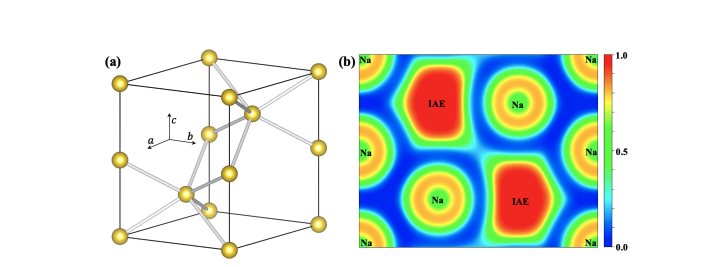
This research delivers a groundbreaking understanding of electron behaviour in materials, overturning long-held assumptions about how electrons occupy space between atoms. Scientists discovered a counterintuitive phenomenon, termed potential-barrier affinity (PBA), where electrons accumulate not within potential wells, but at the maximum points of potential barriers between atoms. Experiments conducted on sodium-high pressure 4 (Na-hP4) at 320 GPa revealed a finite bandgap of approximately 1. 75 eV and provided crucial evidence for PBA, with analysis of the electron localization function showing highly localized electron features in the interstitial regions.
Crucially, the team found that the Fermi energy level is significantly higher than the maximum point of the potential, indicating the presence of near-free electrons (NFEs) occupying energy levels between these points. Detailed analysis of electron densities along a specific crystallographic direction demonstrated that these NFEs contribute almost entirely to the electron density near the maximum potential point, directly confirming the PBA effect, which was extended to seven other representative electrides. To explore the underlying physics, scientists established a one-dimensional Kronig-Penney model for unbound states, which reproduced the observed double peaks in the interatomic electron density of Na-hP4, and revealed that the number of peaks in the wavefunction directly correlates with the band index. These results demonstrate that the PBA effect is a predictable consequence of electron behaviour in a periodic potential, offering a new theoretical foundation for the microscopic design of material properties.
Potential-Barrier Affinity Governs Electron Localization
This research establishes a new understanding of electron distribution in materials, demonstrating a phenomenon termed potential-barrier affinity (PBA). Scientists discovered that when electron energy exceeds the height of potential barriers between atoms, electrons accumulate in those interatomic regions, a counterintuitive effect not previously accounted for in conventional bonding theories. This accumulation, driven by PBA, fundamentally determines patterns of electron density and governs the microstructure and properties of condensed matter. The findings overturn the traditional requirement for potential wells or hybrid orbitals to explain electron localization in materials like electrides, instead proposing that PBA serves as the underlying mechanism for both the formation of these materials and conventional chemical bonds. Calculations performed on materials exhibiting metallic and covalent bonding, such as aluminum and diamond, confirm that PBA is a universal phenomenon, observable whenever electrons possess sufficient energy to overcome interatomic potential barriers. This research provides a new theoretical foundation for the microscopic design of material properties and opens avenues for controlling electron distribution to achieve desired functionalities.
🗞 Counterintuitive Potential-Barrier Affinity Effect
🧠 ArXiv: https://arxiv.org/abs/2511.11160