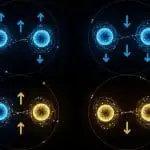
A team led by Professor Kyoung-Duck Park at Pohang University of Science and Technology (POSTECH) has developed a method to electrically control polaritons, hybrid light-matter particles, at room temperature. This breakthrough could enhance the performance of optical displays. The team’s technique, “electric-field tip-enhanced strong coupling spectroscopy,” allows for the manipulation of individual polariton particles. This could replace the need for three types of quantum dots in QLED TVs, as a single polariton particle can emit light in all colors with enhanced brightness. The research, supported by the Samsung Future Technology Incubation Program, was published in “Physical Review Letters.”
Hybrid Light-Matter Particles: A Breakthrough in Ultra-High-Resolution Spectroscopy
A team of researchers from the Department of Physics at Pohang University of Science and Technology (POSTECH), led by Professor Kyoung-Duck Park and integrated PhD student Hyeongwoo Lee, has made a significant advancement in ultra-high-resolution spectroscopy. This achievement is marked by the first-ever electrical control of polaritons, hybrid light-matter particles, at room temperature.
Polaritons, often described as “half-light half-matter” hybrid particles, possess characteristics of both photons (particles of light) and solid matter. These unique properties distinguish them from traditional photons and solid matter, opening up possibilities for next-generation materials, especially in overcoming performance limitations of optical displays. However, the inability to electrically control polaritons at room temperature on a single particle level has previously impeded their commercial application.
A Novel Approach to Electrically Controlled Spectroscopy
The POSTECH research team has developed a new method known as “electric-field tip-enhanced strong coupling spectroscopy”. This technique allows for ultra-high-resolution electrically controlled spectroscopy, enabling the active manipulation of individual polariton particles at room temperature.
This method combines super-resolution microscopy, previously invented by Professor Park’s team, with ultra-precise electrical control. The resulting instrument not only enables stable generation of polariton in a unique physical state called strong coupling at room temperature but also allows for the manipulation of the color and brightness of the light emitted by the polariton particles through the use of an electric field.
Polariton Particles: A Potential Game-Changer for Optical Displays
Using polariton particles instead of quantum dots, the key materials of QLED televisions, offers a significant advantage. A single polariton particle can emit light in all colors with significantly enhanced brightness. This eliminates the need for three distinct types of quantum dots to produce red, green, and blue light separately. Furthermore, this property can be electrically controlled, similar to conventional electronics.
In terms of academic significance, the team has successfully established and experimentally validated the quantum confined stark effect in the strong coupling regime, providing insights into a longstanding mystery in polariton particle research.
Implications for Future Research and Industrial Advancement
The team’s achievement holds considerable significance as it marks a scientific breakthrough that could pave the way for the next generation of research aimed at creating diverse optoelectronic devices and optical components based on polariton technology. This breakthrough could make a substantial contribution to industrial advancement, particularly by providing key source technology for the development of innovative products within the optical display industry, including ultra-bright and compact outdoor displays.
Hyeongwoo Lee, the lead author of the paper, emphasized the research’s importance, stating that it represents “a significant discovery with the potential to drive advancements across numerous fields including next-generation optical sensors, optical communications, and quantum photonic devices.”
Collaborative Effort and Publication
The research utilized quantum dots fabricated by Professor Sohee Jeong’s team and Professor Jaehoon Lim’s team from Sungkyunkwan University. The theoretical model was crafted by Professor Alexander Efros of the Naval Research Laboratory while data analysis was conducted by Professor Markus Raschke’s team from the University of Colorado and Professor Matthew Pelton’s team from the University of Maryland. Yeonjeong Koo, Jinhyuk Bae, Mingu Kang, Taeyoung Moon, and Huitae Joo from POSTECH’s Physics Department carried out the measurement work.
The research has been recently published in “Physical Review Letters”, an international physics journal, and was conducted with support from the Samsung Future Technology Incubation Program.
External Link: Click Here For More