

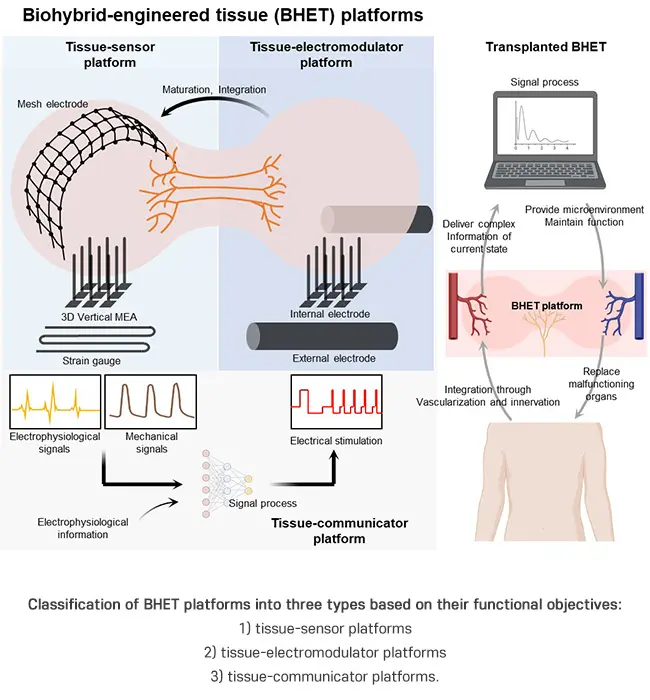
Researchers at the Pohang University of Science and Technology (POSTECH) detailed in Trends in Biotechnology the development of biohybrid-engineered tissue (BHET) platforms, integrating living tissues with electronics to create responsive and programmable devices. These platforms are classified into three types – sensor, electromodulator, and communicator – and have demonstrated the ability to exhibit learning, synchronise contractions, and release insulin in response to signals. POSTECH researchers anticipate that combining BHET with artificial intelligence will enable autonomous monitoring and regulation of bioengineered organ function, potentially advancing clinical applications.
Biohybrid-Engineered Tissue Platforms Emerge
Biohybrid-engineered tissue (BHET) platforms represent a developing field integrating engineered tissues with biomedical electronics to achieve continuous monitoring, modulation, and feedback control of tissue function, thereby addressing limitations inherent in conventional tissue engineering. These platforms are classified into three primary types: tissue-sensor platforms, which capture real-time physiological signals such as electrical activity or metabolite levels; tissue-electromodulator platforms, designed to apply controlled electrical stimulation to regulate cellular behaviour and promote tissue maturation; and tissue-communicator platforms, which integrate both sensing and stimulation into a closed-loop feedback system.
Demonstrated applications of these platforms include brain organoids exhibiting learning through neural feedback, cardiac tissues synchronising contractions with external pacing, and engineered cells releasing insulin in response to electrical signals, effectively transforming tissues into responsive and programmable devices. Researchers at Pohang University of Science and Technology (POSTECH) detail how advances in biofabrication and biomedical electronics are expanding the frontiers of tissue engineering with these BHET platforms.
Future research directions, as highlighted in a recent review, include the incorporation of artificial intelligence (AI)-driven control systems, the development of conductive hydrogel electrodes, and refinement of scalable three-dimensional bioprinting techniques, all of which could facilitate clinical translation of intelligent tissue platforms. According to Prof. Jinah Jang of POSTECH, combining bioelectronics with tissue engineering will create more functional and intelligent bioengineered organs, while integrating this with AI-based analytics will allow these organs to autonomously monitor and regulate functions with unprecedented precision.
Classifying Intelligent Tissue Systems
The classification of these BHET platforms is categorised by their functionality, with tissue-sensor platforms designed to monitor physiological signals originating from engineered tissues, including electrical activity, metabolic markers, and mechanical forces. Tissue-electromodulator platforms, conversely, apply controlled electrical stimulation to engineered tissues, enabling the regulation of cellular behaviour, the promotion of tissue maturation, and the enhancement of functional stability.
The most complex of these systems are tissue-communicator platforms, which integrate both sensing and stimulation within a closed-loop feedback system, allowing for autonomous adaptation of engineered tissues to physiological changes and the maintenance of functional homeostasis. This integrated approach represents a significant step towards creating more sophisticated and responsive bioengineered organs capable of dynamic regulation.
According to the review, future development of these platforms will likely focus on incorporating AI-driven control systems, developing conductive hydrogel electrodes, and refining scalable three-dimensional bioprinting techniques, all of which could accelerate the clinical application of these intelligent tissue systems.
Future Prospects and Technological Refinements
Looking forward, the review highlights future directions such as the incorporation of AI-driven control systems, the development of conductive hydrogel electrodes, and the refinement of scalable 3D bioprinting techniques, all of which could bring intelligent tissue platforms closer to clinical application. According to Prof. Jinah Jang of POSTECH, combining bioelectronics with tissue engineering will create more functional and intelligent bioengineered organs, while integrating this with AI-based analytics will allow these organs to autonomously monitor and regulate their functions with unprecedented precision.
This research was supported by grants from the National Research Foundation of Korea and the Ministry of Trade, Industry & Energy, indicating a commitment to the advancement of biohybrid technologies. The development of these platforms aims to bridge gaps in conventional tissue engineering approaches by enabling continuous monitoring, modulation, and feedback control of tissue function, ultimately enhancing the potential for creating responsive and programmable devices.
More information
External Link: Click Here For More


