

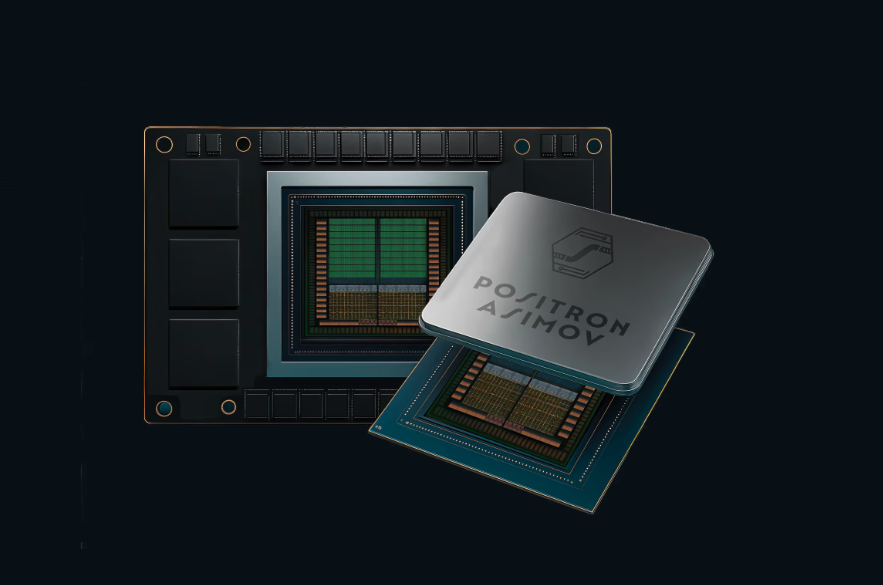
Positron AI has secured $230 million in Series B funding, valuing the company at over $1 billion, to accelerate development of energy-efficient AI inference hardware. The financing round was co-led by ARENA Private Wealth, Jump Trading, and Unless, with strategic investment from industry giants including Arm and Qatar Investment Authority (QIA). Positron is focused on overcoming key AI deployment hurdles, with plans to “tape-out” its next-generation Asimov chip in late 2026, promising a five-fold increase in tokens per watt compared to Nvidia’s upcoming Rubin GPU. According to CEO Mitesh Agrawal, “We’re grateful for this investor enthusiasm, which itself is a reflection of what the market is demanding,” as energy availability becomes a critical bottleneck for scaling AI.
$230 Million Series B Funds Positron AI’s Expansion
Positron AI is poised for rapid advancement following a successful oversubscribed $230 million Series B financing, propelling the company’s valuation beyond $1 billion. This influx of capital isn’t simply about growth, but a direct response to burgeoning demand for energy-efficient AI inference hardware—a critical need as AI deployments strain existing resources. The company’s immediate focus is scaling production of its Atlas systems while simultaneously accelerating development of the next-generation Asimov silicon, slated for completion in late 2026 and production in early 2027.
A key differentiator for Asimov is its memory capacity; Positron aims to deliver over 2304 GB of RAM per device, significantly exceeding the 384 GB offered by Nvidia’s upcoming Rubin GPU. This memory-centric design addresses a fundamental bottleneck in modern AI workloads, where memory bandwidth and capacity increasingly limit performance.
Dylan Patel, founder and CEO of SemiAnalysis, notes, “Positron is taking a unique approach to the memory scaling problem, and with its next-generation Asimov chip, can deliver more than an order of magnitude greater high-speed memory capacity per chip than incumbent or upstart silicon providers.” Notably, Jump Trading’s decision to co-lead the round followed initial deployment of the Atlas system, demonstrating tangible results and validating Positron’s trajectory, as Alex Davies, CTO of Jump Trading, stated, “In our testing, Positron Atlas delivered roughly 3x lower end-to-end latency than a comparable H100-based system.”
Asimov Silicon Targets 2TB Memory & 5x Token/Watt
Positron AI is aggressively addressing limitations in current AI infrastructure with its forthcoming Asimov silicon, prioritizing memory capacity as a key performance driver. This focus directly tackles the challenges of increasingly complex AI workloads demanding larger context windows, such as advanced video processing and multi-trillion parameter models. This efficiency gain is crucial as “energy availability has emerged as a key bottleneck for AI deployment,” according to Mitesh Agrawal, CEO of Positron AI.
The company intends to “tape out” the Asimov chip in late 2026, with production slated for early 2027, maintaining a rapid development pace to compete with established players like Nvidia. Eddie Ramirez, Vice President of Go-to-Market, Cloud AI Business Unit, Arm, highlights that “As AI inference scales, efficiency and system design matter more than raw benchmarks.” Positron’s strategy positions it to deliver substantial gains in performance per dollar for memory-intensive tasks.
Energy availability has emerged as a key bottleneck for AI deployment. And our next-generation chip will deliver 5x more tokens per watt in our core workloads versus Nvidia’s upcoming Rubin GPU.
Mitesh Agrawal, CEO of Positron AI
Jump Trading Validates Atlas with 3x Latency Reduction
The burgeoning field of AI inference is facing increasingly acute challenges, not necessarily in raw computational power, but in efficient memory access and energy consumption—a reality underscored by Jump Trading’s decision to co-lead Positron AI’s $230 million Series B financing. Beyond financial backing, Jump Trading’s involvement stems from direct experience with Positron’s existing Atlas system, demonstrating tangible performance gains in real-world applications. “For the workloads we care about, the bottlenecks are increasingly memory and power—not theoretical compute,” explained Alex Davies, Chief Technology Officer of Jump Trading. This performance boost, coupled with a dependable supply chain, proved decisive for Jump Trading. Davies elaborated, “The deeper we went, the more we agreed with Positron’s roadmap.” Positron’s strategy directly addresses the growing demand for AI systems capable of handling complex tasks with minimized power requirements and reduced latency.
Arm & QIA Invest in Memory-First AI Infrastructure
This capital isn’t merely fueling expansion; it’s directly addressing a critical shift in AI hardware development toward prioritizing memory capacity and efficiency. The company’s approach acknowledges that increasingly complex AI tasks are hitting limitations not in processing power, but in accessing and managing data. This enhanced memory capability is specifically targeted at demanding applications like video processing, financial trading, and large language models requiring extensive context windows. Arm’s Eddie Ramirez added, “Positron’s memory-centric approach, built on Arm technology, reflects how tightly coupled systems and a broad ecosystem come together to deliver scalable, performance-per-watt gains.”


