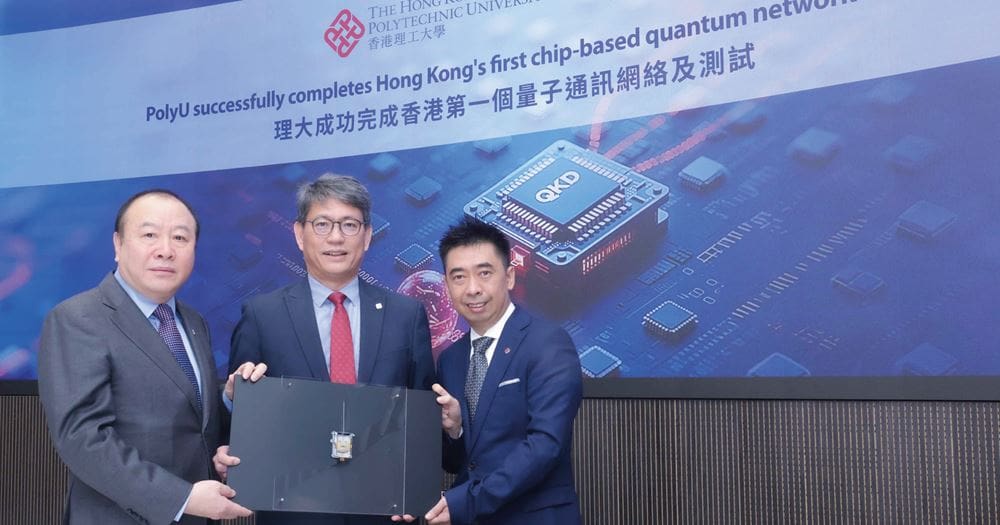
Led by Prof. Ai-Qun Liu of the Research Institute for Quantum Technology (RIQT) at The Hong Kong Polytechnic University (PolyU), a research team has successfully established and tested Hong Kong’s first chip-based quantum network. Utilizing a newly developed quantum communication chip, the network demonstrated secure communication capabilities via a locally built platform offering high speed, stability, low cost, and scalability for mass production. This achievement represents a critical step towards the commercialization of quantum communication technologies within Hong Kong and supports China’s “15th Five-Year Plan” prioritization of quantum technology development, addressing emerging cybersecurity threats to critical infrastructure.
PolyU Develops Hong Kong’s First Chip-Based Quantum Network
Hong Kong Polytechnic University (PolyU) has achieved a significant milestone with the development of its first chip-based quantum network. This breakthrough utilizes a compact quantum chip – measuring just 12mm x 4mm – fabricated using semiconductor techniques. Researchers successfully completed a test on a 55-kilometer optical fiber network connecting four locations across Hong Kong, demonstrating secure quantum key distribution. The system operates at 1.25 GHz, achieving a key generation rate of 45.73 kbps – paving the way for long-distance, secure communication.
This new quantum chip addresses critical cybersecurity needs, particularly as quantum computing advances and threatens current encryption methods. Unlike bulky, discrete-component systems, PolyU’s chip boasts high speed, stability, low cost, and scalability for mass production. This makes widespread deployment of quantum communication networks more feasible, aligning with China’s 15th Five-Year Plan and Hong Kong’s Innovation and Technology Development Blueprint. It’s designed for compatibility with existing infrastructure, easing the transition for financial institutions and governments.
PolyU’s innovation isn’t just about technology; it’s about future-proofing Hong Kong’s digital infrastructure. The chip’s ability to dynamically adapt to environmental factors like temperature and vibration ensures stable connections, crucial for real-world applications. Researchers plan to refine and scale the multi-point transmission technology, leveraging existing networks to enable widespread adoption across various industries. This positions Hong Kong to become a leader in next-generation smart quantum networks and secure communication.
Quantum Chip Technology: Speed, Stability, and Scalability
Hong Kong Polytechnic University (PolyU) has achieved a breakthrough in quantum communication with the development of a chip-based quantum network. This system utilizes a compact quantum chip – measuring just 12mm x 4mm – fabricated using standard semiconductor techniques. Crucially, the chip operates at 1.25 GHz, enabling secure key generation at 45.73 kbps and reliable encrypted communication over distances exceeding 100 kilometers. This marks significant progress toward practical, long-distance quantum networks.
The PolyU chip distinguishes itself through scalability and cost-effectiveness. Unlike systems built with bulky optical components, this chip-based approach promises high speed, stability, and ease of mass production. A 55-kilometer test network, connecting multiple Hong Kong locations, demonstrated successful quantum encrypted transmission. This compatibility with existing fiber optic infrastructure simplifies integration, positioning Hong Kong to proactively address emerging cybersecurity threats posed by advancements in quantum computing.
This innovation aligns with both China’s “15th Five-Year Plan” and Hong Kong’s Innovation and Technology Development Blueprint. PolyU’s research tackles a critical need for secure communication in the face of potentially decryption-capable quantum computers. By focusing on a scalable, chip-based solution, the team is laying the groundwork for widespread adoption of quantum communication across finance, government, and other sectors, bolstering Hong Kong’s position as a global innovation hub.
Quantum Communication Safeguards Data and Finances
Hong Kong Polytechnic University (PolyU) has achieved a breakthrough in quantum communication, successfully building and testing the city’s first chip-based quantum network. Utilizing a newly developed quantum chip—measuring just 12mm x 4mm—the team demonstrated secure key generation at 45.73 kbps over a 55-kilometer optical fiber network. This milestone addresses growing cybersecurity threats posed by advancing quantum computing, which could break existing encryption methods used to protect financial transactions and sensitive data.
This innovative quantum chip offers significant advantages over existing solutions: high speed (operating at 1.25 GHz), stability, low cost, and scalability for mass production. Unlike bulky, discrete-component systems, PolyU’s approach is designed for easy integration into existing network infrastructure. Successful tests connected four nodes across Hong Kong, Kowloon, and the New Territories, showcasing the potential for a city-wide, secure communication system vital for maintaining Hong Kong’s position as a leading international financial hub.
The development aligns with both China’s “15th Five-Year Plan” and Hong Kong’s Innovation and Technology Development Blueprint, prioritizing advanced manufacturing and microelectronics. Because quantum communication relies on the principles of quantum mechanics—where states cannot be cloned—it offers theoretically uncrackable encryption. PolyU’s research team is now focused on refining and scaling the multi-point transmission technology, paving the way for widespread adoption across industries and a secure transition to next-generation smart networks.
Future Deployment & Hong Kong’s Quantum Advancement
Hong Kong Polytechnic University (PolyU) has achieved a significant milestone with the successful development and testing of its chip-based quantum network. This marks Hong Kong’s first such network, utilizing a compact quantum chip – measuring just 12mm x 4mm – fabricated using semiconductor techniques. The 55-kilometer optical fiber network, connecting nodes across Hong Kong, Kowloon and the New Territories, demonstrated secure key generation at 45.73 kbps, enabling reliable encrypted communication exceeding 100km. This achievement directly addresses growing cybersecurity threats posed by advancing quantum computing.
The PolyU Quantum Chip boasts advantages crucial for widespread adoption: high speed (1.25 GHz clock rate), stability, low cost, and scalability for mass production. Unlike bulky, discrete-component systems, this integrated chip offers a “plug-and-play” solution compatible with existing network infrastructure. This ease of integration is vital for a smooth transition for financial institutions and government sectors preparing for the quantum era, aligning with both China’s 15th Five-Year Plan and Hong Kong’s Innovation & Technology Development Blueprint.
This breakthrough isn’t just a technical feat, but a strategic move for Hong Kong. As a leading international financial center, proactively addressing quantum cybersecurity risks is paramount. PolyU’s work positions Hong Kong to lead in quantum communication, driving innovation and bolstering its reputation as a global technology hub. Future efforts will focus on refining multi-point transmission technology and expanding network scale, paving the way for truly smart and secure quantum networks across multiple industries.