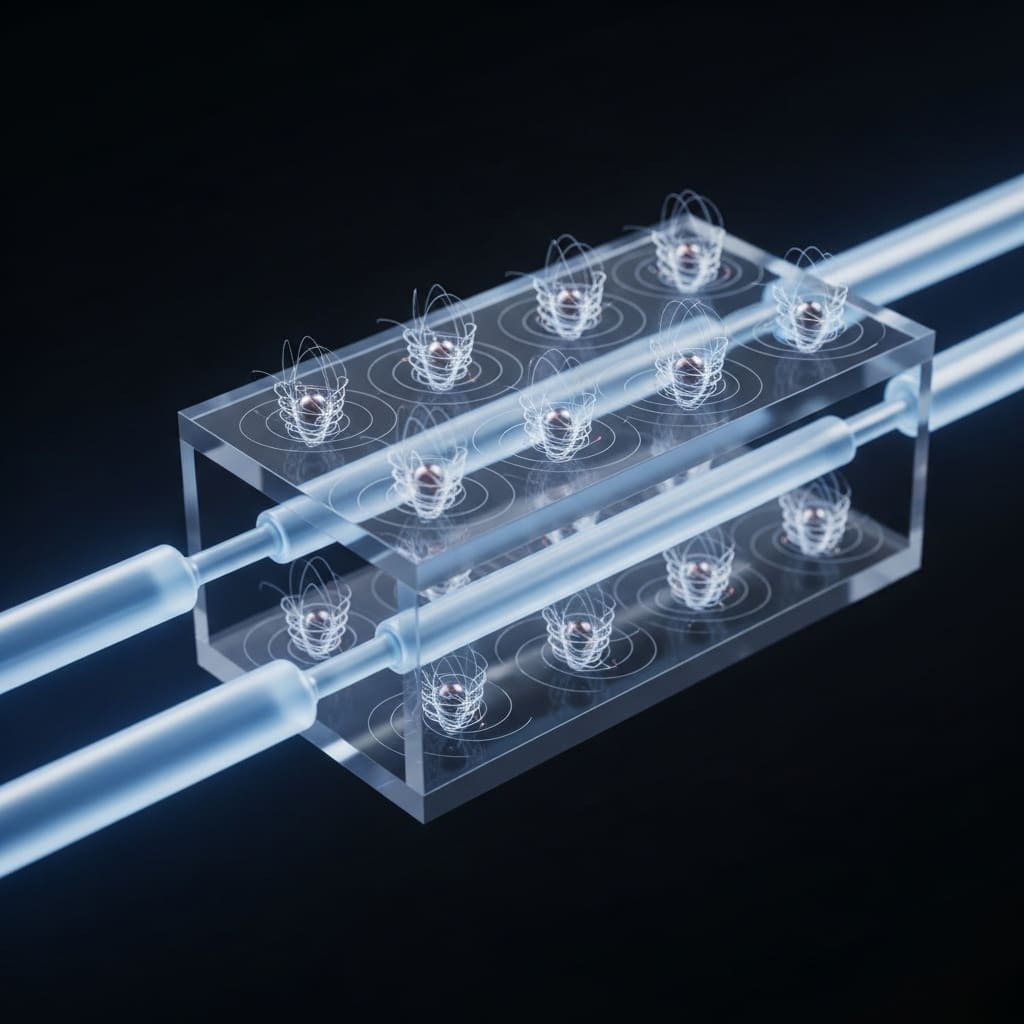
Researchers have demonstrated a novel approach to controlling supercurrent direction in Josephson junctions, potentially revolutionising quantum materials research. Joon Young Park (Sungkyunkwan University & IBS), Thomas Werkmeister, and Jonathan Zauberman, alongside Omri Lesser et al, report an ‘even-odd’ Josephson diode effect in a unique Corbino-geometry junction built from a three-dimensional topological insulator. Significantly, the team discovered that the direction of supercurrent flow reliably switches with the number of vortices enclosed within the junction , a behaviour not seen in standard devices. This vortex-parity-controlled diode effect, linked to the topological superconductivity of the material and the device’s circular design, offers compelling evidence for the existence of non-Abelian anyons within the vortices and opens exciting possibilities for new quantum devices.
Topological Insulator Junctions and Vortex Polarity Switching
Scientists have demonstrated a novel Josephson diode effect (JDE) in Corbino-geometry junctions fabricated from a bulk-insulating three-dimensional topological insulator (3DTI), revealing a robust link between supercurrent direction and vortex parity. The team achieved this breakthrough by meticulously crafting junctions on the pristine surface of the 3DTI, observing that the polarity of the diode, indicating the preferred direction of supercurrent flow, consistently alternates depending on whether an even or odd number of vortices are enclosed within the junction. This behaviour stands in stark contrast to control devices, specifically a non-topological Corbino Josephson junction and a conventional 3DTI-based linear junction, where such polarity switching is absent. The study unveils that this polarity-tunable JDE arises from the unique interplay between proximitized topological superconductivity on the 3DTI surface and the closed-loop geometry of the Corbino device, offering a new avenue for exploring exotic quantum phenomena.
Experiments show a clear correlation between the number of vortices trapped within the junction and the direction of supercurrent flow, a phenomenon not observed in conventional Josephson junctions. Researchers fabricated these devices using high-quality single-crystal Sn-doped Bi1.1Sb0.9Te2S, a 3DTI material boasting a substantial bulk band gap of 350 meV and surface states well-isolated from bulk bands, ensuring minimal interference. The fabrication process involved an in vacuo protective capping layer and air-bridge contacts, preserving the pristine topological surface states crucial for observing the JDE. Theoretical modelling attributes the observed sign change in diode polarity to the alternating sign of periodic boundary conditions inherent in topological superconductors, strongly suggesting that the vortex-parity-controlled JDE directly reflects the underlying Andreev bound state topology.
The research establishes that the alternating polarity is a direct manifestation of non-Abelian anyons residing within the vortices, providing compelling evidence for topological superconductivity in the system. This discovery builds upon recent investigations of nonreciprocal supercurrents as sensitive probes of broken symmetries in superconducting quantum materials, offering a more robust and controllable method for investigating these states. The Corbino geometry, with its edge-free, closed-loop design, allows for well-separated Josephson vortices and facilitates the manipulation of their angular position, opening possibilities for MBS exchange and braiding, key ingredients for fault-tolerant quantum computation. This work opens exciting avenues for exploring and harnessing topological superconductivity for future quantum technologies, providing a platform for manipulating and controlling exotic quantum states with unprecedented precision.
In-vacuo Fabrication of TI Josephson Junctions enables high-quality
Scientists engineered a novel fabrication process for Corbino-geometry Josephson junctions (CJJs) on the pristine surface of bulk-insulating three-dimensional topological insulator (3DTI), Bi1.1Sb0.9Te2S, to investigate nonreciprocal supercurrents. This multi-step procedure, conducted entirely in vacuo, incorporates a protective capping layer and air-bridge contacts to preserve the delicate topological surface states during device creation. Researchers utilized single-crystal Sn-doped Bi1.1Sb0.9Te2S, chosen for its 350 meV bulk band gap, well-isolated Dirac point energy, high electron mobility, and suitability for exfoliation into atomically flat surfaces. The team addressed the material’s susceptibility to air degradation by performing all fabrication steps within a high-vacuum environment, ensuring the preservation of surface state quality.
The study pioneered a method for creating CJJs with well-defined geometries and controlled vortex configurations, crucial for probing topological superconductivity. Experiments employed electron-beam lithography to define the CJJ structure on the Sn-BSTS surface, followed by deposition of superconducting niobium electrodes via sputtering, a process delivering a 100nm thick niobium layer. Scientists then etched away excess niobium, leaving behind the desired Corbino-geometry junction with a diameter of 2μm. This precise fabrication technique enabled the creation of junctions with minimal edge effects, facilitating the isolation and manipulation of vortices within the ring.
Researchers further developed a magnetic flux threading protocol to control the number of vortices trapped within the CJJ ring. Applying an out-of-plane magnetic field, the team precisely tuned the vortex number, alternating between even and odd parity, and subsequently measured the resulting supercurrent characteristics. The system delivers a highly sensitive platform for investigating the relationship between vortex parity and the observed Josephson diode effect (JDE). This approach enables the direct observation of the JDE polarity switching as a function of the enclosed vortex number, a key signature of topological superconductivity and non-Abelian anyons. Control devices, a non-topological Corbino Josephson junction and a 3DTI-based linear Josephson junction, were fabricated using identical procedures to provide crucial benchmarks for comparison and confirm the unique topological origin of the observed effects.
Even-Odd Diode Effect in Topological Insulators
Scientists have demonstrated an even-odd Josephson diode effect (JDE) in Corbino-geometry junctions fabricated on the surface of a bulk-insulating three-dimensional topological insulator (3DTI). The team measured a robust alternation in the sign of the diode polarity, indicating the preferred direction of supercurrent flow, depending on whether an even or odd number of vortices were enclosed within the junction. This behaviour was notably absent in control devices, a non-topological graphene Corbino Josephson junction and a 3DTI-based linear Josephson junction, confirming the effect’s unique origin. These results strongly suggest the polarity-tunable JDE arises from the specific combination of proximitized topological superconductivity on the 3DTI surface and the closed-loop geometry of the Corbino device.
Experiments revealed that the observed sign change in diode polarity correlates with the alternating sign of periodic boundary conditions in topological superconductors. Theoretical modelling supports the interpretation that this vortex-parity-controlled JDE is a direct manifestation of the Andreev bound state topology, potentially linked to the presence of non-Abelian anyons within the vortices. The researchers fabricated high-quality Corbino-geometry Josephson junctions on single-crystal Sn-doped Bi1.1Sb0.9Te2S (Sn-BSTS), a 3DTI material possessing a bulk band gap of 350 meV and surface-dominated transport at low temperatures. Measurements confirm the Sn-BSTS material exhibits high electron mobility and quantum oscillations originating from its surface states, making it ideal for device fabrication.
The team successfully developed a multi-step fabrication process, including an in vacuo protective capping layer and air-bridge contacts, to preserve the pristine topological surface states during device creation. Data shows the researchers were able to control the number of vortices within the junction, and crucially, observed that the JDE polarity switched predictably with each change in vortex parity. Specifically, the polarity consistently alternated between positive and negative values as the enclosed vortex number transitioned between even and odd states. This consistent switching provides compelling evidence for the connection between vortex topology and the observed diode effect.
Tests prove that the observed effect is not simply a result of edge effects or other trivial phenomena, as the control devices exhibited no such polarity switching. The breakthrough delivers a novel method for probing Andreev bound state topology and potentially manipulating non-Abelian anyons, opening avenues for fault-tolerant quantum computation. Measurements confirm the potential for controlling the angular position of vortices through the gauge-invariant phase difference across the junction, offering a pathway for future braiding operations.
Topological Supercurrent Switching via Vortex Parity
Scientists have demonstrated an even-odd Josephson diode effect (JDE) in Corbino-geometry junctions fabricated from a bulk-insulating three-dimensional topological insulator (3DTI). This JDE exhibits a robust alternation in the direction of supercurrent flow, dictated by the parity, even or odd, of the number of enclosed vortices. Crucially, this behaviour was not observed in control devices, namely a non-topological Corbino Josephson junction and a linear 3DTI Josephson junction, highlighting the specific requirements for this effect. Researchers. This work establishes the even-odd JDE as a signature directly linked to vortex number parity in 3DTI-based Corbino Josephson junctions.
The significance of these findings lies in establishing a novel quantum phenomenon and a sensitive method for probing the topology of Andreev bound state spectra. The strong agreement between experimental results and theoretical modelling, based on topological superconductivity, suggests a pathway towards investigating and potentially manipulating non-Abelian anyons, particles crucial for fault-tolerant quantum computation. Authors acknowledge limitations in the current study, noting that further research is needed to fully characterise the system and explore the potential for manipulating individual Josephson vortices. Future work will focus on performing braiding operations to unambiguously demonstrate non-Abelian statistics, paving the way for advancements in topological quantum computation and a deeper understanding of topological superconductors.
🗞 Vortex-parity-controlled diode effect in Corbino topological Josephson junctions
🧠 ArXiv: https://arxiv.org/abs/2601.14384