

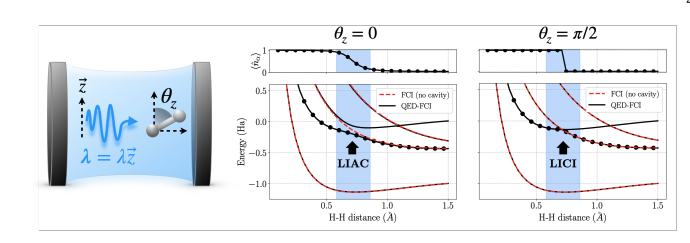
Researchers evaluate three computational strategies—qubit, qudit, and hybrid qubit-qumode—to model strong electron-photon interactions in polaritonic chemistry. Simulations of a cavity-embedded hydrogen molecule demonstrate comparable accuracy across all platforms; however, the hybrid and qudit approaches require fewer computational resources than conventional qubit-based methods.
The interaction between light and matter at the quantum level, specifically the creation of polaritons – quasi-particles arising from the strong coupling of photons and electrons – presents a significant computational challenge. Accurately modelling these systems requires representing both fermionic (electron) and bosonic (photon) degrees of freedom, a task demanding substantial resources from even the most powerful classical computers. Researchers are now investigating the potential of emerging quantum computing platforms to address this complexity. A collaborative effort led by Even Chiari, Wafa Makhlouf, Lucie Pepe, and Saad Yalouz from the Laboratoire de Chimie Quantique de Strasbourg, alongside Emiel Koridon from Vrije Universiteit and Instituut-Lorentz, Universiteit Leiden, and Johanna Klein, Bruno Senjean, and Benjamin Lasorne from ICGM, Univ Montpellier, CNRS, ENSCM, details a comparative analysis of three distinct quantum computational strategies. Their work, entitled “Ab Initio Polaritonic Chemistry on Diverse Quantum Computing Platforms: Qubit, Qudit, and Hybrid Qubit-Qumode Architectures”, explores the efficacy of qubit-based, qudit-based, and hybrid qubit-qumode approaches in simulating polaritonic systems, benchmarking each on a cavity-embedded hydrogen molecule to assess accuracy and resource requirements.
Polaritonic chemistry, the study of chemical reactions influenced by strong coupling between molecules and photons, necessitates novel computational methodologies to accurately model these interactions and harness the potential of hybrid quantum systems. Researchers currently investigate translating ab initio polaritonic chemistry—calculations based on first principles without empirical parameters—onto emerging quantum computers, with a central focus on efficiently representing both fermionic, relating to electrons and other particles with half-integer spin, and bosonic, relating to photons and other particles with integer spin, degrees of freedom. A key question concerns the optimal computational strategy for accurately capturing strong electron-photon correlations with reasonable implementation costs on near-term quantum hardware, prompting exploration of diverse quantum architectures and encoding schemes.
This work investigates three distinct approaches—qubit-based, qudit-based, and
This work investigates three distinct approaches—qubit-based, qudit-based, and hybrid qubit-qumode strategies—to address the challenges of simulating complex light-matter interactions and determine the most resource-efficient method for achieving accurate results. Qubits represent the fundamental unit of quantum information, analogous to bits in classical computing, while qudits extend this concept to higher-dimensional quantum systems, potentially offering advantages in encoding complexity. Researchers design compact, physically motivated circuit ansätze—parameterised quantum circuits used as trial wavefunctions—and integrate them within the state-averaged variational eigensolver, a hybrid quantum-classical algorithm used to find the ground and excited states of a quantum system, enabling simultaneous computation of multiple polaritonic eigenstates and streamlining the simulation process. A key element involves the development of compact electron-photon entangling circuits, specifically tailored to the native capabilities and limitations of each hardware architecture, maximising performance and minimising resource consumption.
Researchers benchmark all three strategies on a cavity-embedded hydrogen molecule, successfully reproducing characteristic phenomena such as light-induced avoided crossings—where energy levels repel each other due to interaction—demonstrating the ability of each platform to capture the essential physics of polaritonic systems. Results demonstrate that each platform achieves comparable accuracy in predicting polaritonic eigen-energies and eigenstates, validating the effectiveness of all three approaches in modelling light-matter interactions. However, significant differences emerge when considering resource requirements, highlighting the importance of optimising computational strategies for practical implementation on near-term quantum hardware.
The hybrid qubit-qumode approach proves to be the
The hybrid qubit-qumode approach proves to be the most resource-efficient, offering the best tradeoff between accuracy and the number of qubits or qudits needed, suggesting a promising avenue for future research and development. This work presents a hardware-conscious comparison of encoding strategies, highlighting the potential of higher-dimensional platforms for simulating complex light-matter interactions and advancing the field of quantum chemistry. Researchers underscore the importance of efficiently encoding and manipulating both fermionic and bosonic degrees of freedom to unlock the full potential of these hybrid quantum systems and enable accurate modelling of complex phenomena.
🗞 Ab Initio Polaritonic Chemistry on Diverse Quantum Computing Platforms: Qubit, Qudit, and Hybrid Qubit-Qumode Architectures
🧠 DOI: https://doi.org/10.48550/arXiv.2506.12504


