Scientists are increasingly focused on understanding how planets form and migrate within protoplanetary discs, a puzzle complicated by observed exoplanetary systems that defy simple formation models. Tenri Jinno, Takayuki R. Saitoh, and Yoko Funato, from Kobe University and The University of Tokyo respectively, with colleagues, present groundbreaking research addressing this challenge by investigating planetesimal-driven migration (PDM) in detail. Building on previous work, the team performed the first high-resolution simulations of planet formation within a planetesimal disc, incorporating complex interactions between gas, planets, and countless planetesimals. Their findings reveal dynamic inward and outward migration of protoplanets via PDM, potentially explaining the formation timescales of ice giants and offering a compelling mechanism for the diversity of exoplanetary systems , all within the framework of standard protoplanetary disc models.
Planetesimal Disk Simulations Reveal Dynamic Formation
Modeling Planet Formation in Planetesimal Disks
Scientists have demonstrated the first high-resolution simulations of planet formation originating from a large-scale planetesimal disk, revealing a dynamic process significantly different from traditional models. The research, published in Publications of the Astronomical Society of Japan, addresses longstanding challenges in explaining the formation timescales of ice giants and the diversity observed in exoplanetary systems. This comprehensive modelling represents a substantial leap forward in understanding the complex processes governing planetary birth.
The study unveils that protoplanets undergo dynamic inward and outward migrations during the crucial runaway growth stage, driven by PDM. These simulations show that orbital repulsion, acting in concert with PDM, causes a segregation of protoplanets, with outer bodies migrating outwards and inner bodies drifting inwards. This dynamic migration profoundly influences the early stages of planetary formation, challenging the conventional “in-situ” runaway and oligarchic growth model which struggles to account for the observed diversity of planetary systems. The team achieved this breakthrough by performing self-consistent N-body simulations, incorporating a level of detail previously unexplored in planet formation studies.
Experiments show that PDM can be effective even when the mass ratio of protoplanets to planetesimals is below 10, a finding that challenges previous thresholds established by Minton & Levison (2014). Furthermore, the research establishes that protoplanets can effectively overcome inward drift caused by Type-I migration, with some even experiencing outward migration via outward PDM. These findings provide a viable pathway for the formation of both Earth-like planets and the cores of ice giants, offering a compelling explanation for the observed characteristics of our solar system and beyond. This work opens exciting possibilities for understanding the formation of diverse exoplanetary systems without invoking additional, complex hypotheses. The simulations suggest that a standard protoplanetary disk model, combined with the dynamic effects of PDM, can adequately account for the planetary migration necessary to explain the wide range of exoplanetary architectures observed by missions like Kepler and TESS. The research team’s innovative approach and detailed simulations represent a significant advancement in the field, paving the way for future investigations into the intricate processes that shape planetary systems throughout the galaxy.
Planetesimal Disk Simulations of Planet Formation reveal complex
Advanced N-Body Simulation Techniques Applied
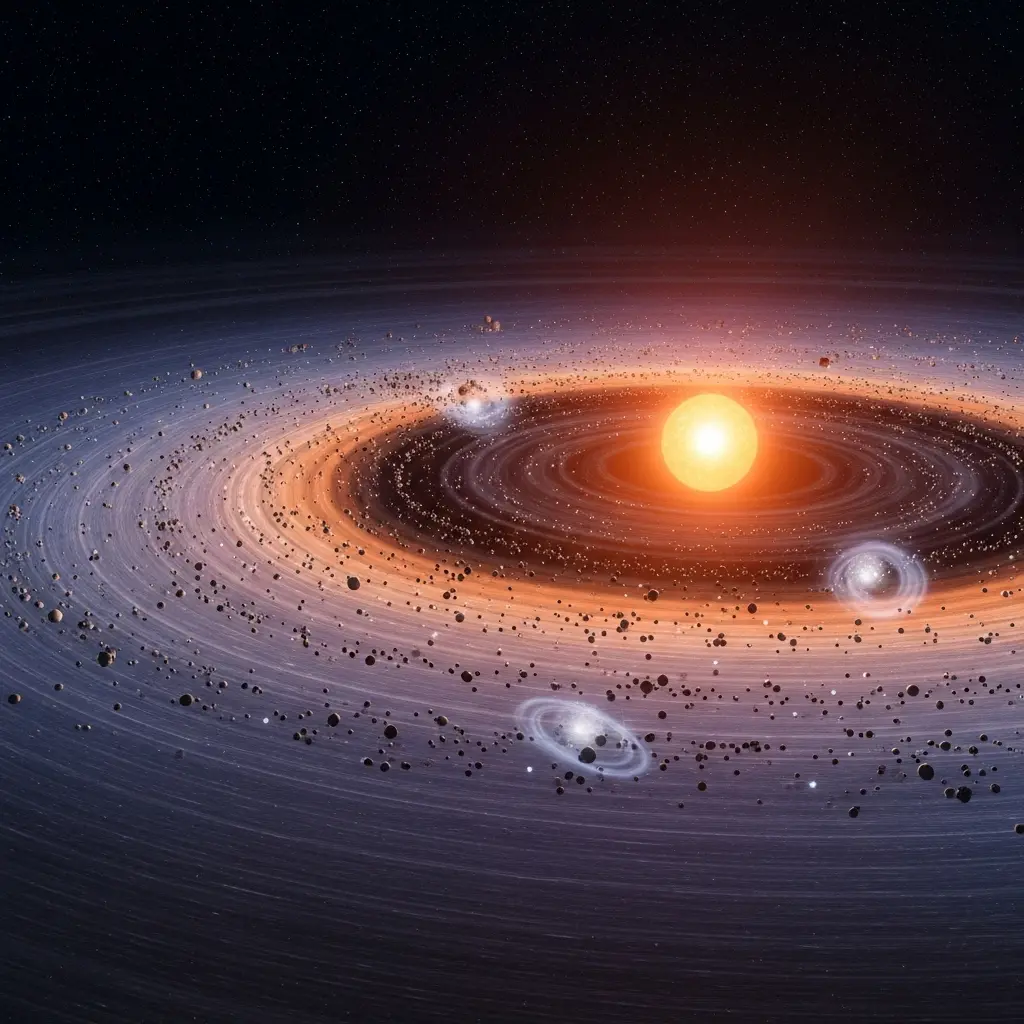
Scientists pioneered the first high-resolution simulations of planet formation originating from a large-scale planetesimal disk, meticulously integrating planet-gas disk interactions, planet-planetesimal interactions, gravitational interactions amongst all planetesimals, and physical collisions between these small bodies. This work builds upon previous research detailed in Jinno et al0.2024, which investigated single-planet migration via planetesimal-driven migration (PDM), addressing previously unexplored gravitational dynamics and gas interactions. The current study employed a novel numerical approach to model the entire planet formation process, moving beyond isolated planet scenarios to encompass a fully populated disk environment. Researchers constructed a protoplanetary disk model incorporating a smoothed gas component, representing the initial conditions for planet formation, and a substantial planetesimal disk to serve as the building blocks of planets.
N-body simulations were then performed, tracking the gravitational interactions of all planetesimals, enabling self-stirring and collective dynamical evolution of the disk, a crucial step for realistic modelling. The simulations accounted for gas drag forces acting on planetesimals and protoplanets, alongside Type-I migration torques, which typically drive planets inward towards the star. To accurately capture these forces, the team implemented a sophisticated hydrodynamic model of the gas disk, coupled with a direct N-body integration scheme for the planetesimals and forming protoplanets. Experiments employed a protoplanet-to-planetesimal mass ratio below 10, challenging the previously proposed threshold of 100 for effective PDM, and revealing that migration can occur even with relatively small protoplanets.
Planetesimal-Driven Orbital Migration Mechanisms
The team meticulously tracked the orbital evolution of protoplanets during the runaway growth stage, observing dynamic inward and outward migrations driven by PDM, a process where gravitational scattering of planetesimals imparts momentum changes to the growing planets. This innovative approach revealed a tendency for protoplanets to segregate into two groups: outer planets migrating outward and inner planets migrating inward, driven by the combined effects of repulsion and PDM. Furthermore, the study demonstrated that protoplanets can effectively overcome inward drift caused by Type-I torque, with some undergoing outward migration, a finding that significantly alters the understanding of planetary system architecture. The simulations delivered a viable pathway for the formation of both Earth-like planets and the cores of ice giants, suggesting that a standard protoplanetary disk model can account for the observed diversity of exoplanetary systems without invoking additional, complex hypotheses. This detailed methodology provides a robust framework for understanding the complex interplay of forces governing planet formation and migration. . Migrating embryos tend to form compact groups with nearly constant separation, aligning with orbital repulsion.
🗞 Self-consistent -body simulation of Planetesimal-Driven Migration. II. The effect of PDM on planet formation from a planetesimal disk
🧠 ArXiv: https://arxiv.org/abs/2601.20348