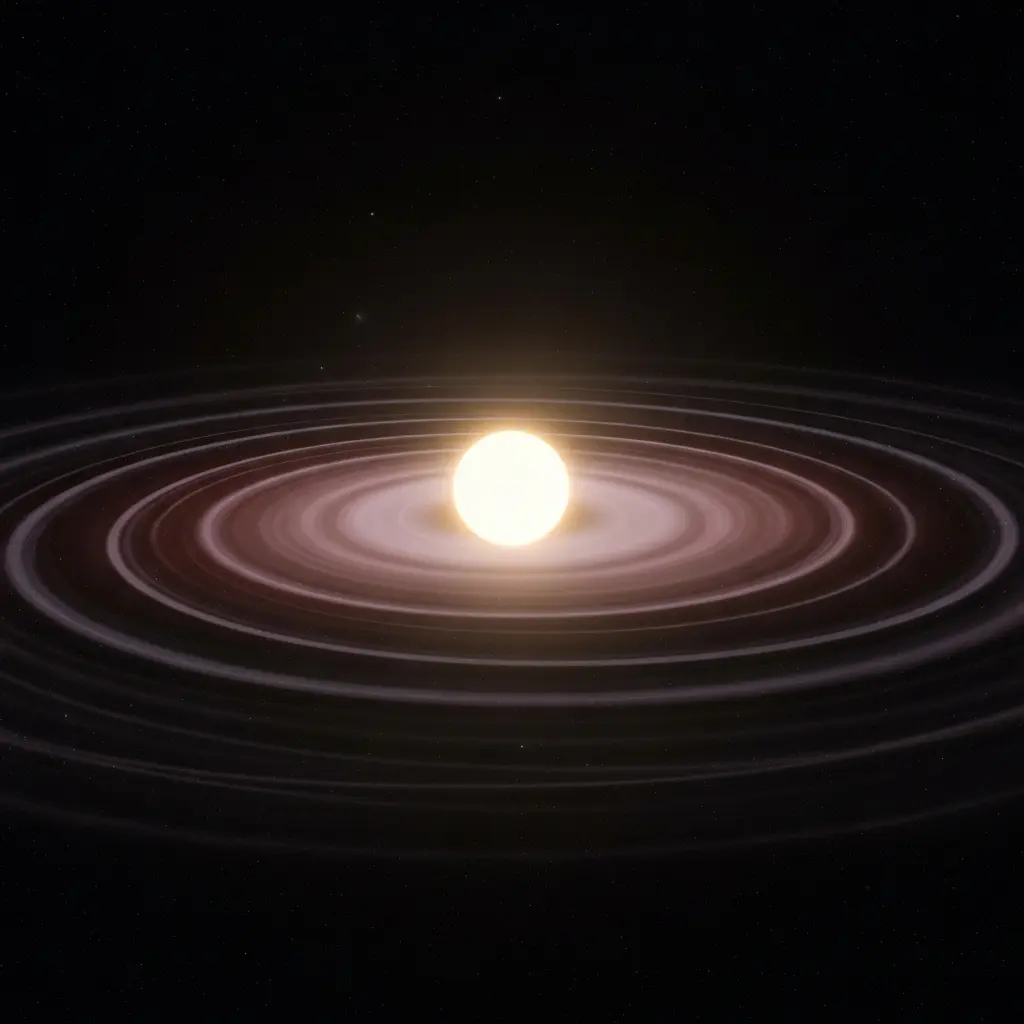
Researchers are increasingly focused on understanding the interplay between gas and dust within protoplanetary disks, crucial environments for planet formation. Luca Delussu, Rossella Anania, and Tilman Birnstiel, from the University Observatory, Ludwig-Maximilians-Universität München, alongside Claudia Toci, Giovanni Rosotti, and Sebastian Markus Stammler et al., present a population synthesis study investigating how disk substructures and external photoevaporation influence observed gas-to-dust size ratios in the Lupus star-forming region. This work is significant because it addresses a persistent challenge in modelling these disks: the difficulty of simultaneously reproducing observed gas and dust sizes, revealing a potential fine-tuning problem where specific initial conditions are required for accurate simulations. Their findings suggest that while substructures improve model accuracy, they often overestimate gas radii, prompting consideration of links between substructure location and the outer disk edge.
Recent work has focused on substructures, ring-like features observed within these protoplanetary disks, and their role in both disk evolution and the eventual creation of planets.
These substructures, revealed in detail by the Atacama Large Millimeter/Sub-millimeter Array, are not merely visual curiosities but appear essential for explaining observed characteristics of these disks, including their spectral indices and size-luminosity distributions. This study investigates whether substructures are truly necessary to reproduce the observed ratios of gas to dust sizes in the Lupus star-forming region, and attempts to predict the characteristics of these substructures.
Researchers performed a population synthesis, modelling the evolution of gas and dust within disks using a two-population model coupled with the DustPy code. The simulations incorporated key physical processes such as viscous evolution, dust growth, fragmentation, transport, and the effects of external photoevaporation, the erosion of the disk by high-energy radiation.
By post-processing the resulting disk profiles, the team generated simulated population distributions of density, maximum grain size, and disk temperature. Although substructures demonstrably reduce discrepancies between simulations and observations regarding gas-to-dust size ratios, they do not fully account for the observed values, even when external photoevaporation is included.
The research reveals that only very specific initial conditions, combined with viscous evolution and photoevaporation, can accurately reproduce the observed ratios, suggesting a degree of fine-tuning is required. While substructured disks successfully model dust size and spectral index, they consistently overestimate the radii of the gas component.
Ultimately, this work highlights the significant challenge of simultaneously modelling the sizes of both gas and dust within protoplanetary disks. One potential explanation is that the outermost substructure is directly linked to the disk truncation radius, which governs the gas radius, or that substructures are sufficiently frequent to consistently appear near the outer edge of the gas disk.
Simulating Protoplanetary Disc Evolution with Dust and Gas Dynamics
A population synthesis study investigated the role of substructures in protoplanetary disk evolution and planet formation. The research employed the two-pop-py model and DustPy code to simulate gas and dust dynamics within disks, focusing on the Lupus star-forming region. Simulations incorporated viscous evolution, dust growth, fragmentation, transport, and external photoevaporation as key physical processes influencing disk characteristics.
The study then post-processed resulting disk profiles of surface density, maximum grain size, and disk temperature to generate simulated population distributions. This work specifically examined the necessity of substructures to reconcile simulated and observed gas-to-dust size ratios. Researchers systematically varied initial disk conditions within the simulations, exploring how substructures impact the distribution of gas and dust.
External photoevaporation was included to model the effects of radiation from nearby stars on disk dispersal. The resulting models allowed for a direct comparison between simulated disk properties and observational data from the Lupus region, assessing the ability of substructures to address discrepancies in gas and dust size predictions.
A key methodological innovation involved the combined treatment of gas and dust evolution within a single population synthesis framework. This approach enabled a more holistic understanding of disk dynamics, moving beyond studies that focus on either gas or dust in isolation. By analysing the simulated population distributions, the study aimed to predict the characteristics of substructures required to reproduce observed features in protoplanetary disks. Although substructures partially alleviate discrepancies in gas-to-dust ratios, the simulations revealed that specific initial conditions are required to fully match observations, suggesting a potential fine-tuning problem in disk evolution.
Gas and dust evolution modelling constrains protoplanetary disk substructure properties
Protoplanetary disk substructures are thought to play a crucial role in disk evolution and planet formation. Population studies utilising large-sample size surveys demonstrate that rapid substructure formation is needed to reproduce observed spectral indices and simultaneously match size-luminosity distributions.
This work investigates the necessity of substructures and predicts their characteristics to reproduce gas-to-dust size ratios observed in the Lupus star-forming region. A population synthesis study of gas and dust evolution in disks was performed using a two-population model coupled with the DustPy code.
The simulations accounted for viscous evolution, dust growth, fragmentation, transport, and external photoevaporation, with resulting disk profiles post-processed to obtain distributions of density, maximum grain size, and temperature. Although substructures reduce the discrepancy between simulated and observed disk gas-to-dust size ratios, they do not fully resolve it, even when external photoevaporation is included.
Reproducing the observations requires specific initial conditions in disks undergoing viscous evolution with external photoevaporation, highlighting a fine-tuning problem. While substructured disks successfully reproduce dust size and spectral index, they tend to overestimate gas radii. The results ultimately highlight the main challenge of simultaneously reproducing gas and dust sizes within these disks.
One possible explanation is that the outermost substructure is linked to the disk truncation radius, which determines the gas radius, or that substructures are frequent enough to always be near the gas outer radius. The study builds upon observations from the Atacama Large Millimeter/Sub-Millimeter Array, which first revealed substructures in disks like HL Tau.
Surveys such as DSHARP and ODISEA have confirmed that optically thick substructures are ubiquitous in bright, extended disks. These substructures may mitigate solid particle migration, potentially trapping them at pressure maxima and enhancing the local dust-to-gas ratio, thus creating favourable conditions for planetesimal formation. The quick disappearance of large-sized dust particles and the evolution of gas disk sizes remain challenging problems in disk evolution theory.
Lupus disk modelling reveals partial success in matching gas-to-dust ratios with substructures
Protoplanetary disk substructures are considered vital components in the evolution of disks and the subsequent formation of planets. Population studies utilising large datasets demonstrate that these substructures form rapidly and are necessary to accurately model observed spectral indices, as well as simultaneously reproduce both the spectral index and size-luminosity distributions.
This work investigated the necessity of substructures and predicted their characteristics to replicate gas-to-dust size ratios observed within the Lupus star-forming region. Researchers performed population synthesis modelling of gas and dust evolution in disks, employing a two-population model and the DustPy code, while considering viscous evolution, dust growth, fragmentation, transport, and photoevaporation.
Simulations revealed that while substructures do help to lessen the differences between modelled and observed gas-to-dust size ratios, they do not entirely resolve the discrepancy. Reproducing observations requires specific initial conditions within disks undergoing viscous evolution alongside external photoevaporation, indicating a degree of fine-tuning is necessary.
Although substructured disks successfully reproduce dust size and spectral index, they tend to overestimate the radii of gas distributions. The primary challenge identified is the difficulty of simultaneously modelling gas and dust sizes accurately. One potential explanation is that the outermost substructure may be connected to the disk truncation radius, which governs the gas radius, or that substructures are sufficiently frequent to consistently appear near the outer gas radius.
The study acknowledges limitations in fully resolving the observed gas-to-dust ratios, even with the inclusion of substructures and photoevaporation. Future research could focus on exploring the link between substructure location and disk truncation, or investigating the required frequency of substructures to better align model predictions with observations.
🗞 A tension between dust and gas radii: the role of substructures and external photoevaporation in protoplanetary disks
🧠 ArXiv: https://arxiv.org/abs/2602.07528