

The ability to control electron flow at the nanoscale is crucial for developing the next generation of electronic devices, and researchers are increasingly exploring novel materials to achieve this goal. Radhika Soni, Suvronil Datta, and Robin Bajaj, all from the Indian Institute of Science, alongside colleagues, now demonstrate significantly enhanced electron tunneling through junctions created from twisted layers of graphene combined with other materials. Their work reveals that twisting the graphene layers boosts the interaction between electrons and vibrations within the material, making it easier for electrons to tunnel through barriers. This discovery, which establishes planar tunneling as a valuable technique for studying electron-phonon coupling, promises to unlock new possibilities for designing more efficient and versatile nanoscale electronics based on twisted van der Waals materials.
Planar Tunneling Reveals Graphene’s Electron-Phonon Interactions
The emergence of twisted bilayer graphene has sparked intense research into materials exhibiting exotic electronic properties, including superconductivity and correlated insulating states. These properties arise from the unique band structure of tBLG, where the interaction between layers creates “flat bands” that enhance electron interactions. Researchers have now demonstrated a novel approach using planar tunneling spectroscopy to investigate these electron-phonon interactions in tBLG. Traditional methods for studying the electronic structure of tBLG often struggle to directly reveal how phonons influence its behavior.
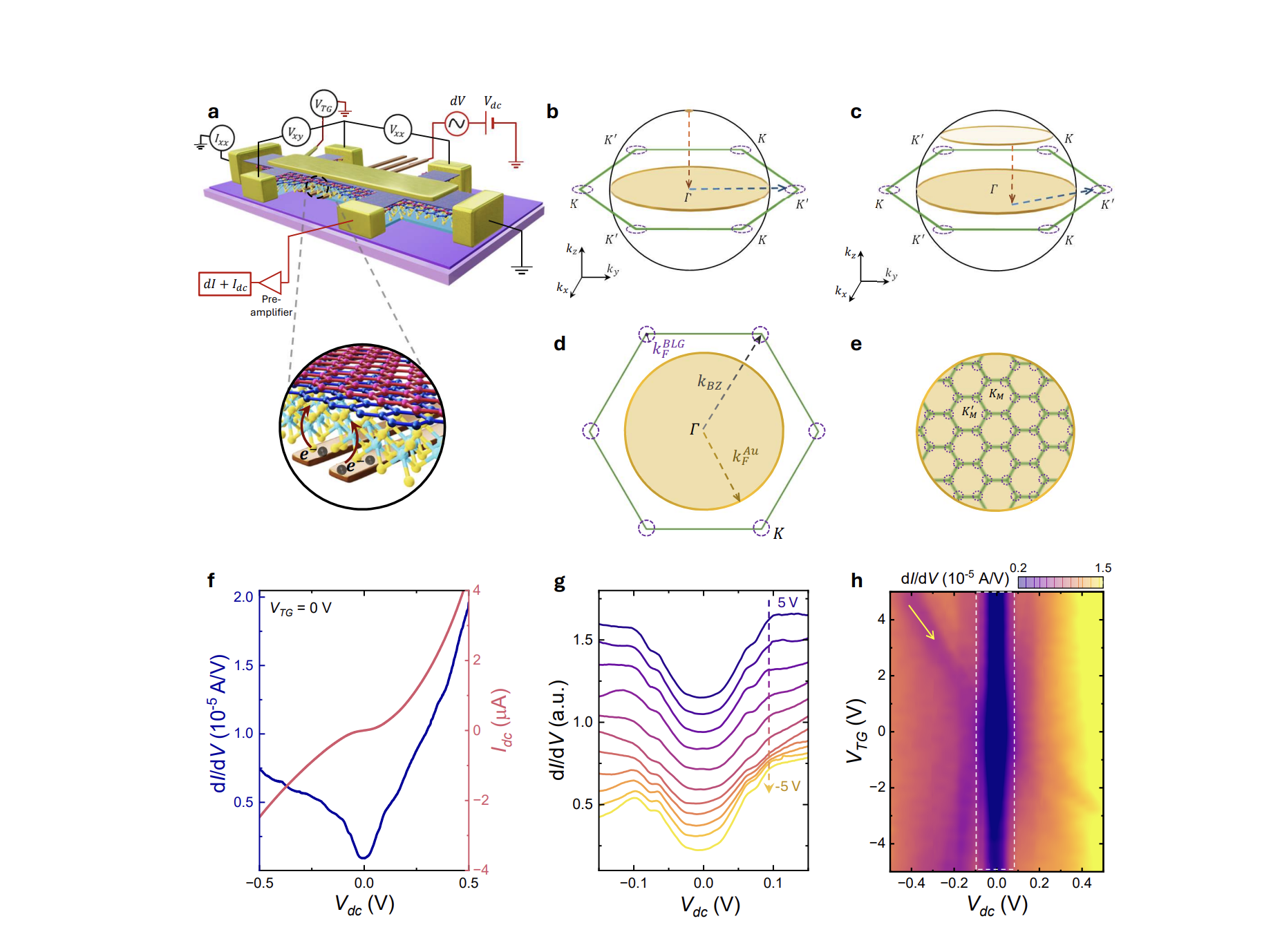
Planar tunneling overcomes these limitations, allowing scientists to probe the electronic structure of tBLG across a broad area. By creating junctions consisting of tBLG, a thin barrier, and a metal electrode, the team can measure how electrons tunnel between the layers, revealing crucial information about the material’s electronic and vibrational properties. Experiments directly compare tunneling in tBLG with that of conventional bilayer graphene, highlighting that electron tunneling is significantly enhanced in tBLG due to relaxed requirements for momentum conservation. In conventional graphene, electrons must maintain a specific momentum during tunneling, requiring phonon involvement.
However, the unique band structure of tBLG allows for more flexible momentum exchange, leading to a substantial increase in tunneling current, suggesting phonons play a more significant role in facilitating electron transport. Further analysis, supported by theoretical calculations of phonon behavior, confirms that the observed enhancement in tunneling is directly linked to the interplay between electrons and phonons in tBLG. This work establishes planar tunneling spectroscopy as a versatile technique for understanding the complex relationship between electron-phonon coupling and the emergence of exotic properties in twisted van der Waals materials, promising to accelerate the development of novel electronic devices.
Twisted Graphene Tunneling and Phonon Interactions
Researchers employed planar tunneling spectroscopy to investigate the electronic properties of twisted bilayer graphene, comparing it to conventional bilayer graphene. This technique measures the flow of electrons through a barrier, providing insights into the materials’ density of states and how electrons interact with vibrations, or phonons. The study focused on understanding how twisting the graphene layers affects the tunneling process and enhances electron-phonon interactions. A key aspect of the methodology was the careful comparison of phonon behavior in both bilayer and twisted bilayer graphene.
Calculations revealed that the twisted structure exhibits unique phonon characteristics, influencing how electrons tunnel through the material. The team correlated these theoretical calculations with experimental measurements of tunneling current, confirming the role of specific phonons in enhancing the process. The researchers paid particular attention to the momentum matching between electrons in the metal contact and the graphene layers, recognizing that efficient tunneling requires compatible momentum values. They discovered that the twisting effectively relaxes the strict momentum matching criteria, making it easier for electrons to tunnel.
This relaxation is due to the formation of a smaller unit cell in the twisted structure, which encompasses the metal’s electronic states and reduces the need for phonons to compensate for momentum differences. To analyze this effect, the team examined how phonons bridge the momentum gap between the metal and graphene. They determined that in conventional bilayer graphene, the necessary momentum compensation is insufficient, hindering tunneling. However, in the twisted bilayer, the smaller unit cell and the presence of specific phonons significantly enhance the overlap between electron states, leading to a substantial increase in tunneling current. This detailed analysis highlights the crucial role of geometric compatibility and phonon-assisted processes in governing electron transport.
Twisted Graphene Exhibits Enhanced Electron Tunneling
Researchers have developed a novel method to probe the unique electronic properties of twisted bilayer graphene, a material garnering significant attention for its potential in next-generation electronics. This technique, called planar tunneling spectroscopy, allows scientists to examine how electrons move through the material and interact with its atomic vibrations, or phonons. The research demonstrates that twisted bilayer graphene exhibits significantly enhanced electron tunneling compared to its non-twisted counterpart due to a more relaxed requirement for momentum conservation during the tunneling process. The team created junctions consisting of twisted or non-twisted graphene layers separated by a thin barrier, with metal electrodes on either side.
By measuring the electrical current flowing through these junctions, they were able to map out the energy levels and momentum states of electrons within the graphene. The results reveal that the twisting introduces “folded” energy bands, effectively broadening the range of momenta that can participate in tunneling, and thus increasing the tunneling current. Theoretical calculations of the phonon band structures corroborate these experimental findings, demonstrating that the twisting modifies the vibrational modes of the graphene, creating a greater density of states and further enhancing the tunneling probability. This enhancement directly relates to the unique electronic structure created by the twisting, providing a sensitive probe of electron-phonon interactions crucial for understanding phenomena like superconductivity. The planar tunneling technique offers a distinct advantage over other methods by allowing researchers to examine larger areas of the material and average out local variations. This provides a more comprehensive understanding of the material’s overall electronic properties and opens new avenues for exploring the potential of twisted bilayer graphene in advanced electronic devices.
🗞 Enhanced Phonon-Assisted Tunneling in Metal — Twisted Bilayer Graphene Junctions
🧠 DOI: https://doi.org/10.48550/arXiv.2507.12991


