

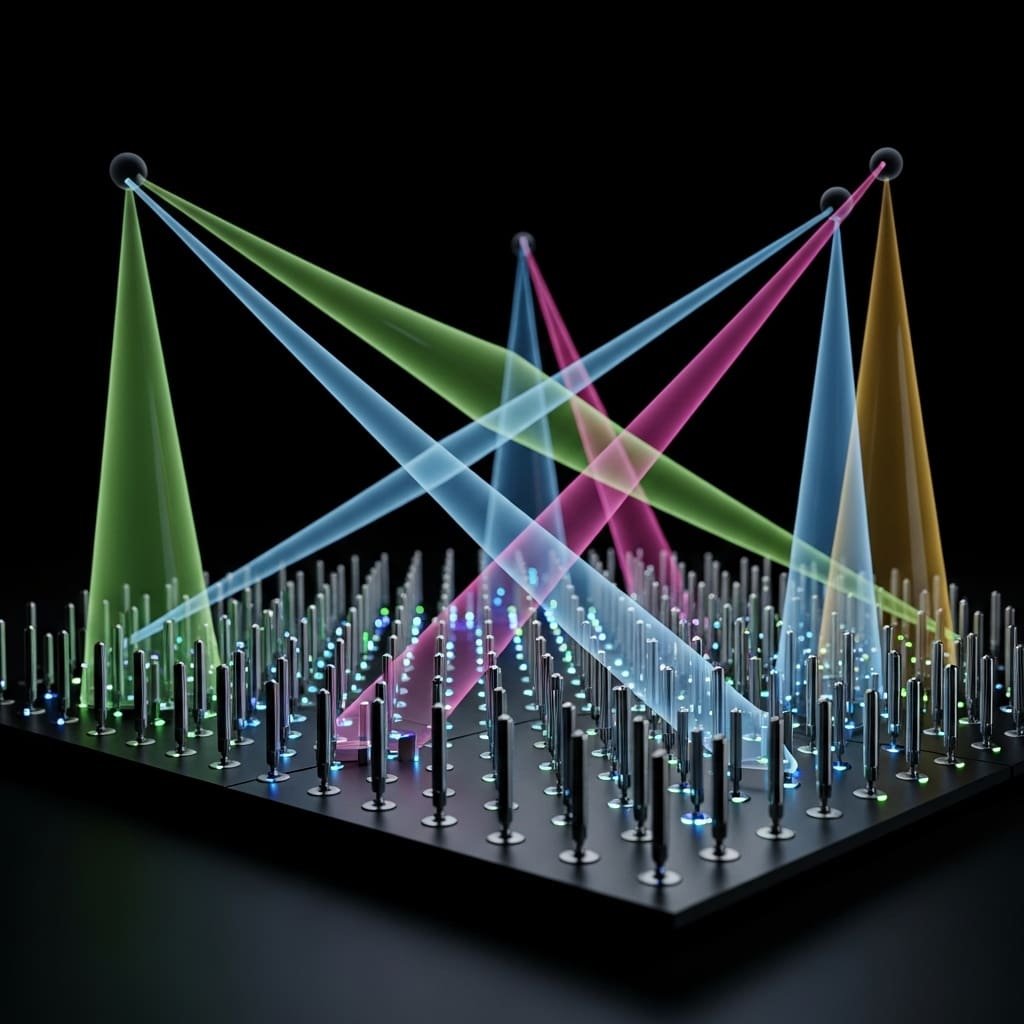
Researchers are increasingly focused on integrated sensing and communication (ISAC) to meet the growing demands of sixth-generation wireless systems. Qian Gao, Ruikang Zhong, and Yue Liu, from Queen Mary University of London and Macao Polytechnic University respectively, alongside Hyundong Shin from Kyung Hee University and Yuanwei Liu from The University of Hong Kong et al., present a novel approach utilising a three-dimensional pinching antenna array to significantly enhance ISAC performance. Their work addresses the complex challenge of optimising antenna positioning, time allocation and transmit power, formulating a solution that maximises communication rates while maintaining target sensing accuracy and energy efficiency. This research is significant because it demonstrates the substantial gains achievable through 3D antenna deployment and introduces a heterogeneous reinforcement learning algorithm that outperforms existing methods in both speed and effectiveness, paving the way for more efficient and powerful wireless networks.
This research is significant because it demonstrates the substantial gains achievable through 3D antenna deployment and introduces a heterogeneous Reinforcement learning algorithm that outperforms existing methods in both speed and effectiveness, paving the way for more efficient and powerful wireless networks.
3D Antenna Deployment via Reinforcement Learning offers promising
This breakthrough reveals a new approach to ISAC by moving beyond planar antenna arrangements to a fully three-dimensional configuration. The study establishes that this 3D deployment not only offers full-space beam steering capabilities for users and targets, including those airborne or at elevated positions, but also introduces additional spatial degrees-of-freedom. These degrees-of-freedom effectively decouple communication and sensing beams, leading to improved system efficiency and accuracy. However, the increased complexity of the 3D geometry presents a challenge, creating a larger continuous action space for antenna displacement, time-division multiple access (TDMA) weights, and power allocation, which traditional optimisation methods struggle to manage.
This innovative approach represents the antenna, user, target topology as a time-varying heterogeneous graph, encoding it using a graph neural network (GNN). Experiments conducted demonstrate the effectiveness of both the proposed 3D pinching antennas and the HGRL algorithm in significantly enhancing ISAC performance. The system model considers a base station equipped with three orthogonal waveguides, each aligned along the Cartesian axes, serving K communication users and detecting L sensing targets, with each waveguide containing N pinching antennas, resulting in a total of M = 3N antennas. This work opens avenues for future research into advanced ISAC systems for applications such as autonomous vehicles and WiFi sensing, where enhanced spectral efficiency and situational awareness are paramount.
3D Antenna Deployment via Reinforcement Learning offers promising
Researchers implemented the HGRL algorithm using the Advantage Actor-Critic (A2C) framework to optimise the agent’s decision-making policy. A2C, a synchronous on-policy reinforcement learning algorithm, balances sample efficiency and training stability through the joint updating of a policy network and a value network. To capture complex topological and relational information within the environment, the team employed a Graph Convolutional Network (GCN) to extract structural features from a heterogeneous graph. These graph-based embeddings then served as input for the actor-critic framework, facilitating more informed and spatially-aware decision-making.
The agent’s policy network, πθ, is a continuous actor network outputting actions based on the heterogeneous GNN embeddings, optimised using a clipped objective function. Simultaneously, the critic network, Vψ, estimates expected return by minimising the temporal difference (TD) error. Crucially, the study developed a heterogeneous GNN encoder, φHetGNN, to compute structured representations from the input graph, enabling the system to differentiate between communication and sensing components. Experiments employed a multi-user ISAC system with six users and one target randomly distributed within a 50m × 50m area. The antenna array comprised six elements, with the carrier frequency set to 28GHz and each element adjustable under a minimum inter-element spacing of λ/2. Communication channels were modelled as line-of-sight paths with an effective refractive index of 1.4, while TDMA time fractions and power allocations were dynamically optimised, subject to a total power constraint of 100W and a per-antenna limit of 0.1W.
3D antenna deployment boosts ISAC performance significantly
This algorithm effectively addresses the complex optimization problem inherent in 3D antenna deployment. The team constructed a system model featuring a base station equipped with three orthogonal waveguides, each containing N pinching antennas, resulting in a total of 3N antennas. Measurements confirm that the positions of the nth pinching antenna on each waveguide are defined as ψp nx = (xn, 0, d), ψp ny = (0, yn, d), and ψp nz = (0, 0, zn), where ‘d’ represents a fixed elevation. The study considered K single-antenna communication users and L sensing targets located in the x-y plane, with coordinates ψcom k = (xk, yk, 0) and ψsen l = (xl, yl, 0), respectively.
To manage communication and sensing, a time-division multiple access (TDMA) scheme was implemented, allocating separate time slots for each function. This allows for scalable optimization across graph-structured states and mixed action spaces. The breakthrough delivers a new approach to ISAC system design, offering full-space beam steering and decoupling communication and sensing beams.
3D Antenna Deployment via Heterogeneous Reinforcement Learning offers
A heterogeneous based reinforcement learning (HGRL) algorithm was developed to address this complex optimisation problem effectively. Notably, the 3D deployment effectively manages sensing signal-to-noise ratio, closely approaching the constraint and reducing unnecessary power consumption, thereby allocating more resources to communication. This work establishes the benefits of utilising spatial diversity through tri-axial waveguides, enabling flexible beam steering and efficient separation of communication and sensing beams. The authors acknowledge limitations inherent in the simulation environment and suggest future research could explore the algorithm’s performance in more complex and realistic wireless environments. Further investigation into adaptive resource allocation strategies based on real-time channel conditions could also refine the system’s efficiency and robustness.
👉 More information
🗞 RL based Beamforming Optimization for 3D Pinching Antenna assisted ISAC Systems
🧠 ArXiv: https://arxiv.org/abs/2601.20654