
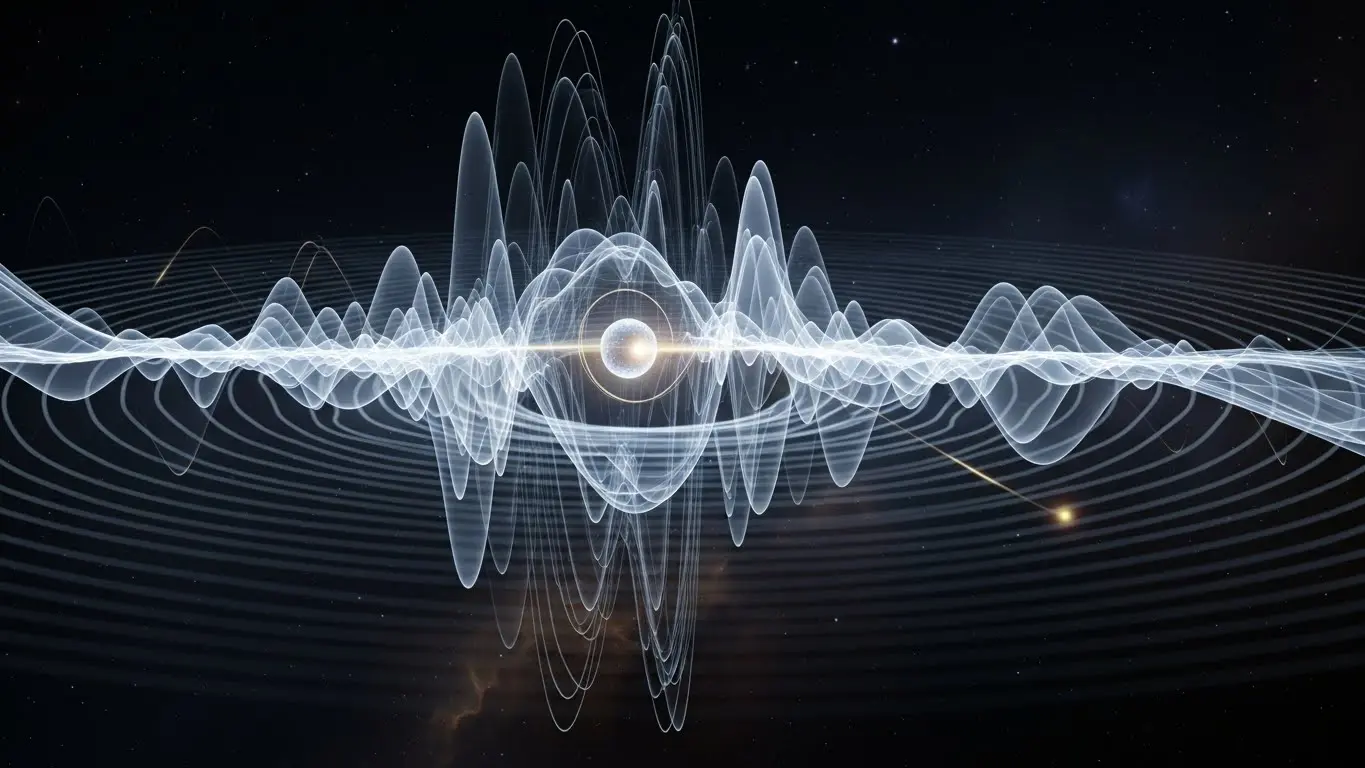
In the realm of quantum mechanics, the Copenhagen interpretation has long dominated, but an alternative framework, Pilot Wave Theory, is experiencing renewed interest. This theory, originally proposed by Louis de Broglie and later expanded by David Bohm, offers a deterministic view of quantum phenomena, challenging the probabilistic nature of mainstream interpretations. Recent advancements in experimental techniques and theoretical models have sparked a resurgence, prompting a reevaluation of its potential to resolve longstanding questions in quantum physics. The revival of Pilot Wave Theory is not merely an academic curiosity; it represents a significant shift in how scientists might approach the fundamental nature of reality. By positing that particles have definite trajectories guided by a “pilot wave,” the theory aims to reconcile quantum mechanics with classical intuitions about causality and determinism. This resurgence is particularly timely as researchers grapple with the limitations of existing interpretations and seek new avenues to unify quantum mechanics with general relativity. The implications of this revival extend beyond theoretical physics, potentially influencing the development of quantum technologies and our understanding of the universe at its most fundamental level.
Quantum mechanics, a fundamental theory in physics, provides a mathematical description of the dual particle-like and wave-like behavior and interactions of energy and matter.
— Britannica Encyclopedia
#
The Significance of Pilot Wave Theory in Modern Physics
Pilot Wave Theory, also known as the de Broglie-Bohm theory, has gained renewed attention due to its potential to address some of the most perplexing questions in quantum mechanics. Unlike the Copenhagen interpretation, which relies on the concept of wavefunction collapse and inherent probabilities, Pilot Wave Theory posits that particles possess definite positions at all times, guided by a deterministic wavefunction. This deterministic framework challenges the conventional view that quantum systems are inherently probabilistic, offering a more intuitive explanation of phenomena such as quantum entanglement and measurement. The resurgence of this theory is driven by recent experimental advances, including the development of analog systems that mimic pilot wave behavior in classical settings. These experiments, such as those involving droplets on vibrating fluid surfaces, provide tangible demonstrations of wave-particle duality, reigniting interest in the theory’s validity. Furthermore, the potential to unify quantum mechanics with general relativity through Pilot Wave Theory’s deterministic structure has spurred theoretical research into novel solutions for the long-standing problem of quantum gravity. As scientists continue to explore the implications of this theory, its resurgence may lead to a paradigm shift in our understanding of the quantum world, bridging the gap between classical and quantum descriptions of reality.
The de Broglie-Bohm theory, also known as pilot-wave theory, is an interpretation of quantum mechanics in which particles have definite positions at all times, and their motion is guided by a wavefunction that determines the trajectory of the particles.
— Britannica Encyclopedia
The Fundamental Principles Behind Pilot Wave Theory
Pilot Wave Theory is rooted in the idea that quantum systems can be described by two fundamental components: particles with definite positions and a guiding wavefunction that influences their motion. This dualistic framework diverges sharply from the Copenhagen interpretation, which treats particles as inherently probabilistic entities without definite trajectories until measured. In Pilot Wave Theory, the wavefunction is not merely a mathematical tool but a real, physical entity that governs the behavior of particles. The theory introduces the concept of a “pilot wave,” which evolves according to the Schrödinger equation and guides the particles through a deterministic trajectory. This trajectory is determined by the guidance equation, a mathematical expression that links the particle’s position to the wavefunction’s properties. One of the most intriguing aspects of this theory is its ability to explain quantum phenomena without invoking wavefunction collapse. Instead, the act of measurement is seen as a process that reveals the pre-existing position of a particle, rather than collapsing its wavefunction into a definite state. This deterministic approach challenges the conventional view that quantum mechanics is fundamentally probabilistic, offering a more intuitive explanation for phenomena such as quantum interference and entanglement. The theory’s compatibility with classical physics further enhances its appeal, as it suggests that quantum mechanics can be reconciled with the deterministic laws of Newtonian mechanics under a unified framework.
How the Pilot Wave Guides Particles
At the heart of Pilot Wave Theory lies the guidance equation, a mathematical relationship that dictates how particles move in response to the pilot wave. This equation, derived from the wavefunction, ensures that each particle follows a deterministic trajectory, even in the presence of quantum uncertainty. The guidance equation is expressed as v = ∇S/m, where v is the particle’s velocity, S is the phase of the wavefunction, and m is the particle’s mass. This equation implies that the particle’s motion is directly influenced by the spatial gradients of the wavefunction, leading to trajectories that can exhibit complex, non-classical behavior. For example, in the case of a double-slit experiment, the pilot wave theory predicts that individual particles pass through one slit or the other, with their paths determined by the interference pattern of the wavefunction. This explanation avoids the need for wavefunction collapse, instead attributing the observed interference to the guiding influence of the pilot wave. The deterministic nature of these trajectories also resolves the measurement problem in quantum mechanics, as the act of measurement simply reveals the pre-existing position of the particle rather than creating it through an indeterministic process. By providing a clear, mathematically consistent framework for particle motion, Pilot Wave Theory offers a compelling alternative to the probabilistic interpretations that dominate mainstream quantum mechanics.
The Role of the Quantum Potential
A critical component of Pilot Wave Theory is the quantum potential, a non-classical energy term that arises from the wavefunction’s structure. Unlike classical potentials, which depend on the position of a particle in space, the quantum potential is a function of the entire wavefunction and influences the particle’s motion in a non-local manner. This potential is derived from the wavefunction’s amplitude and is given by Q = – (ħ²/2m)(∇²R/R), where R is the amplitude of the wavefunction and ħ is the reduced Planck constant. The quantum potential plays a pivotal role in shaping the trajectories of particles, introducing deviations from classical Newtonian dynamics. For instance, in the case of quantum tunneling, the quantum potential allows particles to pass through energy barriers that would be insurmountable in classical physics. This phenomenon is explained not by probabilistic tunneling but by the deterministic influence of the quantum potential, which modifies the particle’s effective potential energy landscape. The non-local nature of the quantum potential also accounts for the instantaneous correlations observed in entangled systems, challenging the classical notion of locality. By incorporating this unique potential into the equations of motion, Pilot Wave Theory provides a coherent explanation for quantum phenomena that remain enigmatic under traditional interpretations. The quantum potential’s ability to influence particles without transferring energy or momentum further underscores the theory’s departure from classical physics, highlighting its potential to unify quantum mechanics with other fundamental forces.
Challenges in Experimental Verification
Despite its theoretical elegance, Pilot Wave Theory faces significant challenges in experimental verification. One of the primary obstacles is the difficulty in directly observing the trajectories of particles, which are inherently deterministic but often indistinguishable from probabilistic outcomes in standard experiments. The theory predicts that particles follow well-defined paths, but these trajectories are not directly accessible through conventional measurement techniques, which typically only provide statistical distributions of outcomes. This has led to debates about whether the theory’s deterministic framework can be empirically distinguished from the probabilistic Copenhagen interpretation. Another major challenge is the non-local nature of the quantum potential, which implies instantaneous correlations between particles regardless of their spatial separation. While Bell’s theorem has demonstrated that quantum mechanics violates local hidden variable theories, it does not rule out non-local deterministic models like Pilot Wave Theory. However, designing experiments that can conclusively test the non-local aspects of the theory remains a formidable task. Additionally, the theory’s compatibility with relativistic quantum field theory is an open question, as the deterministic trajectories of particles may conflict with the principles of special relativity, particularly in the context of entangled systems. These challenges highlight the need for innovative experimental approaches, such as analog systems or quantum simulations, to probe the predictions of Pilot Wave Theory in controlled environments. Until such experiments yield definitive results, the theory’s empirical validation will remain a topic of active research and debate.
Comparing Pilot Wave Theory and the Copenhagen Interpretation
The divergence between Pilot Wave Theory and the Copenhagen interpretation lies in their fundamental assumptions about the nature of quantum systems. The Copenhagen interpretation, championed by Niels Bohr and Werner Heisenberg, posits that quantum systems do not have definite properties until they are measured. This view is encapsulated in the principle of complementarity, which asserts that particles exhibit both wave-like and particle-like behaviors, but these cannot be observed simultaneously. In contrast, Pilot Wave Theory asserts that particles have definite positions at all times, with their motion governed by a deterministic wavefunction. This deterministic framework challenges the Copenhagen interpretation’s reliance on probabilities and wavefunction collapse, offering a more intuitive explanation for quantum phenomena. For instance, in the case of quantum entanglement, the Copenhagen interpretation attributes the correlated outcomes of measurements to the collapse of the wavefunction into a definite state, while Pilot Wave Theory explains them through the non-local influence of the quantum potential. The deterministic trajectories predicted by Pilot Wave Theory also resolve the measurement problem, as the act of measurement simply reveals the pre-existing position of a particle rather than creating it through an indeterministic process. These differences highlight the philosophical and methodological distinctions between the two interpretations, with Pilot Wave Theory providing a more ontological description of quantum systems that aligns with classical intuitions about causality and determinism.
Recent Advancements in Pilot Wave Theory Research
Recent years have witnessed significant advancements in the study of Pilot Wave Theory, driven by both theoretical developments and experimental innovations. One notable area of progress is the exploration of analog systems that mimic the behavior of quantum particles under the guidance of a pilot wave. For example, experiments involving droplets on the surface of a vibrating fluid have demonstrated classical analogs of quantum phenomena such as wave-particle duality, interference, and tunneling. These “walker” systems provide a tangible, macroscopic demonstration of the theory’s core principles, offering insights into how deterministic trajectories might manifest in quantum systems. Another area of research involves the application of Pilot Wave Theory to quantum field theory, where scientists are investigating whether the theory can be extended to account for the creation and annihilation of particles in a relativistic framework. This line of inquiry is particularly important for addressing the theory’s compatibility with the principles of special relativity, as the deterministic trajectories of particles may conflict with the notion of causality in relativistic contexts. Additionally, researchers are exploring the potential of Pilot Wave Theory to resolve the measurement problem in quantum mechanics, with some proposing that the theory’s deterministic structure could provide a natural explanation for the emergence of classical behavior from quantum systems. These advancements underscore the growing interest in Pilot Wave Theory as a viable alternative to the Copenhagen interpretation, with the potential to reshape our understanding of the quantum world.
Applications in Quantum Foundations and Technology
The implications of Pilot Wave Theory extend beyond theoretical physics, with potential applications in quantum foundations and emerging quantum technologies. In the realm of quantum foundations, the theory’s deterministic framework offers a novel perspective on unresolved issues such as the measurement problem and the nature of quantum entanglement. By providing a clear ontological description of quantum systems, Pilot Wave Theory may help bridge the gap between quantum mechanics and classical physics, fostering a deeper understanding of the underlying principles that govern the universe. This could lead to new insights into the unification of quantum mechanics with general relativity, particularly in the context of quantum gravity, where the theory’s deterministic structure might provide a framework for reconciling the probabilistic nature of quantum mechanics with the deterministic laws of spacetime. In terms of technology, the deterministic trajectories predicted by Pilot Wave Theory could inform the development of quantum computing and quantum communication systems. For instance, the theory’s ability to explain entanglement without invoking wavefunction collapse might lead to more efficient algorithms for quantum information processing. Additionally, the theory’s compatibility with classical physics could facilitate the design of hybrid quantum-classical systems, where deterministic and probabilistic elements coexist. As researchers continue to explore the practical applications of Pilot Wave Theory, its resurgence may not only advance our theoretical understanding of quantum mechanics but also drive innovation in quantum technologies that could revolutionize fields ranging from cryptography to materials science.
Key Challenges in the Acceptance of Pilot Wave Theory
Despite its theoretical appeal and recent experimental advancements, Pilot Wave Theory faces several hurdles that hinder its widespread acceptance within the scientific community. One of the most significant challenges is the theory’s non-locality, which implies that the quantum potential can influence particles instantaneously across arbitrary distances. While Bell’s theorem has demonstrated that quantum mechanics violates local hidden variable theories, it does not preclude non-local deterministic models like Pilot Wave Theory. However, the non-local nature of the theory raises concerns about its compatibility with the principles of special relativity, particularly the requirement that no information or influence can travel faster than the speed of light. This tension between non-locality and relativity remains a critical unresolved issue, as researchers seek to reconcile the deterministic trajectories of Pilot Wave Theory with the relativistic framework. Another major challenge is the lack of direct experimental evidence confirming the existence of deterministic particle trajectories. While analog experiments such as droplet systems on vibrating fluids provide compelling visual demonstrations of wave-particle duality, they do not conclusively prove that quantum particles behave in a similar deterministic manner. The difficulty in designing experiments that can distinguish between the predictions of Pilot Wave Theory and the probabilistic Copenhagen interpretation further complicates empirical validation. Additionally, the theory’s departure from the mainstream interpretations of quantum mechanics has led to skepticism among some physicists, who argue that its deterministic framework may not be necessary given the success of probabilistic models in explaining experimental results. These challenges highlight the need for continued theoretical and experimental research to address the open questions surrounding Pilot Wave Theory and to determine its viability as a foundational description of quantum mechanics.
The Future of Pilot Wave Theory and Quantum Mechanics
The future of Pilot Wave Theory hinges on its ability to address the unresolved challenges that have hindered its acceptance and to demonstrate its utility in both theoretical and applied contexts. One promising avenue is the development of more sophisticated experimental techniques capable of testing the theory’s deterministic predictions. Advances in quantum simulation and analog systems may provide clearer evidence of particle trajectories, potentially bridging the gap between theoretical models and empirical validation. Additionally, ongoing research into the theory’s compatibility with relativistic quantum field theory could lead to breakthroughs in understanding how deterministic trajectories might coexist with the principles of special relativity. This could involve redefining the quantum potential in a way that respects relativistic causality, ensuring that the theory’s non-local aspects do not conflict with the speed of light constraint. Another critical direction for future research is the exploration of Pilot Wave Theory’s implications for quantum gravity. By providing a deterministic framework that could unify quantum mechanics with general relativity, the theory may offer new insights into the nature of spacetime and the behavior of quantum systems at the Planck scale. Furthermore, the theory’s potential applications in quantum technologies, such as quantum computing and communication, could drive practical advancements that validate its theoretical foundations. As researchers continue to refine the mathematical structure of Pilot Wave Theory and explore its experimental and technological applications, the theory may emerge as a cornerstone of a new paradigm in quantum mechanics, reshaping our understanding of the universe at its most fundamental level.