The accurate and efficient simulation of electromagnetic wave propagation remains a significant challenge across diverse fields, from antenna design to medical imaging. Researchers are increasingly exploring the application of machine learning techniques, specifically Physics-Informed Neural Networks (PINNs), to address this complexity. PINNs integrate the underlying physical laws directly into the training process of a neural network, offering a data-efficient alternative to traditional numerical methods. A team led by Ziv Chen, Gal G. Shaviner, Hemanth Chandravamsi, Shimon Pisnoy, Steven H. Frankel, and Uzi Pereg, all from the Technion – Israel Institute of Technology, present a novel framework, detailed in their article, “Quantum Physics-Informed Neural Networks for Maxwell’s Equations: Circuit Design, ‘Black Hole’ Barren Plateaus Mitigation, and GPU Acceleration”. Their work introduces a Quantum Physics-Informed Neural Network (QPINN) designed to solve two-dimensional, time-dependent Maxwell’s equations, leveraging parameterized circuits and GPU acceleration to enhance both accuracy and computational efficiency.
Physics-informed neural networks (PINNs), a developing computational methodology, solve partial differential equations by integrating known physical laws directly into the neural network’s training process. Recent research details a quantum-enhanced PINN (QPINN) framework, designed to solve two-dimensional, time-dependent Maxwell’s equations, and demonstrates improved accuracy and efficiency compared to classical PINN baselines. Maxwell’s equations describe the behaviour of electric and magnetic fields, and are fundamental to understanding electromagnetic wave propagation. The QPINN leverages parameterized quantum circuits, alongside classical neural network architectures, enforcing global energy conservation as a key training constraint.
Researchers developed a GPU-accelerated simulation library using PyTorch, a popular machine learning framework, facilitating end-to-end training of the QPINN and enabling efficient computation of circuit outputs and their derivatives. Derivatives are essential for solving differential equations, as they represent rates of change. The method was evaluated on two electromagnetic wave propagation problems, one simulating free space – a vacuum with no material properties – and another incorporating a dielectric medium, a material that reduces the electric field. This assessment gauged performance across different scenarios. A comprehensive ablation study systematically compared various quantum circuit architectures, known as ansätze, input scaling methods, and the inclusion of an energy conservation loss term, providing valuable insights into optimal parameter configurations.
The study incorporates recent advancements in PINN convergence,
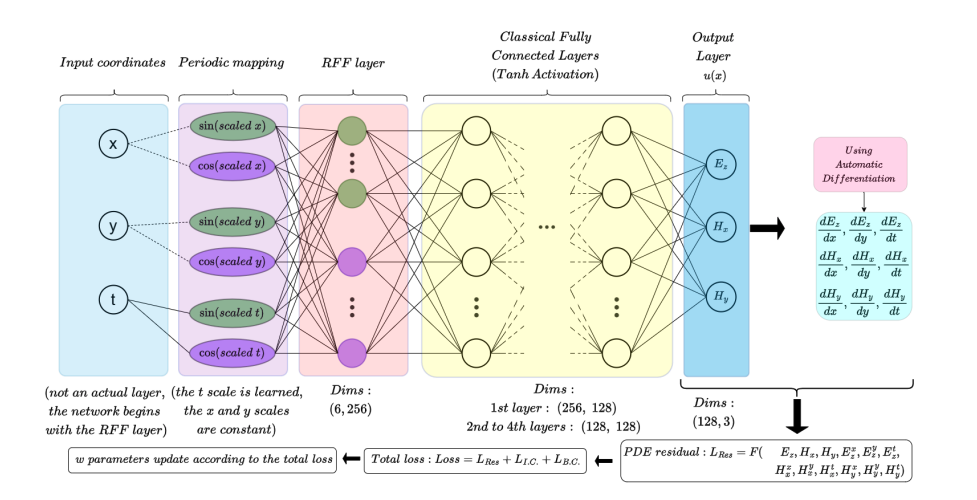
The study incorporates recent advancements in PINN convergence, including random Fourier feature embeddings and adaptive time-weighting techniques, to further enhance the method’s robustness and efficiency. Random Fourier features approximate complex functions with simpler, more manageable representations, while adaptive time-weighting adjusts the importance of different time steps during training. Results indicate that the QPINN achieves comparable, and in some cases superior, accuracy to classical PINNs while utilising significantly fewer trainable parameters, demonstrating a potential for computational savings. The addition of an energy conservation term to the loss function demonstrably stabilises the training process and enhances the physical fidelity of the solutions, particularly in lossless free-space scenarios. The loss function quantifies the difference between the network’s predictions and the true solution, guiding the training process.
Notably, the energy conservation term mitigates a newly identified phenomenon resembling a “black hole” loss landscape, a specific type of barren plateau encountered during training. Barren plateaus are regions in the parameter space where the gradient of the loss function becomes vanishingly small, hindering effective optimisation. By optimising the quantum circuit ansatz and embedding energy-conservation constraints, the QPINN achieves up to a 19% improvement in accuracy on benchmark 2D Maxwell problems compared to its classical counterpart, highlighting the benefits of this hybrid approach. This research underscores the potential of hybrid quantum-classical approaches for solving complex physical problems, offering a pathway towards more efficient and accurate simulations of electromagnetic wave propagation.
The ability to achieve higher accuracy with a
The ability to achieve higher accuracy with a reduced number of trainable parameters, coupled with improved training stability and physical fidelity, positions QPINNs as a potentially powerful tool for solving complex physical problems across various scientific and engineering disciplines. Further research will focus on exploring the scalability of this approach to higher dimensions and more complex physical systems.
🗞 Quantum Physics-Informed Neural Networks for Maxwell’s Equations: Circuit Design, “Black Hole” Barren Plateaus Mitigation, and GPU Acceleration
🧠 DOI: https://doi.org/10.48550/arXiv.2506.23246
See today’s quantum computing news on Quantum Zeitgeist for the latest breakthroughs in qubits, hardware, algorithms, and industry deals.