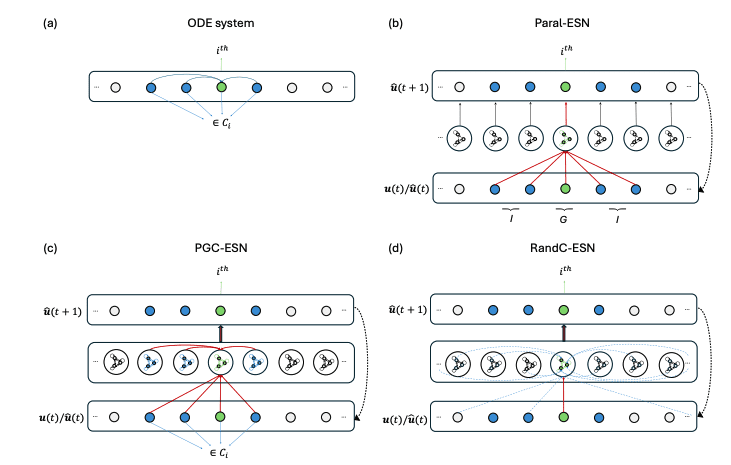
On April 2, 2025, researchers Kuei-Jan Chu, Nozomi Akashi, and Akihiro Yamamoto published Incorporating Coupling Knowledge into Echo State Networks for Learning Spatiotemporally Chaotic Dynamics, detailing a method that enhances the efficiency of Echo State Networks by integrating physical coupling knowledge to improve performance in large-scale chaotic systems.
The study addresses inefficiencies in data-driven methods for large-scale chaotic systems by incorporating spatial coupling structure as an inductive bias. Physics-guided clustered echo state networks (ESNs) leverage ESN efficiency while improving performance. Experiments show the method outperforms standard ESNs on benchmark systems, demonstrating robustness to noise and imperfect prior knowledge. This approach enhances model effectiveness for spatiotemporally chaotic systems.
Predicting chaotic systems has long been a formidable challenge across various scientific disciplines. These systems, characterized by their extreme sensitivity to initial conditions, are notoriously difficult to model and predict accurately. From weather patterns to fluid dynamics, the ability to forecast such systems can have profound implications on our understanding and management of natural phenomena.
Enter Echo State Networks (ESNs), a recurrent neural network designed for time series prediction. ESNs excel in capturing temporal dependencies, making them ideal for modeling complex dynamics. By maintaining a reservoir of neurons that process input data, ESNs can learn and predict patterns from sequential information efficiently.
Despite their strengths, traditional ESNs face limitations when dealing with highly complex systems. They often struggle to capture the intricate coupling between different components of spatiotemporally chaotic systems, such as those described by the Kuramoto-Sivashinsky equation—a model used in various fields, including plasma physics and fluid dynamics.
Recent advancements have introduced a novel approach called PGC-ESN (Projection-based Group Coupling Echo State Network). This method integrates coupling knowledge into ESNs, enabling them to better handle the interdependencies within complex systems. By explicitly modeling how different parts of the system interact, PGC-ESN significantly improves prediction accuracy and stability.
The effectiveness of PGC-ESN is evident in its application to both homogeneous and inhomogeneous versions of the Kuramoto-Sivashinsky equation. Figures 11 and 12 illustrate the predictive results, showing that PGC-ESN outperforms traditional ESNs across various metrics. These visualizations highlight the enhanced ability to capture system dynamics accurately, with improved power spectra and reduced prediction errors.
The success of PGC-ESN opens new avenues for research and application. This method not only advances our computational tools but also enhances our ability to predict and manage chaotic systems. Potential applications span climate modeling, where accurate long-term forecasts are crucial, to neuroscience, where understanding complex brain dynamics is essential.
In conclusion, the integration of coupling knowledge into Echo State Networks represents a significant leap forward in predicting chaotic systems. As we continue to refine these models, the implications for science and technology are vast. Stay tuned as this innovative approach paves the way for more accurate predictions and deeper insights into the complex world around us.
👉 More information
🗞 Incorporating Coupling Knowledge into Echo State Networks for Learning Spatiotemporally Chaotic Dynamics
🧠 DOI: https://doi.org/10.48550/arXiv.2504.01532