

Researchers have uncovered a surprising link between two rapidly advancing fields in theoretical physics: quantum information theory and particle and condensed matter physics. A recent study published in Physical Review Letters reveals that any operation involving non-invertible symmetries, a concept crucial in particle and condensed matter theories, is essentially a quantum operation.
Masaki Okada, a graduate student at the University of Tokyo School of Science, and Yuji Tachikawa, a professor at the Kavli Institute for the Physics and Mathematics of the Universe (Kavli IPMU, WPI), achieved this breakthrough.
Building on an idea proposed by mathematician Marcel Bischoff, the researchers demonstrated that non-invertible symmetries can be understood within the framework of quantum operations, a fundamental concept in quantum computation. This discovery has significant implications for our understanding of quantum information theory and its applications in quantum computing.
Unveiling the Connection between Quantum Information Theory and Particle Physics
Theoretical physicists have made a groundbreaking discovery, establishing a profound link between two rapidly advancing fields in theoretical physics: quantum information theory and non-invertible symmetries in particle and condensed matter theories. A recent study published in Physical Review Letters has proven that any operation of non-invertible symmetries is, in fact, a quantum operation.
Symmetry in Physics
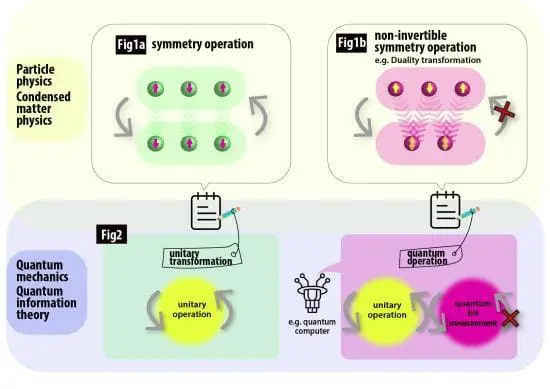
Symmetry plays a crucial role in understanding the properties of a physical theory. It provides an essential clue to the behavior of a system under different transformations. For instance, in a magnetic field, swapping the N-poles with S-poles and vice versa leaves the forces on objects and the energy stored in the magnetic field unchanged, despite the reversal of the magnetic field direction. This is because the equations describing the magnetic field are symmetric with respect to the operation of swapping the N and S poles.
Over the past few years, the concept of symmetries has undergone significant generalization in various directions in theoretical particle physics and condensed matter physics, becoming an active area of research. One such generalization is non-invertible symmetry. Conventional symmetries are always invertible, meaning there exists a reverse operation to undo them. Non-invertible symmetry, on the other hand, allows for certain non-invertibility in these symmetry operations.
Quantum Information Theory
Quantum information theory has been gaining significant attention from physicists in recent years. It forms the foundation of quantum computers, which rely on performing various operations on memories called quantum bits or qubits. Among these operations, any operation that can be undone is formulated by a mathematical operation called a unitary transformation. However, non-invertible operations, where there is no reverse operation, are also essential, such as the measurement of quantum bits. These operations are carried out using a generalized concept of unitary transformation, called a quantum operation.
The Connection between Non-Invertible Symmetries and Quantum Operations
Several years ago, mathematician Marcel Bischoff and his collaborators proposed an idea that the operation of non-invertible symmetries is a quantum operation. However, their idea was described in a framework applicable only to physical systems with specific properties, unfamiliar to most physics communities.
Recently, researchers Masaki Okada and Yuji Tachikawa have successfully proven this idea in a widely used framework in particle physics and condensed matter physics. Their work has provided an answer to the long-standing question of what general property non-invertible symmetry operations possess: any operation of non-invertible symmetries is a quantum operation.
This breakthrough discovery has far-reaching implications for our understanding of the connection between quantum information theory and particle physics. It opens up new avenues for research, enabling physicists to explore the properties of non-invertible symmetries in various physical systems and their potential applications in quantum computing.
Implications and Future Directions
The study’s findings have significant implications for the development of quantum computers and the understanding of complex physical systems. By recognizing that non-invertible symmetry operations are, in fact, quantum operations, researchers can now investigate how these symmetries can be harnessed to improve the performance and stability of quantum computers.
Furthermore, this discovery may lead to a deeper understanding of the fundamental principles governing the behavior of particles and condensed matter systems. As research continues to uncover the intricacies of non-invertible symmetries, it is likely that new insights will emerge, shedding light on the intricate connections between quantum information theory and particle physics.
In conclusion, the connection between quantum information theory and particle physics has been significantly advanced by the recent study, which has proven that any operation of non-invertible symmetries is a quantum operation. This breakthrough discovery is poised to have a profound impact on our understanding of complex physical systems and the development of quantum computing technology.
External Link: Click Here For More


