

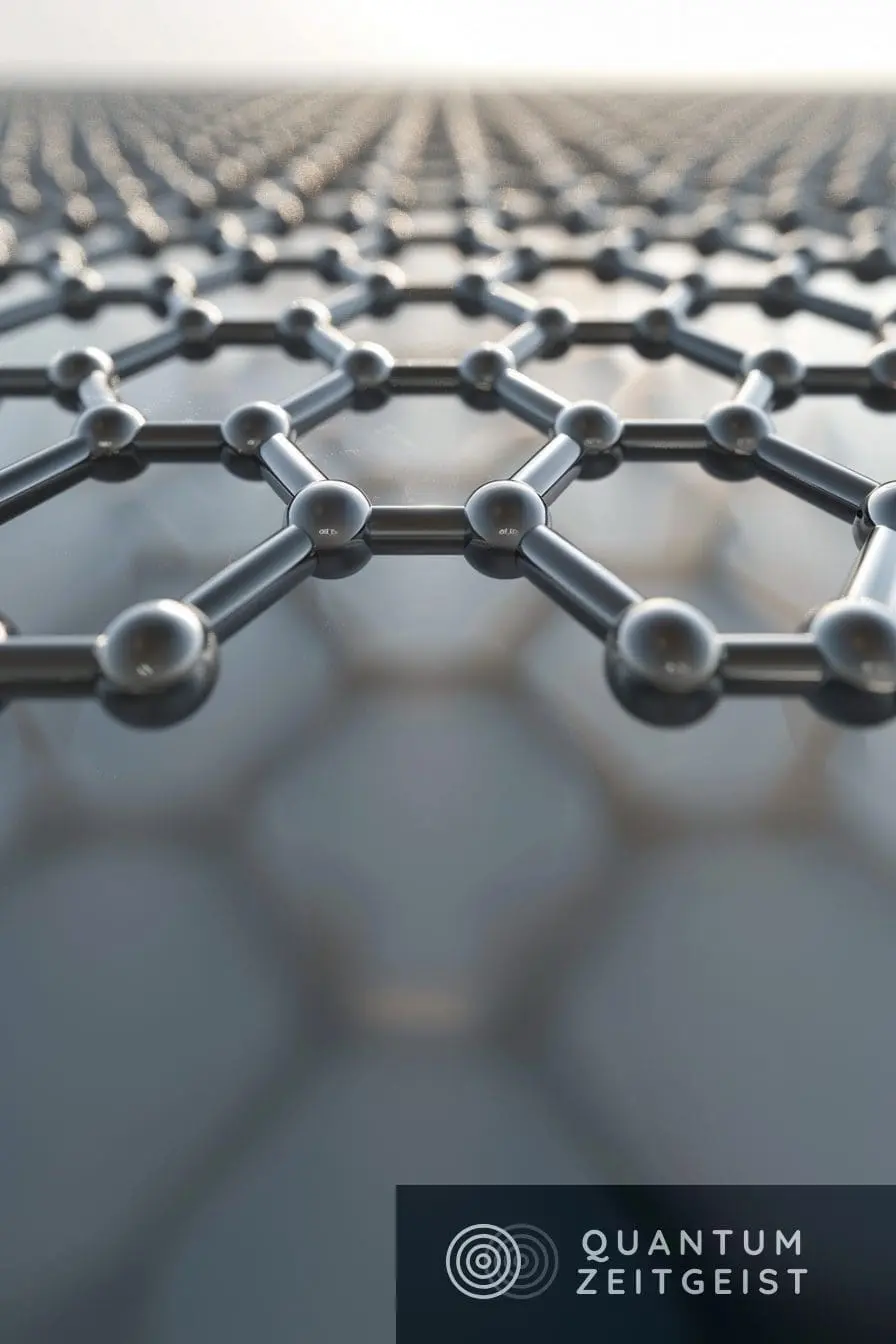
Physicists at the University of Washington and the Massachusetts Institute of Technology (MIT) have observed a phenomenon known as the fractional quantum anomalous Hall effect (FQAHE) in two different materials. The teams found that electrons in these materials acted as if they had fractional charges, which could have implications for quantum computing. The findings, which have yet to be replicated, were presented at the American Physical Society (APS) March Meeting. Theorists are still working to understand the exact mechanism of the FQAHE in these materials.
Discovery of Fractional Quantum Anomalous Hall Effect in Graphene
In May of last year, a group of physicists from the University of Washington in Seattle made an intriguing observation. They noticed that when an electrical current was run across two atom-thin sheets of molybdenum ditelluride (MoTe2), the electrons behaved in a coordinated manner as if they had fractional charges. This was unusual because the electrons exhibited this behavior due to the material’s inherent properties, without any external magnetic field influencing them. The results of this study were published in August.
The Phenomenon of Fractional Quantum Anomalous Hall Effect
The phenomenon observed by the researchers is known as the fractional quantum anomalous Hall effect (FQAHE). This effect was also observed in a completely different material in the same month. A team of researchers led by Long Ju, a condensed-matter physicist at the Massachusetts Institute of Technology (MIT) in Cambridge, noticed the effect when they sandwiched five graphene layers between boron nitride sheets. The results of this study were published in February this year, and physicists are still discussing it.
Theoretical Implications and Practical Applications of FQAHE
The FQAHE might have practical applications in the future. Fractionally charged particles are a key requirement for a certain type of quantum computer. However, the findings are capturing physicists’ imagination because they are fundamentally new discoveries about how electrons behave. The exact mechanism of the FQAHE in the layered graphene is still not fully understood and will require a lot of work from theorists.
The Role of Moiré Materials in FQAHE
The University of Washington team reported the FQAHE for the first time in a specially designed 2D material: two sheets of MoTe2 stacked on top of one another and offset by a twist. This arrangement of MoTe2 is known as a moiré material. The term has been appropriated by physicists to describe the patterns in 2D materials created from atom-thin lattices when they are stacked and then twisted, or staggered atop one another. The slight offset between atoms in different layers of the material shifts the hills and valleys of its electric potential. And it effectively acts like a powerful magnetic field, taking the place of the one needed in the quantum Hall effect and the FQHE.
The Future of FQAHE Research
Theorists are relatively comfortable with the MoTe2 results, for which the FQAHE was partly predicted. However, Ju’s layered graphene moiré was a surprise to the community, and researchers are still struggling to explain how the effect happens. Experimentalists are now trying to replicate the results in graphene and find other materials that behave similarly. The uncertainty surrounding the mechanism of FQAHE in layered graphene moiré is exciting for theorists, as it shows that there are still more mysteries to uncover in the field of quantum Hall effect.
External Link: Click Here For More


