Physicists have made a breakthrough in quantum computing by creating a mechanical qubit, a device that can exist in multiple states simultaneously. This achievement echoes back to the early 20th century when computers employed mechanical switches. The team, led by Yiwen Chu at ETH Zürich, used a sapphire crystal’s vibrations to make a two-way-at-once quantum bit.
They deposited a tiny dome of aluminum nitride on the crystal, which would expand and contract in response to an oscillating voltage, sending vibrations into the material. These vibrations were then coupled with a superconducting qubit equipped with a tiny antenna, allowing the researchers to tune the frequencies to create a single system with unevenly spaced energy states.
This “anharmonicity” enabled the isolation of two lowest energy states as the 0 and 1 states of a qubit. While the fidelity of this mechanical qubit is lower than other qubits, it could potentially serve as a supersensitive probe of forces like gravity. Key individuals involved in the work include Adrian Bachtold and Stephan Dürr, and companies involved are ETH Zürich and the Max Planck Institute for Quantum Optics.
Mechanical Qubits: A New Frontier in Quantum Computing
Quantum computing has taken a significant step forward with the development of a mechanical qubit, a device that can exist in multiple states simultaneously. This breakthrough echoes back to the early 20th century when mechanical switches were used in the first computers. Physicists have successfully created a working qubit from a tiny, moving machine, which could potentially be used to probe the interface between quantum mechanics and gravity.
The Challenge of Creating a Mechanical Qubit
A qubit can be any system that has two quantum states of different energies that can be isolated from all other states. However, creating a mechanical qubit is challenging due to the inherent motion of tiny objects, even at absolute zero temperatures. Additionally, mechanical oscillators have harmonic energy states, making it difficult to isolate and control two specific states.
Overcoming the Challenges
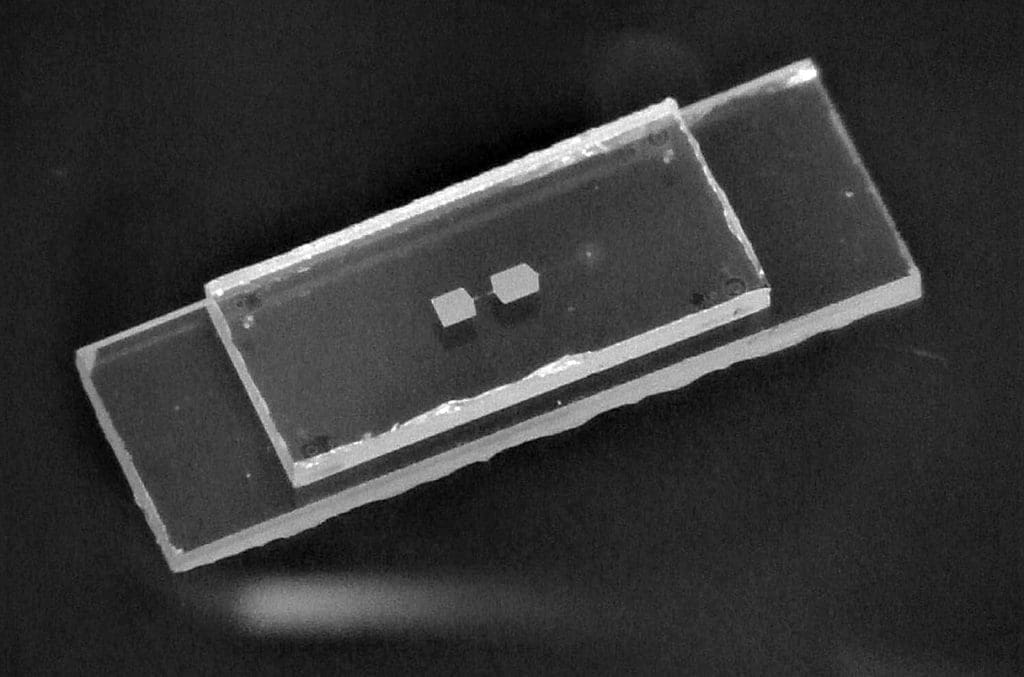
Physicists Yiwen Chu and her team at ETH Zürich have overcome these challenges by employing a two-part system. The first part is a mechanical resonator consisting of a tiny dome of aluminum nitride deposited on a sapphire crystal, which expands and contracts in response to an oscillating voltage, sending vibrations into the material. The second part consists of a superconducting qubit equipped with a tiny antenna, deposited on a similar sapphire crystal. By stacking the crystals, the researchers could tune the superconducting qubit’s oscillating current to be slightly offset from that of the mechanical oscillator, inducing anharmonicity and allowing for the isolation of two specific energy states.
The Mechanical Qubit in Action
Using the superconducting qubit as a controller, the ETHZ team demonstrated that they could achieve any combination of 0 and 1 in the mechanical qubit. Although the fidelity of the mechanical qubit is currently lower than that of more mature qubits, this breakthrough represents an advance in principle.
Potential Applications
The mechanical qubit may serve as a supersensitive probe of forces, such as gravity, that don’t affect other qubits. Researchers hope to take their demonstration further by using two mechanical qubits to perform simple logical operations. If successful, the physical switches of the very first computers will have made a tiny comeback.
The Future of Mechanical Qubits
While the mechanical qubit is unlikely to replace more mature qubits in the near future, it represents an exciting new frontier in quantum computing. As researchers continue to develop and refine this technology, we may see the emergence of new applications that take advantage of the unique properties of mechanical qubits.
External Link: Click Here For More