The creation of complex light states, essential for advances in quantum technologies ranging from computing to sensing, often presents significant challenges. Andrei Aralov from Laboratoire Kastler Brossel, alongside colleagues, now demonstrates a new method for generating these intricate states with precise control and a minimal number of steps. The team establishes a link between manipulating light and the mathematical problem of symmetric tensor decomposition, revealing a surprising ‘photon catalysis’ effect where photons are temporarily injected and retrieved to create entanglement beyond the reach of conventional techniques. This innovative approach, which also introduces a generalized tensor decomposition for designing optimal circuits, achieves perfect fidelity in simulations across various light states, representing a substantial step forward in photonic quantum engineering.
Photonic quantum computing extends beyond computation to applications such as quantum sensing. This work presents a procedure for generating any desired quantum state exactly, and with a controlled number of steps. The method relies solely on multiport interferometers, photon number resolving detectors, photon additions, and displacements. Researchers achieve this goal by establishing a connection between photonic quantum state engineering and the algebraic problem of symmetric tensor decomposition, revealing a mechanism of photon catalysis where photons are injected and subsequently retrieved in measurements to generate entanglement unattainable through conventional means.
Quantum Optics, Tensors, and Machine Learning Tools
This extensive collection of research papers covers a broad range of topics including quantum optics, tensor decomposition, algebraic geometry, and machine learning. The bibliography focuses on continuous-variable quantum computation, exploring techniques to generate and manipulate squeezed states and non-Gaussian states for building quantum computers using light. A central theme is tensor decomposition and algebraic geometry, with a strong emphasis on understanding the mathematical foundations of quantum information. The inclusion of DeepMind’s JAX ecosystem suggests an interest in applying machine learning tools to solve problems in quantum optics and improve computational efficiency.
The bibliography delves into specific areas such as low-rank approximations of tensors, algebraic geometry of tensors, and algorithms for tensor decomposition, alongside mathematical foundations including matrix analysis, projective geometry, and invariant theory. This suggests a desire to build a solid theoretical framework for the research, utilizing JAX for optimization algorithms and numerical linear algebra essential for working with tensors and matrices. This collection of resources points to several exciting research directions, including hybrid quantum-classical algorithms that use machine learning to optimize quantum state preparation and control, and tensor network methods for quantum simulation. Researchers are also exploring the application of algebraic geometry to understand the structure of quantum states and the limitations of quantum computation, developing new methods for generating non-Gaussian states using photon catalysis and designing scalable quantum architectures based on integrated photonics. Finally, it highlights the potential of tensor networks for quantum error correction and developing new algorithms for tensor decomposition with applications to both quantum information and machine learning.
Photon Catalysis Creates Complex Quantum States
Researchers have developed a new method for creating any desired multimode multiphoton state, a crucial resource for advanced quantum technologies like quantum computing and sensing. These complex states, involving multiple photons distributed across multiple modes, are notoriously difficult to produce with precision using standard techniques. This new approach overcomes these limitations by connecting photonic state engineering with a mathematical concept called symmetric tensor decomposition. The team’s method relies on a process akin to photon “catalysis”, where photons are initially injected into a system and then retrieved during measurement, allowing for the creation of entanglement otherwise inaccessible through conventional means.
Importantly, the researchers demonstrate that their method can achieve 100% fidelity in generating these complex states, meaning the created states perfectly match the intended design, across a range of different configurations. This breakthrough addresses a long-standing challenge in the field, as previous methods were limited in the types of states they could produce. The new technique utilizes ancillary modes and photon counting to project the system into the desired state, offering a quantifiable cost and guaranteed fidelity. Furthermore, the researchers have shown that this approach can generate states with any number of photons distributed across the modes, including those with uneven distributions, expanding the possibilities for quantum applications.
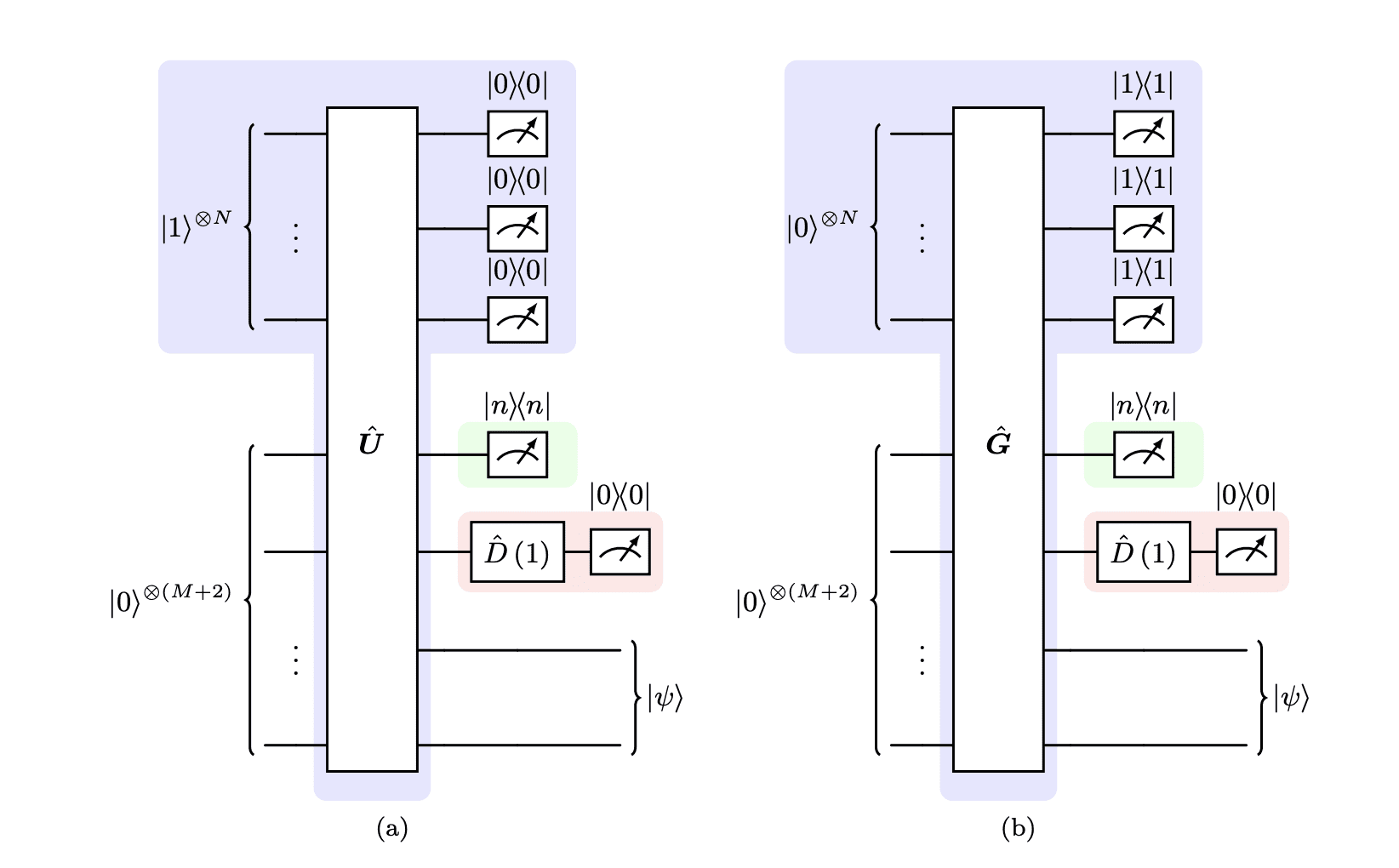
The team has identified two potential implementations of this method, one using a specialized boson sampler and another utilizing a Gaussian boson sampler, both established photonic devices. While the boson sampler requires seeding with a larger number of photons, these are ultimately retrieved, serving the crucial purpose of creating the necessary entanglement. The Gaussian boson sampler implementation involves injecting weakly squeezed states into an interferometer, a technique already used for creating single-mode non-Gaussian states, but now extended to the multimode case. This work provides the first explicit demonstration of a general quantum state-engineering protocol, offering a powerful new tool for researchers developing future quantum technologies.
Multimode States from Interferometers and Detectors
This research presents a new method for creating arbitrary multimode multiphoton states, essential resources for various photonic technologies. The team successfully demonstrated a procedure to generate these states using only multiport interferometers, photon additions, photon subtractions, and photon number resolving detectors, establishing a link between photonic state engineering and symmetric tensor decomposition. Numerical evaluations confirm the method achieves 100% fidelity for different classes of states, suggesting it provides a bound on the resources needed for state preparation. While not optimal for all specific state types, and with computational limitations for very large states, the generality of this approach offers a valuable tool for quantum optical experiments. The authors acknowledge that determining the minimal number of “catalysis” photons required for state preparation and extending the method to mixed states represent areas for future investigation, alongside exploring refinements to achieve higher success probabilities and generalizing the core theorem to incorporate unitary transformations, potentially leading to more feasible designs for continuous-variable quantum information processing. This research highlights a connection between the decomposition rank and entanglement properties, opening avenues for further theoretical exploration.
👉 More information
🗞 Photon catalysis for general multimode multi-photon quantum state preparation
🧠 DOI: https://doi.org/10.48550/arXiv.2507.19397