

This comprehensive review examines emerging photonic hardware technologies poised to address the escalating computational demands of large language models (LLMs). As training models like GPT-3 consumes approximately 1,300 MWh of electricity and future models may require gigawatt-scale power budgets, researchers are exploring alternatives to conventional von Neumann architectures and silicon-based computing.
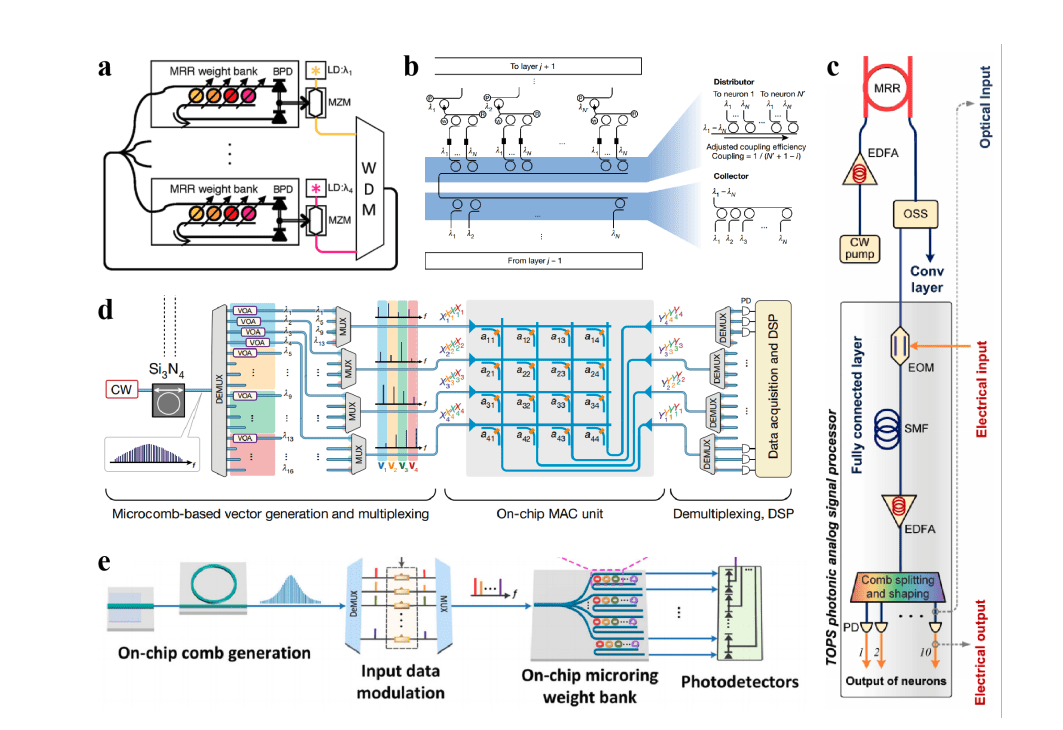
The review highlights several photonic components that enable neural network computations. Microring resonators (MRRs) leverage resonance effects for wavelength multiplexing and optical frequency comb generation, providing foundation for multi-wavelength signal processing. Mach-Zehnder Interferometer (MZI) arrays perform optical matrix-vector multiplication through phase modulation, enabling core linear transformations in neural networks via cascaded 2D unitary transformations. Metasurfaces manipulate the phase and amplitude of light waves via subwavelength structures, executing parallel optical computations in the diffraction domain through either multilayer diffractive architectures or 1D high-contrast transmit arrays. Specialized lasers including Vertical-Cavity Surface-Emitting Lasers (VCSELs) and Distributed Feedback lasers with saturable absorbers (DFB-SA) can implement spike-based computing with sub-nanosecond response times.
Integrating two-dimensional materials (graphene and transition metal dichalcogenides) offers significant advantages for photonic chips. Graphene absorbs approximately 2.3% of incident light across a wide spectral range despite its single-atom thickness, making it highly effective for optical modulation, while its ultrafast carrier mobility allows for high-speed modulation and low-power operation. TMDCs (like MoS₂ and WS₂) complement graphene with tunable bandgaps and strong excitonic effects, making them ideal for applications in photodetectors and waveguides. These materials can be integrated into silicon photonics platforms through various techniques including transfer printing, hybrid integration, and van der Waals heterostructures, enabling applications such as high-speed optical modulators, broadband photodetectors, and low-loss waveguides.
The review also discusses how spintronic devices can
The review also discusses how spintronic devices can complement photonic components through nonvolatile memory with ultrafast dynamics (>1 GHz) and near-unlimited endurance (10¹⁵ cycles), stochastic behavior that mirrors probabilistic neural firing mechanisms, and multistate magnetization that provides analog memristive behavior for synaptic weight modulation. Magnetic tunnel junctions (MTJs), spin-orbit torque devices, and magnetic skyrmions are highlighted as promising spintronic technologies that could support photonic neural networks by providing compact weight storage and neuromorphic computing capabilities.
The paper analyzes how transformer-based LLMs (including ChatGPT, LLaMA, and DeepSeek) could be implemented on photonic hardware. Key architectural elements include self-attention mechanisms that allow dynamic modeling of long-range dependencies, chain-of-thought reasoning that enables step-by-step problem solving, and long-context window processing for maintaining conversation history. The primary challenge is mapping these complex operations to photonic hardware given the data-dependent nature of transformer attention weights.
Spiking Neural Networks (SNNs) are presented as a bridging technology between traditional neural networks and photonic computing. They use discrete spikes for information transmission, similar to biological neurons. Various spike encoding schemes (rate coding, temporal coding, and specialized encodings for different sensory modalities) can be implemented. SNNs can achieve substantial energy efficiency by processing information only when spikes occur.
The review identifies several critical challenges for photonic LLM implementations. Memory issues with long context windows and token sequences present a problem, as photonic accelerators generally lack large on-chip memory to buffer thousands of tokens. Storage bottlenecks for mega-sized datasets exist because photonic systems still depend on high-bandwidth external memory. Precision and conversion overhead from translating between analog optical signals and digital representations remains a challenge. The lack of native nonlinear functions is an obstacle, as photonic hardware excels at linear operations but has traditionally struggled with implementing activation functions.
Future research directions include developing photonic attention architectures,
Future research directions include developing photonic attention architectures, neuromorphic and spiking photonic LLMs, and system integration with co-design across hardware and software layers. The authors conclude that photonic computing systems could potentially surpass electronic processors by orders of magnitude in throughput and energy efficiency, but require breakthroughs in memory technologies and integration approaches to fully realize their potential for next-generation AI hardware.
🗞 What Is Next for LLMs? Next-Generation AI Computing Hardware Using Photonic Chips
🧠 DOI: https://doi.org/10.48550/arXiv.2505.05794


