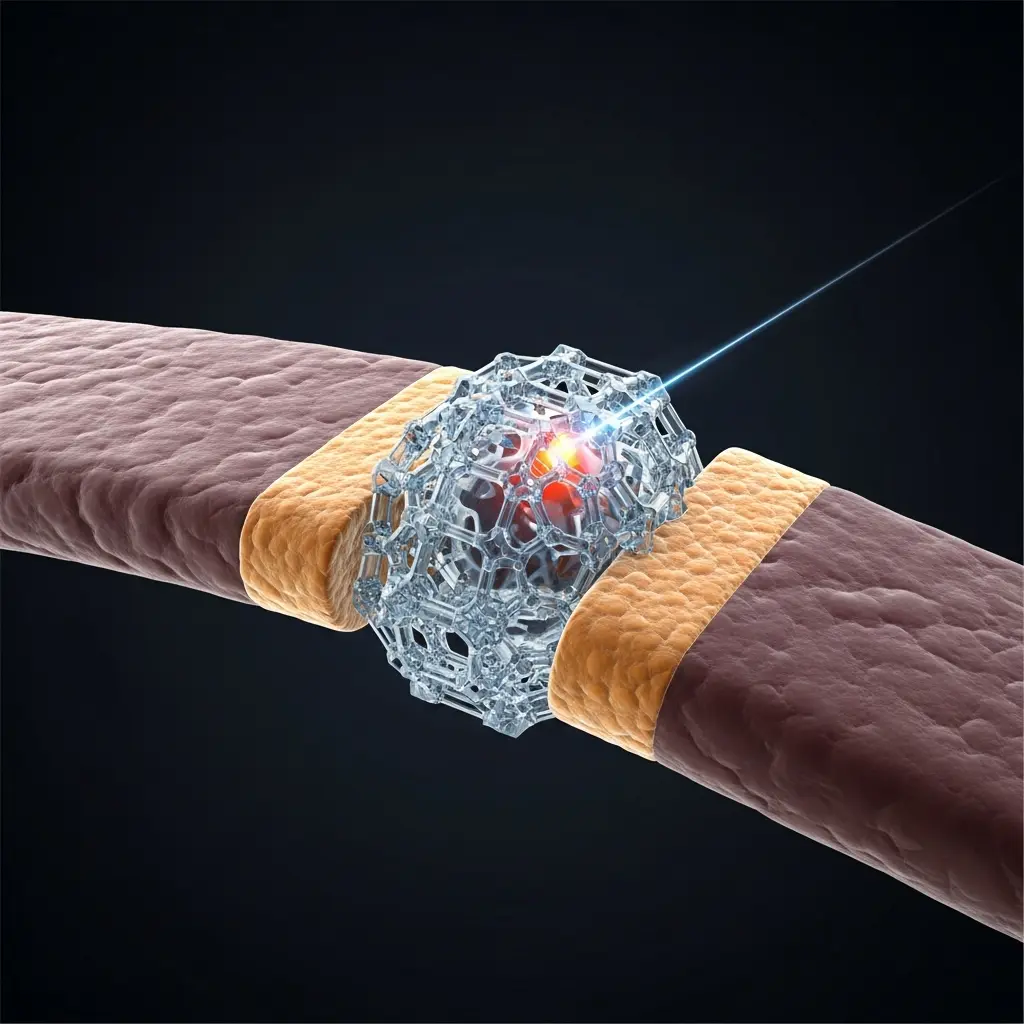
Photonic crystals offer remarkable control over light, revolutionising optics and physics and driving both fundamental research and technological advancements! Catriona A. Thomson, Andreas Stühler, Nachiket Pathak, et al., from the Humboldt Centre for Nano- and Biophotonics, University of Cologne, have now addressed a key limitation , the size and substrate dependence , by developing minimal-footprint photonic crystal nanolasers suitable for biointegration! Their research details the fabrication of substrate-less hexagonal laser particles with an active area of just 30 μm², demonstrating massively parallel fabrication and successful integration into live cells! This breakthrough, achieving mode volumes as small as tens of attolitres, promises to enable label-free sensing of nanoscale intracellular processes and establish a versatile platform for chemical and biological applications , representing a significant step towards truly integrated optical biosensors.
Researchers began by optimising the design of a 2D photonic crystal array to identify the minimal size required for lasing, starting with a silicon slab configuration achieving a simulated quality factor of 5 million! Through a grid-search method involving three iterations of simulations, they tweaked hole positions to adapt the design to a 240nm thick InGaAsP slab with a desired resonant wavelength.
To determine the impact of lattice truncation, the study pioneered on-chip cavities with varying numbers of holes , between 3 and 19 , adjacent to the defect zone, defining array diameters from approximately 5μm to 18μm! Fabrication commenced with sputtering a 100nm hard mask of SiO2 onto an InP cladding layer, followed by spin-coating 230nm of PMMA electron beam resist. Optimized photonic crystal arrays, featuring a lattice spacing of 440nm and a hole size of 0.32a, were then defined in the resist via e-beam lithography, before undergoing inductively-coupled plasma reactive-ion etching (ICP RIE) using CHF3 and Cl2 chemistries. Crucially, the team engineered supportive struts surrounding each hexagonal device to create an air-bridge cavity, enhancing performance.
Suspended photonic crystal cavities were produced by etching the InP substrate with diluted hydrochloric acid, and optical characterisation was performed in phosphate buffered saline (PBS) solution, mimicking the aqueous environment of intended biological applications. A 1064nm pulsed laser pump (5ns, 2MHz) was focused onto the centre of each device using a 100x NIR objective on an inverted microscope. The emitted light was collected through the same objective and analysed using a spectrometer coupled to a cooled NIR InGaAs camera, achieving a spectral resolution of approximately 120pm. Experiments employ devices with four or more adjacent hole pairs, demonstrating clear lasing thresholds between 15-35 pJ, accompanied by linewidth-narrowing.
Notably, a 7μm cavity exhibited the highest quality factor, exceeding 12,500, while intermediate array sizes yielded the highest emission intensities and lowest thresholds. The study also analysed a design with a single shifted hole, further optimising the array for lower thresholds, higher quality factor, and increased brightness. Following successful miniaturisation, researchers detached the nanolasers from the wafer via brief ultrasonication in PBS, enabling biointegration.
Substrate-less PhC Nanolasers for Intracellular Applications
Scientists have achieved a breakthrough in miniaturising photonic crystal (PhC) nanolasers, fabricating substrate-less hexagonal laser particles with an active area as small as 30 μm²! The team successfully demonstrated massively parallel fabrication, robust detachment, and integration of these nanolasers into live cells, opening new avenues for intracellular imaging and sensing. Experiments revealed that a 7μm cavity size yielded a quality factor over 12,500, while nanolasers with intermediate array sizes exhibited the highest emission intensities and lowest lasing thresholds; lasing disappeared completely at an array size of 4μm. Further optimisation, involving a single hole shift on an intermediate-sized array, resulted in an optimised design with a lower threshold, higher quality factor, and increased brightness.
Researchers determined that a photonic crystal cavity truncated to five or six holes on either side of the defect remained viable for standalone nanolaser particle operation without significant performance loss. Hexagonal particles with a 7μm diameter were produced, incorporating a complete hexagonal trench for structural support during detachment from the InP wafer. Following hydrochloric acid etching and ultrasonication in phosphate-buffered saline (PBS), complete detachment of particles into solution was achieved, allowing for incubation with NIH3T3 cells for 24 hours to facilitate internalization. Time-lapse observation confirmed migration of nanolasers within cells, with the specimen remaining viable for several days.
Intracellular nanolaser performance, interrogated using the same optical setup as on-chip devices, demonstrated thresholds of 15-30 pJ and quality factors up to 13,000, approaching the resolution limit of the spectrometer. Sustained pumping above the lasing threshold showed no signs of cell toxicity, consistent with previous intracellular laser platforms. Measurements confirm that the average quality factor achieved in-cell with optimised nanolasers was 1.8× that of the regular design. To further enhance performance, scientists trialled a ‘twisted cavity’ design, a superposition of two regular lattices with a slight tilt angle, which exhibited a quality factor over 6,000 and an improved lasing threshold compared to the L3 devices.
Simulations comparing the twisted cavity, optimised L3, and whispering gallery mode (WGM) nanodisks revealed significant differences in mode volume. Calculations demonstrated that the new designs achieve mode volumes on the order of tens of attolitres, an order of magnitude smaller than comparable WGM probes! This high light localization is comparable in scale to different organelles of eukaryotic cells, promising label-free sensing of nanoscale intracellular processes and a miniature platform for chemical and biological applications.
Cellular integration of nanoscale photonic crystal lasers
Scientists have developed miniaturised photonic crystal (PhC) arrays suitable for integration into single biological cells! These researchers identified the minimal size of a 2D photonic crystal array , reaching a surface area as small as 30 μm² , needed to achieve lasing, overcoming limitations associated with larger, substrate-bound structures. The fabrication of substrate-less hexagonal laser particles was successfully demonstrated, alongside their robust detachment and integration into live cells! This achievement enables the creation of near-infrared (NIR-II) probes with exceptionally small mode volumes, on the order of tens of attolitres, comparable to the scale of cellular organelles.
Crucially, the team observed that the twisted cavity design exhibited a refractive index sensitivity six times greater than whispering gallery mode (WGM) cavities, despite its significantly smaller mode volume. The lasing signal from within live cells remained largely unaffected by the cellular environment, and the cells themselves showed no visible impact from the lasing action! The authors acknowledge limitations in the current design, but suggest future work could incorporate chemical or plasmonic functionalisation to facilitate label-free sensing of nanoscale intracellular processes. Further research may also explore the myriad structural parameters available to optimise the minimal-footprint PhC nanolaser particle for diverse applications in chemical and biological sensing.
👉 More information
🗞 Minimal-footprint photonic crystal nanolasers for biointegration
🧠 ArXiv: https://arxiv.org/abs/2601.12561