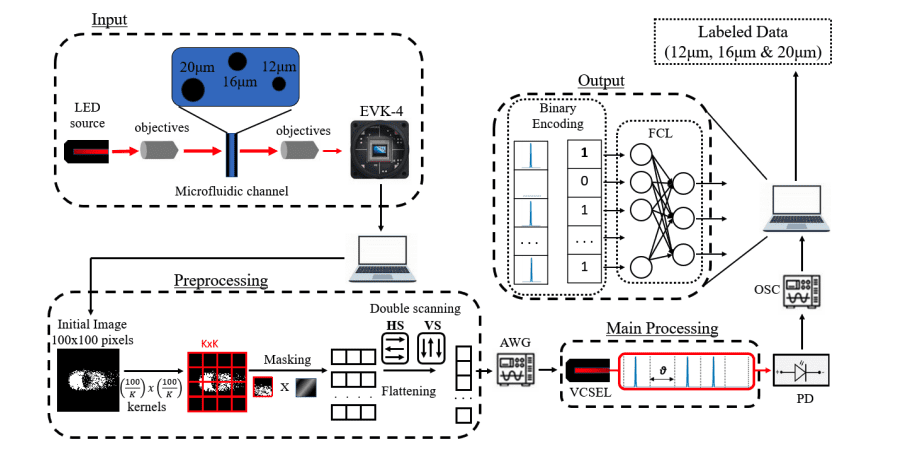
Using a time-delayed photonic extreme learning machine and an event-based camera, a novel optical system classifies polymethyl methacrylate particles with 95.8% accuracy. Encoding images into a 1-bit spike stream reduces memory usage by 98.4–99.5% and hardware requirements by 50–84%, enabling low-power applications.
The efficient analysis of particle flow is critical across diverse fields, from medical diagnostics to industrial process control. Researchers are increasingly focused on developing systems that can perform this analysis with reduced computational demand and energy consumption. A new approach, detailed in ‘A VCSEL based Photonic Neuromorphic Processor for Event-Based Imaging Flow Cytometry Applications’, utilises the principles of neuromorphic computing and event-based vision to achieve high accuracy with minimal resource utilisation. M. Skontranis (University of the Aegean) and G. Moustakas, A. Bogris, and C. Mesaritakis (University of West Attica) demonstrate a system integrating a vertical-cavity surface-emitting laser (VCSEL)-based processor with an event camera to classify polymethyl methacrylate particles travelling at varying speeds, achieving 95.8% accuracy while substantially reducing both memory and hardware requirements.
Optical System Achieves High-Accuracy Particle Classification with Reduced Computational Load
A novel optical system utilising silicon photonics demonstrates accurate, real-time classification of particles in motion, while significantly reducing computational demands compared to conventional image processing. The system, detailed in recent research, integrates a vertical-cavity surface-emitting laser (VCSEL) – a type of semiconductor laser – with an event-based camera to achieve high-speed particle characterisation, with potential applications in fields such as flow cytometry.
Researchers successfully classified polymethyl methacrylate (PMMA) particles, varying in diameter and travelling at speeds between 0.01 and 0.1 m/s, with an accuracy of 95.8%. This performance highlights the potential of photonic implementations for particle analysis, where rapid and precise identification is crucial.
The system’s core employs a time-delayed extreme learning machine, driven by the VCSEL, to process the visual information captured by the event-based camera. Traditional cameras capture entire frames, generating substantial data volumes. In contrast, event-based cameras only transmit changes in pixel intensity – effectively reporting when and where brightness changes occur. This drastically reduces data throughput and power consumption, facilitating efficient processing. This approach mirrors sparse coding observed in biological neural systems, where information is represented using a minimal number of active neurons.
Researchers encoded the original 2D images into a 1-bit spike stream, limiting the maximum number of spikes to 96. This resulted in a 98.4–99.9% reduction in data transmission compared to conventional frame-based imaging.
The system’s performance is further enhanced by utilising time-delayed interference, enabling the creation of complex optical circuits with high precision and efficiency. This allows for sophisticated signal processing directly within the optical domain.
Integrating sensing and processing within a single optical framework streamlines the system’s architecture and reduces communication overhead. Combining these functions on a single chip eliminates the need for data transfer between separate components, reducing both latency and power consumption.
The resulting low power consumption and compact size make the system suitable for deployment in resource-constrained environments, such as remote environmental monitoring stations and agricultural sensors. The architecture leverages the principles of sparse coding, inspired by the human visual system, enhancing efficiency and robustness.
This work demonstrates the potential of silicon photonics to advance image processing and enable a new generation of intelligent systems, offering advantages in speed, efficiency and versatility. Silicon photonics is expected to play a key role in future technologies, enabling applications in communications, sensing and computing.
👉 More information
🗞 A VCSEL based Photonic Neuromorphic Processor for Event-Based Imaging Flow Cytometry Applications
🧠 DOI: https://doi.org/10.48550/arXiv.2505.12026