
The increasing demand for efficient communication technologies drives the need for detectors capable of precisely measuring light at standard telecom wavelengths. Silvia Cassina, Alex Pozzoli, and colleagues at the Como Lake Institute of Photonics, in collaboration with Guglielmo Vesco and Marco Marangoni from Politecnico di Milano, have developed a novel detector that not only operates at these wavelengths but also counts the individual photons within a light signal. This photon-number-resolving capability, achieved through a combination of readily available detectors and nonlinear optical processes, promises to improve communication protocols and unlock new possibilities in quantum communication. The team successfully demonstrated the detector’s performance by characterizing a weak laser source, paving the way for its implementation in more sophisticated communication schemes and potentially enhancing the security and efficiency of data transmission.
The field of quantum communication demands versatile detection solutions, particularly when dealing with very faint light signals. This research presents a new receiver that combines low-cost photon-number-resolving detectors with nonlinear optical techniques to achieve sensitivity at telecommunication wavelengths, around 1550 nanometers. This innovation addresses a key limitation in current technologies, which often struggle with efficient detection at these wavelengths and require complex cooling systems.
SiPMs for Weak Coherent State Detection
Researchers aimed to develop and demonstrate a hybrid quantum receiver using silicon photomultipliers (SiPMs) for secure quantum key distribution (QKD) and other quantum communication protocols. The team investigated how well SiPMs detect weak coherent states and resolve the number of photons, striving for a practical and efficient quantum receiver. They also explored using SiPMs to characterise sources of non-classical light, which exhibit properties not found in everyday light. Quantum key distribution relies on the principles of quantum mechanics to guarantee secure communication. Silicon photomultipliers are solid-state detectors offering high gain, low noise, and a wide detection range, making them ideal for quantum optics.
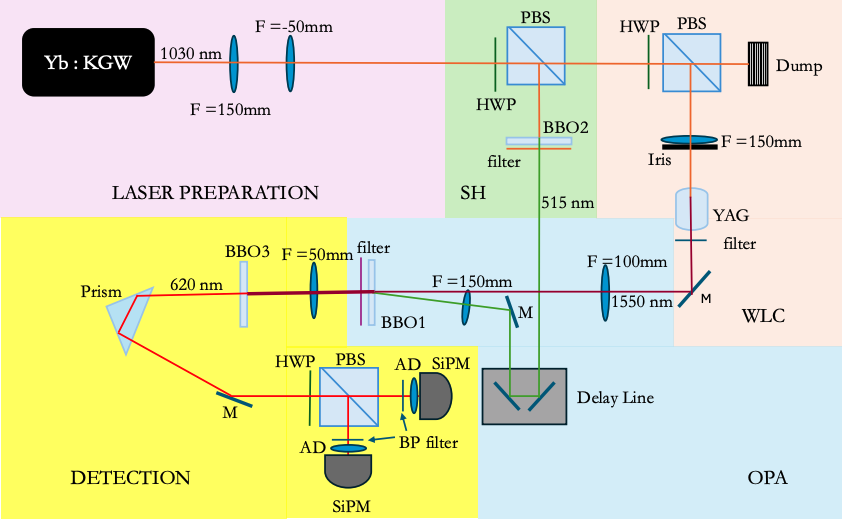
Weak coherent states are crucial for many QKD protocols, and accurately detecting them is essential for secure communication. Photon-number-resolving detectors can measure the number of photons in a quantum state, offering advantages for certain QKD protocols. Twin beams are non-classical light sources with reduced noise, potentially improving receiver performance. The experimental setup involved a femtosecond laser system generating ultrafast pulses, nonlinear crystals for frequency conversion and supercontinuum light generation, an optical parametric amplifier for tunable mid-infrared pulses, and a SiPM-based receiver.
This receiver served as the core of the experiment, detecting weak coherent states and characterising quantum light sources. A twin-beam source calibrated the SiPM, optimising its performance. A data acquisition and analysis system recorded and analysed the detector signals. The methodology involved characterising the SiPM’s gain, noise, and timing resolution, calibrating it using twin beams, detecting weak coherent states used in QKD, and characterising non-classical light sources. The researchers demonstrated that SiPMs achieve high gain, low noise, and a wide detection range, making them suitable for quantum optics.
They showed that twin beams accurately calibrate SiPMs and determine their detection efficiency. SiPMs effectively detect weak coherent states used in QKD, achieving high detection efficiency and low error rates. The team successfully characterised the correlations and statistical properties of non-classical light sources using the SiPM. The hybrid quantum receiver based on SiPMs showed promising performance in terms of detection efficiency, error rate, and security. They also demonstrated efficient generation of broadband supercontinuum light and tunable mid-infrared pulses.
This research contributes to the development of practical and cost-effective QKD systems based on SiPMs. The hybrid quantum receiver offers improved performance in terms of detection efficiency, error rate, and security. The research advances quantum optics by demonstrating the capabilities of SiPMs for characterising non-classical light sources. The techniques and results can be applied to other quantum communication protocols and quantum information processing tasks. The development of efficient supercontinuum and mid-infrared pulse sources opens up new possibilities for spectroscopy, imaging, and sensing.
In conclusion, this research demonstrates that SiPMs are a viable and promising technology for building practical quantum receivers. Twin beams are a valuable tool for calibrating and optimising SiPM performance. Hybrid quantum receivers based on SiPMs can achieve high performance in terms of detection efficiency, error rate, and security. This research contributes to the advancement of quantum communication and quantum information processing.
Telecom Signals Detected with Novel Receiver
Researchers have developed a new receiver capable of detecting faint light signals at crucial telecommunication wavelengths, around 1550 nanometers. This addresses a significant limitation in current quantum communication technologies, which often struggle with efficient detection at these wavelengths. The team’s approach combines readily available, low-cost detectors with nonlinear optical techniques to extend their sensitivity into the telecom range, offering a potentially more practical and affordable solution. The core of this innovation lies in a method to convert light at 1550 nanometers into light at 620 nanometers, a wavelength more easily detected by standard silicon photomultipliers.
This conversion is achieved through a cascade of nonlinear optical interactions, starting with a laser source and culminating in a detectable signal. By carefully tailoring the light source and utilizing specialized crystals, the researchers successfully amplified a weak signal generated via a white light continuum, demonstrating the feasibility of this approach. Importantly, the receiver exhibits photon-number-resolving capability, meaning it can not only detect the presence of light but also determine the number of photons present in a signal. This is a critical feature for advanced quantum communication protocols, enabling enhanced security and improved data transmission rates.
The team demonstrated that the detected light follows a Poissonian distribution, a statistical characteristic indicating the source’s suitability for quantum applications. The performance of this new receiver represents a significant step forward, offering a compact and potentially low-power alternative to existing technologies. While current detectors often require cryogenic cooling, this system operates at room temperature, simplifying operation and reducing costs. The researchers envision this technology enabling new quantum communication schemes, including more sophisticated receivers and potentially enhancing the capacity and security of future communication networks.
This work paves the way for more accessible and practical quantum communication technologies, bringing secure communication closer to widespread implementation. This work demonstrates a receiver combining low-cost photon-number-resolving detectors with nonlinear optical interactions, successfully achieving sensitivity at telecommunication wavelengths. Results, including autocorrelation and cross-correlation functions, align with theoretical expectations, validating the detector’s performance and opening possibilities for more complex optical schemes.
👉 More information
🗞 Sum-frequency-based photon-number-resolving detector for telecom wavelengths
🧠 ArXiv: https://arxiv.org/abs/2508.02203