

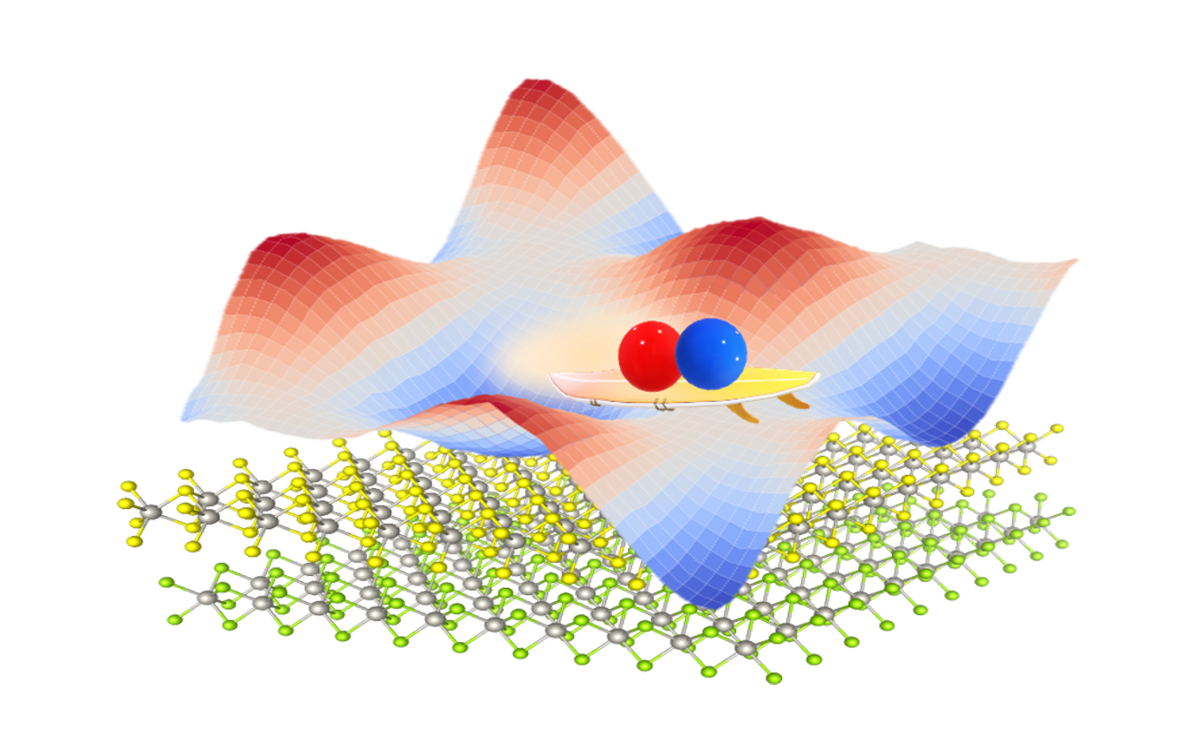
Researchers at Berkeley Lab discovered that phasons enable interlayer excitons to move within moir potentials in stacked transition metal dichalcogenides (TMDs), even at low temperatures. This contributes to materials science and potentially enhances the stability of quantum technologies by reducing decoherence.
Phason quasiparticles are low-temperature quantum excitations in crystal lattices that enable interlayer excitons to move at extremely cold temperatures. These quasiparticles act as a medium, allowing excitons—bound electron-hole pairs across layers—to migrate within moiré potentials formed by twisted bilayer graphene and similar systems.
Observations reveal that even as temperatures approach absolute zero, the motion of these excitons does not entirely cease but persists at a minimal level. This suggests that phasons facilitate this movement by transferring momentum or energy, enabling exciton mobility without violating physical constraints.
Moiré Patterns and Electronic Behavior
Moiré patterns emerge when two semiconductor layers are stacked with a slight twist relative to each other, creating a periodic potential across the interface. This structural arrangement significantly influences electronic properties, leading to unique behaviors such as enhanced interactions between electrons and holes, which can result in interlayer exciton formation. The interaction between moiré patterns and electronic behavior is essential for understanding exciton dynamics at low temperatures.
Future research directions include exploring potential superconductivity in twisted bilayer graphene linked to phasons and seeking methods to directly image these quasiparticles. Such studies aim to deepen our understanding of quantum systems and their applications, potentially leading to advancements in materials science and electronics.
Phason quasiparticles are low-temperature quantum excitations in crystal lattices that enable interlayer excitons to move at extremely cold temperatures. These quasiparticles act as a medium, allowing excitons—bound electron-hole pairs across layers—to migrate within moiré potentials formed by twisted bilayer graphene and similar systems. Observations show that even as temperatures approach absolute zero, the motion of these excitons does not entirely cease but persists at a minimal level. This suggests that phasons facilitate this movement by transferring momentum or energy, enabling exciton mobility without violating physical constraints.
Moiré patterns arise when two semiconductor layers are stacked with a slight twist relative to each other, creating a periodic potential across the interface. This structural arrangement significantly influences electronic properties, leading to unique behaviours such as enhanced interactions between electrons and holes, which can result in interlayer exciton formation. The interaction between moiré patterns and electronic behaviour is essential for understanding exciton dynamics at low temperatures.
Future research directions include exploring potential superconductivity in twisted bilayer graphene linked to phasons and seeking methods to directly image these quasiparticles. Such studies aim to deepen our understanding of quantum systems and their applications, potentially leading to advancements in materials science and electronics.
More information
External Link: Click Here For More


