Quantum key distribution promises secure communication, but practical implementations face challenges in generating and distributing quantum states. Roman Shakhovoy from QRate Moscow and colleagues present a new method for preparing these states, relying on precise measurement of phase differences between pulses from a laser. This approach offers a potentially simpler and more effective way to establish secure keys, as it avoids complex active state preparation techniques. The research demonstrates a passive method for encoding quantum information, which could significantly advance the development of practical and robust quantum communication systems.
Proposed method. Keywords, optical injection locking, quantum key distribution, passive state preparation. An important challenge in the field of quantum key distribution (QKD) today is the creation of low-cost, compact devices for metropolitan area QKD networks. One of the solutions in this direction is a passive transmitter, where quantum states are prepared without modulators and where randomized light sources (lasers in a gain switching mode or even thermal sources) are generally used as an entropy source. Such transmitters have a number of advantages; first, they potentially simplify the schematic, which reduces the cost of the transmitter. In addition, the absence
Passive Quantum State Preparation via Lasers
This research details a new method for preparing quantum states for use in quantum key distribution (QKD) networks, particularly those designed for urban environments. The core idea is to generate random quantum states without actively modulating the light, aiming to reduce the complexity and cost of QKD systems. This approach utilizes optically linked lasers and inherent randomness to create the necessary quantum states. The system employs a master laser and a slave laser that are coupled together. The master laser generates a regular sequence of pulses, which are then filtered to create a random sequence of pulses in the slave laser.
This passive state preparation avoids the need for complex and expensive active modulation components, potentially lowering the overall cost of QKD systems. The simplified design makes the system more suitable for deployment in dense urban environments where cost and size are critical factors. The inherent randomness of the system enhances the security of the QKD protocol, offering a viable alternative to traditional QKD systems that rely on active state preparation. The system is adaptable for both phase and amplitude-phase modulation schemes. Challenges remain in integrating and miniaturizing the optical components, minimizing phase noise and jitter, and ensuring precise synchronization between the lasers. A thorough security analysis is also needed to assess the system’s resilience against potential attacks. This research presents a promising approach to developing more practical and cost-effective QKD systems for urban environments, highlighting the importance of leveraging the inherent randomness of semiconductor lasers and optical filtering to create secure communication systems.
Passive State Preparation for Quantum Key Distribution
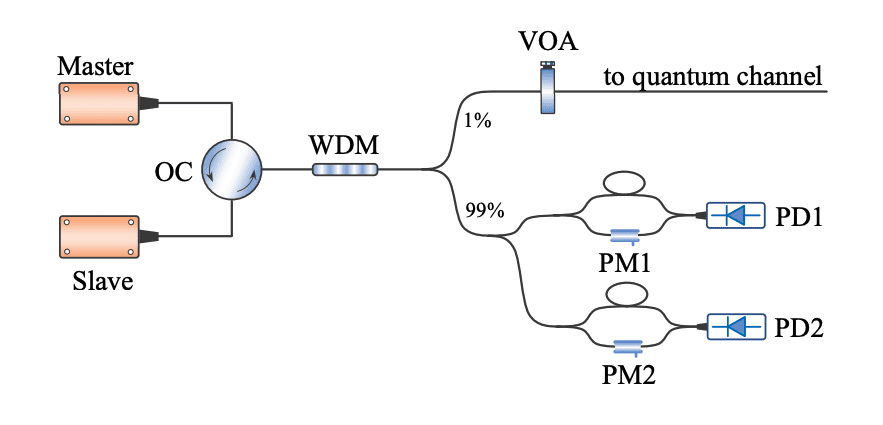
Researchers have developed a novel method for preparing quantum states for secure communication, specifically quantum key distribution (QKD). This approach focuses on simplifying the transmitter component, potentially leading to lower costs and more compact devices suitable for widespread metropolitan area networks. The innovation lies in a “passive” preparation technique, meaning quantum states are created without the need for complex and expensive active modulators, relying instead on the natural randomness of laser light. The system utilizes two lasers working in a coordinated manner, connected by an optical circulator.
One laser acts as a “master” while the other functions as a “slave”, with the slave laser emitting pulses at a higher rate. By carefully controlling the timing and wavelengths of the lasers, the system selectively filters pulses, creating pairs that represent quantum information. The key to this process is that only certain pulses from the slave laser pass through a filter, and these are the ones emitted when the master laser is not actively emitting, establishing a correlation between the pulses. This method inherently avoids potential security vulnerabilities associated with active modulators, such as those exploited in “Trojan horse” attacks.
The information encoded in the quantum states is contained within the phase difference between the paired pulses. To determine these phase differences, the transmitter measures the interference patterns created by the pulses, effectively characterizing the quantum state before sending it through a communication channel. Simulations demonstrate the effectiveness of this passive state preparation method, offering a potentially simpler and more secure way to generate the quantum signals needed for QKD. This approach could significantly reduce the complexity and cost of QKD systems, paving the way for more widespread adoption of this secure communication technology. The research demonstrates that the slave laser’s pulse repetition period is three times less than that of the master laser, resulting in phase locking for one third of the slave laser pulses. The frequency of quantum state preparation is calculated as 1/(3ΔT), where ΔT represents the time delay between pulses in a pair.
Passive Phase Encoding with Time Slots
This research presents a new method for preparing quantum states passively, intended for use in key distribution systems that employ phase encoding. The approach utilizes the measurement of phase differences between pulses generated by gain-switched lasers, and importantly, employs optically coupled lasers to create defined “empty” time slots within the pulse sequence. Simulations demonstrate the effectiveness of this technique in maintaining pulse shape and avoiding distortions that could compromise the accuracy of phase measurements, a common challenge in similar systems. The authors acknowledge that removing the intentional time delay between pulses, while potentially increasing the rate of state preparation, introduces vulnerabilities to attack and complicates signal normalization. They also note that maintaining a bias current above the threshold to improve pulse shape would undermine the randomization of pulse phases, a critical security feature. Future work could investigate the specific vulnerabilities introduced by removing the time delay and explore methods to mitigate potential attacks, as well as further refine the optical coupling and filtering techniques to optimise pulse fidelity and system performance.
👉 More information
🗞 Passive state preparation for quantum key distribution with phase encoding
🧠 ArXiv: https://arxiv.org/abs/2507.21659