

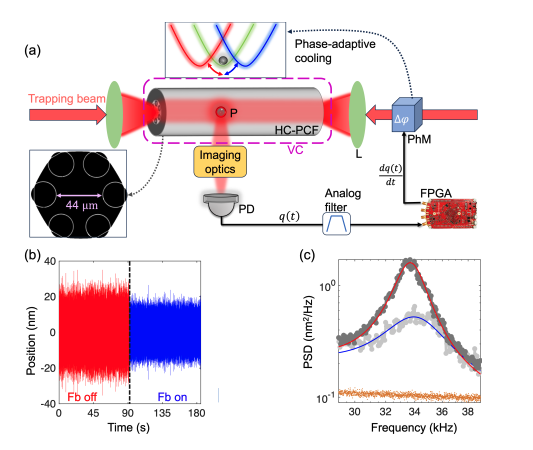
Controlling the motion of microscopic particles opens exciting possibilities for fundamental physics and precision sensing, and researchers are now demonstrating a new technique to cool these particles to incredibly low temperatures. Soumya Chakraborty, from Friedrich-Alexander-Universität Erlangen-Nürnberg and the Max Planck Institute for the Science of Light, along with Gordon K. L. Wong and Pardeep Kumar, lead a team that has developed a method for cooling silica nanoparticles while they are suspended within a hollow-core photonic crystal fiber. Unlike existing techniques that rely on laser intensity or electrical forces, this approach modulates the light itself to create a cooling effect, even working with particles that have no electrical charge. The team achieves temperatures as low as 58 Kelvin for a 195 nanometer particle, and this advance promises a versatile, fiber-integrated platform for manipulating microscopic objects with unprecedented control and precision.
Nanoparticle Levititation and Phase Adaptive Cooling
This research focuses on levitating and controlling nanoparticles within hollow-core photonic crystal fibers for applications in sensing, force measurements, and potentially quantum technologies. Researchers successfully integrated nanoparticle levitation with hollow-core fibers, providing a stable and vacuum-compatible environment for long observation times, and demonstrated phase-adaptive parametric cooling, effectively reducing the nanoparticle’s temperature and bringing it closer to its lowest possible energy state, crucial for high-precision measurements. The system is also being developed as a platform for sensitive force measurements, potentially reaching the attogram level, and techniques are being refined to accurately measure the nanoparticle’s internal temperature. Current research investigates controlling the nanoparticle’s velocity using optical methods and minimizing detection noise to improve measurement sensitivity.</p
The core of the setup is the hollow-core photonic crystal fiber, which guides light through air-filled cores, minimizing interaction with the fiber material and allowing for long propagation lengths. Optical trapping uses focused laser beams to create a potential well that traps the nanoparticle, while phase-adaptive parametric cooling is a sophisticated technique that uses modulated laser beams to extract energy from the nanoparticle’s motion, reducing its temperature. The entire setup is housed in a high-vacuum chamber to minimize collisions with gas molecules, which would heat the nanoparticle and disrupt its motion. Multiple lasers are used for trapping, cooling, and sensing applications, monitored by high-resolution imaging and detection systems.</p
Sophisticated software and hardware control the lasers, acquire data, and analyze the results, with FPGA-based systems enabling real-time control. Researchers utilize silica nanoparticles, often doped with rare earth elements to enhance their properties, and employ various fiber loading techniques to introduce nanoparticles into the hollow-core fiber. They are also exploring velocity-modulated drag-trapping, a novel technique to control nanoparticle velocity using a moving optical fringe pattern, and utilizing the Pyrpl software package for FPGA-controlled quantum optics experiments. This research has potential applications in developing highly sensitive force sensors, precise temperature sensors, building blocks for quantum devices, detecting minute changes in mass, and exploring fundamental physical phenomena at the nanoscale.
Current challenges include further minimizing detection noise, achieving the nanoparticle’s lowest possible energy state, improving fiber loading, exploring different nanoparticle materials, and integrating with quantum systems. This research represents a significant advancement in the field of levitated nanoparticles, combining innovative techniques in optical trapping, cooling, and fiber optics to create a powerful platform for nanoscale sensing and potentially quantum technologies. The use of hollow-core fibers is a key enabler, providing a stable and vacuum-compatible environment for these delicate experiments.
Phase-Adaptive Cooling Reaches 58 Kelvin
Researchers have developed a new technique for cooling tiny particles trapped within optical fibers, achieving temperatures previously unattainable in this type of system. This breakthrough utilizes a phase-adaptive feedback mechanism, dynamically adjusting the optical trap to the particle’s motion, effectively damping its movement without introducing unwanted heat. Unlike conventional methods that rely on laser intensity or electrostatic forces, this approach works even with uncharged particles, broadening its applicability. The team successfully cooled a 195 nanometer silica particle to just 58 Kelvin at reduced air pressure, a significant reduction from its initial temperature. This cooling is achieved by subtly altering the phase of the light beams used to trap the particle, responding to its momentum and gently guiding it back towards the center of the optical trap. The results align closely with theoretical predictions, confirming the effectiveness of this novel cooling process and validating the underlying principles. By minimizing excess heat, researchers can achieve more precise control over the particle’s motion and maintain stable trapping conditions for extended periods. Furthermore, the ability to cool particles within a hollow-core fiber opens up possibilities for long-distance transport along curved paths, potentially creating highly sensitive sensors for detecting weak forces in challenging environments.
Beyond cooling, this platform allows for the trapping of multiple particles in a chain within the fiber, offering a unique opportunity to study how these particles interact and exhibit collective behavior. This capability promises to advance research in areas like quantum optomechanics, where the interplay between light and mechanical motion at the nanoscale is explored. This development represents a new paradigm for controlling microscopic particles within optical fibers, paving the way for innovative applications in sensing, force measurements, and fundamental physics research.</p
Phase Adaptive Cooling of Levitated Nanoparticles
This research demonstrates a new method for cooling levitated silica nanoparticles within a hollow-core photonic crystal fiber, using phase-adaptive feedback. By modulating the relative phase of light beams trapping the particle, researchers effectively dampened the particle’s motion and reduced its temperature, achieving 58. 6 K at reduced air pressure. This technique differs from conventional methods as it avoids excess heating and can be applied to uncharged particles, offering a significant advantage for sensitive measurements and manipulation. The findings validate the cooling mechanism through agreement between experimental results and analytical models, opening possibilities for long-range control of microscopic particles within optical fibers. Future work may focus on optimizing the method for a broader range of particle sizes and exploring applications in precision sensing and coherent manipulation of mesoscopic quantum systems.
🗞 Phase-adaptive cooling of fringe-trapped nanoparticles at room temperature in hollow-core photonic crystal fiber
🧠 DOI: https://doi.org/10.48550/arXiv.2507.17601


