Ultra-stable lasers underpin increasingly precise technologies, from fundamental physics experiments to advanced sensing applications, and researchers continually seek ways to improve their performance and simplify their design. Zitong Feng, from the University of Southampton and the National Physical Laboratory, alongside Giuseppe Marra of the National Physical Laboratory and Irene Barbeito Edreira from both the University of Southampton and the National Physical Laboratory, lead a team that has achieved a significant breakthrough in this field. They demonstrate, for the first time, a laser stabilised using hollow-core fibre that rivals the performance of traditional lasers relying on complex ultra-low expansion material cavities. The team’s system achieves a frequency instability of 4. 6x 10-15 at one second, alongside a remarkably low frequency drift, and importantly, maintains predictable behaviour over three years of characterisation, offering a scalable and high-performance solution for future ultra-stable laser sources.
Compact All-Fiber Laser Frequency Stabilization
This research details the development of a compact, transportable ultra-stable laser system. Scientists created a highly stable laser by coupling a traditional laser with a hollow-core fiber (HCF) delay line, overcoming limitations of traditional laser stabilization methods regarding size, complexity, and sensitivity to environmental disturbances. The all-fiber design significantly reduces the size and weight compared to systems relying on bulky optical cavities, while the HCF delay line provides a stable reference for laser frequency, achieving high stability. Researchers also developed methods to seamlessly connect the HCF to standard single-mode fiber, overcoming a key technical challenge. This technology has potential applications in a wide range of fields, including next-generation optical clocks, tests of fundamental physical theories, and improvements in metrology, remote sensing, optical communication security, and gravitational wave detection. This research presents a promising new approach to building ultra-stable lasers that are compact, robust, and suitable for a wide range of applications.
Hollow Core Fibre Laser Stability Measurement
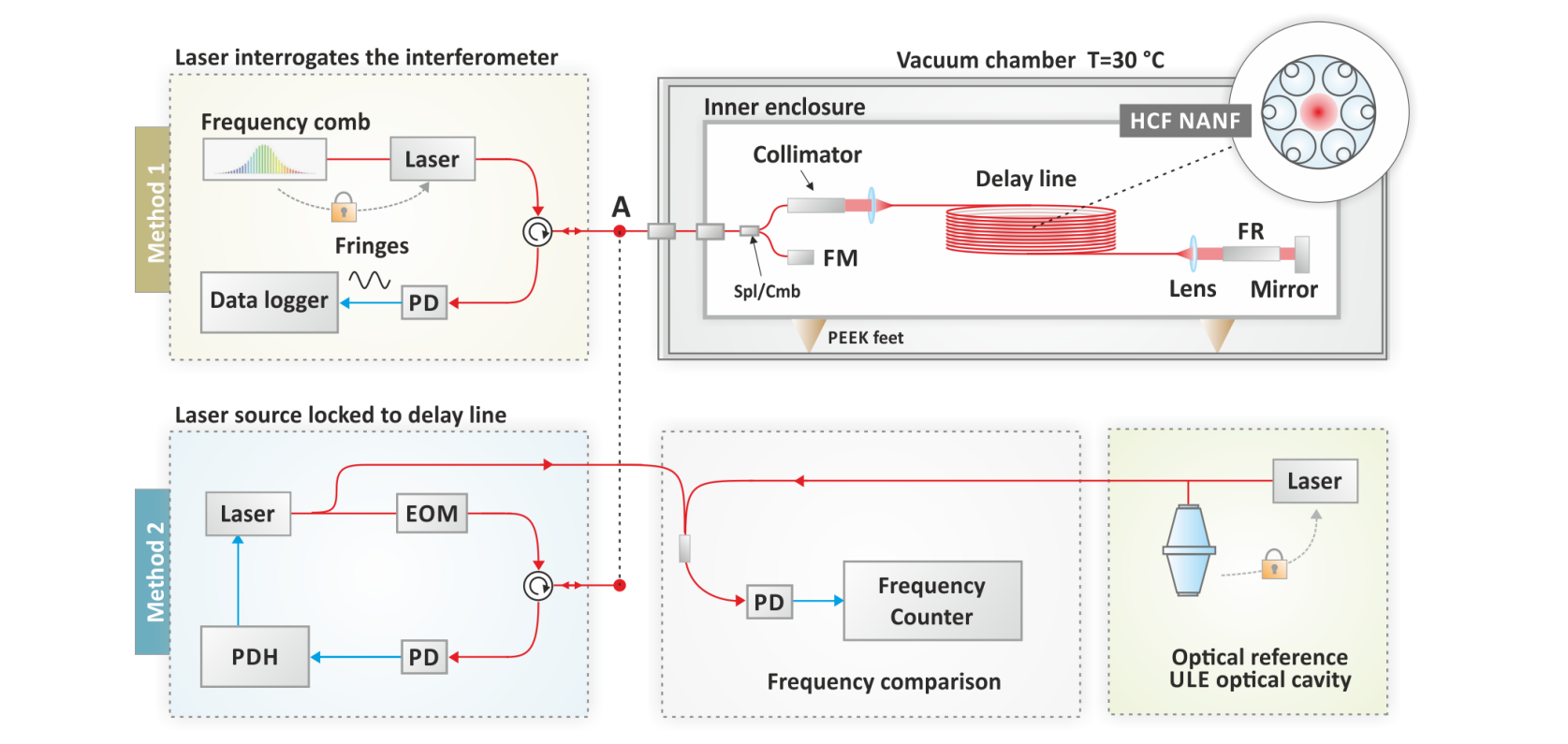
Scientists engineered a novel laser stabilization system utilizing Hollow Core Fibre (HCF) technology, achieving performance comparable to traditional systems relying on Ultra-Low Expansion (ULE) cavities. The study pioneered a method for precisely measuring laser frequency stability using two distinct approaches, designed to capture fluctuations across varying timescales. One method involved phase-locking a laser to an Optical Frequency Comb (OFC) and interrogating the HCF delay line interferometer, converting detected fringes into laser frequency fluctuations to calculate instability. Simultaneously, scientists phase-locked a ULE-cavity stabilized laser to the HCF interferometer, measuring beat frequency changes with a dead-time free frequency counter.
The experimental setup incorporated a vacuum environment to isolate the delay line interferometer from external disturbances, and Faraday mirrors at both interferometer arms ensured polarization insensitivity. Researchers meticulously characterized the coupling losses between single-mode fibre and HCF, measuring 1 dB per connection, with potential for reduction through all-fibre solutions. Over a 109-day period, the team collected data revealing a near-monotonic frequency increase and a total change of 836kHz, corresponding to a drift of 88 mHz/s, attributed to aging of the silica material and its acrylate coating. To mitigate the effects of temperature fluctuations, scientists applied a bivariate regression algorithm, minimizing the ratio between frequency fluctuations and temperature readings, and determined a thermal sensitivity of 0.
32 ppm/K for the HCF. This correction reduced peak-to-peak frequency variations by a factor of 30, down to 2kHz, and lowered the drift to below 3. 7 mHz/s. Allan deviation analysis demonstrated good agreement between the two measurement methods, with the HCF-based system delivering comparable stability to ULE cavities.
Hollow Core Fibre Rivals ULE Laser Stability
Scientists have achieved a breakthrough in ultra-stable laser technology, demonstrating performance comparable to lasers stabilized with traditional ultra-low expansion (ULE) glass cavities, but using a hollow core fibre (HCF) system. The team measured a frequency instability of 4. 6×10-15 at 1 second, a level of precision crucial for applications like optical atomic clocks and fundamental physics research. Long-term characterization spanning three years confirms the predictable behaviour of the HCF system, establishing its reliability for sustained operation. The research team also meticulously characterized the long-term stability of the HCF system, recording a frequency drift of 88 mHz/s over a 100-day period.
Importantly, this drift was reducible to 3. 7 mHz/s through thermal correction, demonstrating the system’s potential for even greater stability. The exceptional performance stems from the unique properties of the HCF, which exhibits a low thermal sensitivity of 0. 3 ppm/°C, as light propagates through a vacuum rather than solid material. This, combined with the fabrication of the fibre from a single glass material, minimizes built-in stress and simplifies drift behaviour. Experiments revealed that the HCF system’s stability is not only comparable to ULE cavities but also offers a simpler, more scalable solution for creating high-performance ultra-stable lasers.
Hollow Core Fibre Achieves Laser Stability
This research demonstrates a new approach to ultra-stable lasers, achieving performance comparable to systems reliant on complex and costly Ultra-Low Expansion (ULE) cavities. Scientists successfully stabilized a laser using a Hollow Core Fibre (HCF) delay line interferometer, a significantly simpler design that overcomes limitations associated with traditional methods. Measurements reveal a frequency instability of 4. 6×10-15 at one second and a frequency drift of 88 mHz/s, which can be further reduced to 3. 7 mHz/s with thermal correction.
The team attributes the observed drift primarily to the aging of materials used in the fibre’s fabrication, a factor they believe can be further mitigated with material improvements. While the current system exhibits coupling losses between standard fibre and the HCF, the researchers note that an all-fibre solution could address this. This work paves the way for scalable and high-performance ultra-stable laser sources, offering a practical alternative to ULE cavity-based systems and broadening the accessibility of this crucial technology.
🗞 Ultra-stable lasers using hollow-core fibre
🧠 ArXiv: https://arxiv.org/abs/2510.24991