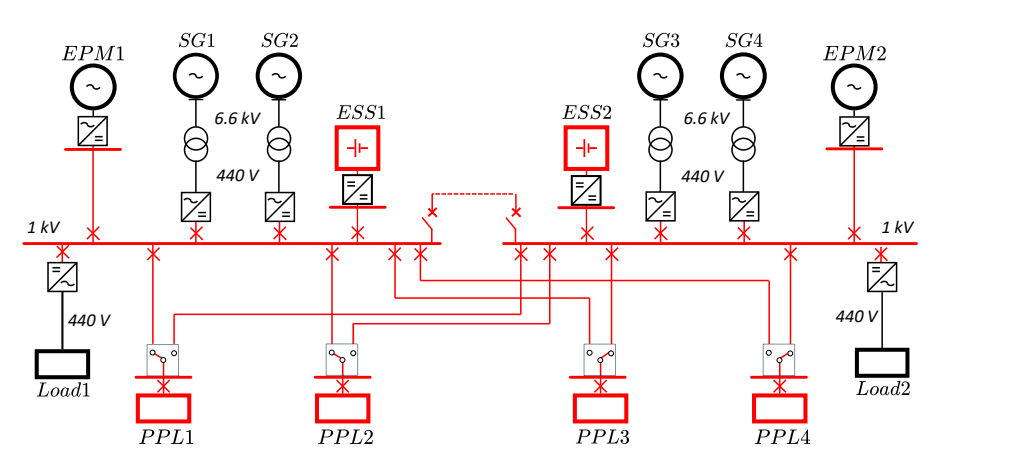
The increasing demand for efficient and reliable power systems drives innovation in naval architecture, and researchers are now exploring the benefits of integrating low-voltage direct current technology into shipboard grids. D. Roncagliolo, M. Gallo, and D. Kaza, alongside colleagues F. D’Agostino, A. Chiarelli, and F. Silvestro, present a comparative assessment of three distinct power system designs, each incorporating low-voltage DC sections alongside existing medium and low-voltage alternating current infrastructure. This work establishes a crucial baseline for future development, evaluating each architecture’s performance across key metrics including weight, volume, and system reliability, ultimately paving the way for more efficient and resilient naval power systems. The team’s analysis offers valuable insight into the practical implementation of low-voltage DC technology, addressing critical considerations for modern ship design and operation.
Researchers evaluated each architecture considering its weight, volume, technological maturity, and overall reliability, aiming to identify the optimal balance of performance characteristics. The three architectures examined were a combination of medium voltage AC, low voltage AC, and an integrated LVDC section, a fully LVDC-based radial distribution system, and a zonal LVDC system designed for improved fault isolation and redundancy. Key to the evaluation were pulsed power loads, which demand short bursts of high power, and energy storage systems, used to smooth power demands, provide backup power, and improve efficiency.
The study considered various technologies including AC and DC systems, batteries, supercapacitors, flywheels, and superconducting magnetic energy storage. Reliability was assessed using established metrics like the System Average Interruption Frequency Index and System Average Interruption Duration Index, providing a quantitative measure of system performance. The research concludes that no single architecture is universally superior, as the best choice depends on the specific requirements of the vessel. Researchers meticulously modeled each architecture, including essential components such as generators, propulsion motors, energy storage systems, and pulsed power loads, to facilitate a comprehensive comparative assessment. They employed a Markovian analysis to estimate the availability of key system elements, focusing on the impact of component failures and repair times on overall system performance. The team established failure rates and repair times for critical components, drawing upon existing data from previous research.
This detailed modeling allowed for a precise calculation of system availability based on the reliability of interconnected elements. Researchers considered the response times of transfer switches and tie-breakers in their calculations. The analysis determined equivalent failure and repair rates for each subsystem to assess overall system performance. Results indicate that incorporating DC sections introduces additional components, potentially increasing downtime. However, the zonal DC architecture demonstrates advantages by strategically positioning energy storage systems near pulsed power loads, reducing reliance on shared infrastructure and minimizing the impact of upstream failures. This distributed approach also reduces cable length, further enhancing reliability, while simultaneously decreasing system weight and volume.
LVDC Integration into Shipboard Power Systems
This work presents a comparative assessment of three shipboard power system (SPS) architectures, radial AC, radial DC, and zonal DC, designed to integrate low-voltage direct current (LVDC) technology. The study utilizes an existing medium-voltage AC-low-voltage AC system as a baseline for comparison, incorporating generators, electric propulsion motors, energy storage systems, extra propulsive loads, and pulsed power loads into each design. Performance was evaluated using five key performance indicators, providing a comprehensive analysis of each architecture’s strengths and weaknesses. Researchers measured weight and volume for each system, demonstrating that the radial AC architecture maintains a high technology readiness level while integrating LVDC components.
Experiments revealed that the radial DC architecture employs a centralized configuration, requiring transformers and voltage source converters to interface with existing generators. The zonal DC architecture, divided into four independent electrical zones, presents a ring topology that enhances resilience. Data shows that the System Average Interruption Duration Index, adapted for naval applications, was used to quantify the average annual outage duration for both propulsion systems and pulsed power loads. Measurements confirm that the pulsed power load interruption index specifically assesses the downtime of critical pulsed power loads, providing an additional metric for evaluating system performance. The results demonstrate that the zonal architecture offers the highest potential for resilience, while the radial AC configuration provides a familiar, high-TRL solution. The radial DC system, while requiring more interface equipment, presents a fully integrated DC distribution approach.
DC and AC Shipboard Power Comparison
This research presents a comparative assessment of three shipboard power system architectures designed to integrate low-voltage direct current distribution alongside existing alternating current systems. The team evaluated a conventional alternating current system with an added direct current section, a full direct current radial distribution, and a direct current zonal distribution, using key performance indicators including weight, volume, technology readiness level, and system reliability metrics. Results demonstrate that no single architecture consistently outperforms the others across all measures, with each offering distinct advantages and disadvantages. The study reveals that the conventional alternating current system with a direct current addition achieves the best results in terms of weight, volume, and technology readiness, benefiting from the maturity of existing components.
Conversely, the direct current zonal distribution offers improved system availability due to its inherent redundancy, although at the cost of increased complexity, weight, and volume. The direct current radial configuration represents a middle ground, providing moderate reliability but less favorably impacting weight and volume. The authors acknowledge limitations in the analysis, specifically the lack of detailed selectivity analysis and the absence of established regulatory standards for these systems. Future work will focus on developing more detailed static and dynamic models to validate these findings and incorporate broader system-level insights for a more comprehensive evaluation of shipboard power systems. This ongoing research aims to refine the understanding of these architectures and contribute to the development of more efficient and reliable power distribution systems for naval applications.
🗞 A Preliminary Assessment of Shipboard Power System Architectures for LVDC Integration
🧠 ArXiv: https://arxiv.org/abs/2509.22567