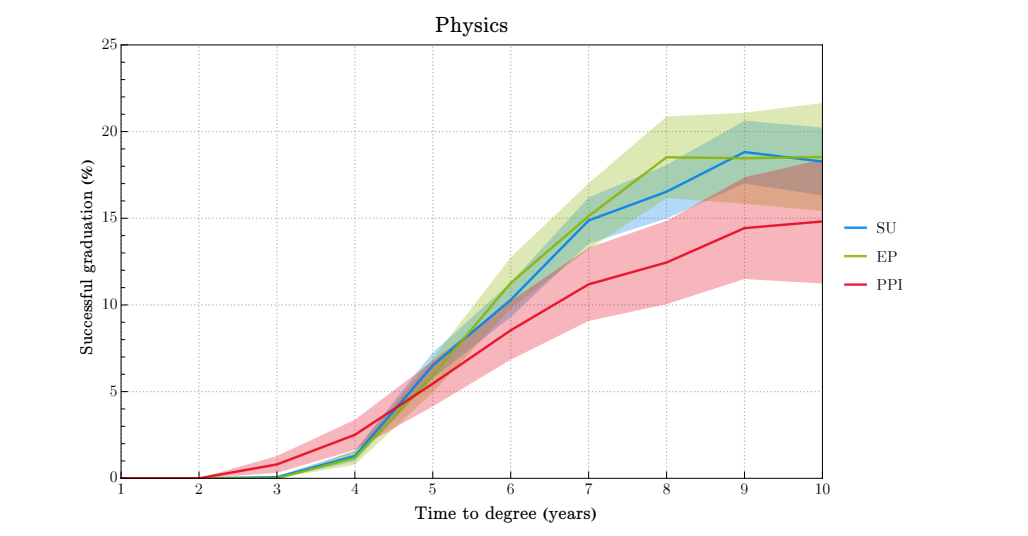
The effectiveness of quota policies in higher education remains a subject of intense debate, and new research from Ricardo D. Matheus, Elmer M. Gennaro, and Marcelo T. Yamashita at Sã o Paulo State University (Unesp) sheds light on this complex issue. The team investigates over a decade of quota implementation across diverse programmes, Physics, Biology, and Pedagogy, to determine how these policies impact student performance. Their analysis reveals significant variations depending on the field of study, demonstrating limited impact in programmes where admission barriers are already low or pass rates are high, but clear differences emerge in Biology. Importantly, the research highlights a performance hierarchy linked to admission type, with students entering through open competition consistently outperforming those from public schools and, subsequently, students admitted via racial quotas, suggesting that initial educational disparities prove difficult to address within the university system.
The study moves beyond simple demographic comparisons to examine academic trajectories and identify factors influencing student success. The core argument centers on the need for nuanced evaluation of quota policies, considering the specific rigor of each academic discipline, statistical significance, and long-term academic outcomes, not just initial access. Key findings reveal that the effectiveness of quotas varies considerably across fields, with minimal impact in highly competitive disciplines like Physics, while differences are less apparent in more permissive fields like Pedagogy.
Biology, however, demonstrates more pronounced differences, with students entering through standard merit-based admission consistently performing better than those admitted through quota programs. Robust analysis, the study emphasizes, requires large datasets to identify genuine trends and avoid statistical noise. The research highlights the importance of tracking student completion rates, finding that performance gaps observed at admission often persist throughout a student’s academic career. Quotas do not solve underlying preparation gaps; students entering with weaker academic backgrounds often face compounded difficulties over time. The study also stresses that quota categories are complex, with the best-performing students within quota groups often qualifying through standard merit-based admission, diluting the impact of the quotas themselves. The methodology involves analyzing a large dataset of student records from Unesp, spanning over a decade, examining enrollment, completion rates, and performance in key courses, broken down by admission track. The implications suggest that quota policies should be carefully designed and evaluated, taking into account the specific characteristics of different academic disciplines and the need for robust support systems. The team classified student outcomes strictly, categorizing those who completed their degree or abandoned the program, with mid-semester withdrawals or failing grades all counted as failures. The core of the methodology involves a comparative analysis of three admission systems: the Universal System (SU), open to all applicants; the Public School track (EP), reserved for students completing high school in Brazilian public schools; and the Black, Brown, and Indigenous quota (PPI), a subgroup within the EP system.
The study carefully accounts for the system’s inherent redistribution logic, where high-scoring EP or PPI candidates are admitted through the SU if eligible, releasing their reserved seat for another applicant. This ensures the PPI subgroup consistently exhibits the lowest admission cutoff scores, a crucial factor in interpreting the results and avoiding simplistic associations between quota categories and demographic factors. Researchers employed a rigorous verification process for PPI candidates, utilizing heteroidentification committees to confirm self-declared racial/ethnic status based on phenotypical traits. Indigenous candidates underwent verification based on documentation from legally recognized communities and the federal agency responsible for Indigenous affairs. This detailed process ensured the accuracy of the PPI classification, allowing for a nuanced understanding of the policy’s impact. Researchers meticulously compared the academic outcomes of students admitted through open competition, public schools, and racial quotas from 2013 to 2025. Contrary to expectations, the study revealed a decreasing probability of passing Calculus I as the number of attempts increased, suggesting that pre-existing educational gaps are difficult to overcome within the higher education environment, even with repeated opportunities. The research team’s findings provide valuable insights into the long-term academic outcomes of quota policies, moving beyond simple access metrics to assess actual student performance and success rates in core subjects. The findings reveal nuanced outcomes, demonstrating that the impact of quotas varies significantly depending on the field of study and the existing academic challenges faced by students. Notably, the study identifies a clear performance hierarchy in introductory Calculus courses, with students admitted through open competition consistently achieving the highest results, followed by those from public schools, and then students admitted through racial quotas. The team emphasizes the importance of distinguishing between fields of knowledge and accurately defining student populations when evaluating quota policies, a distinction often overlooked in previous studies. While acknowledging the limitations of drawing broad conclusions about the merits of quota policies themselves, the authors highlight the value of rigorous, data-driven evaluation to inform future policy decisions and address persistent inequalities in access to higher education.
👉 More information
🗞 Effectiveness of Quota Policies Across STEM, Biological, and Humanities Programs
🧠 ArXiv: https://arxiv.org/abs/2510.08261