

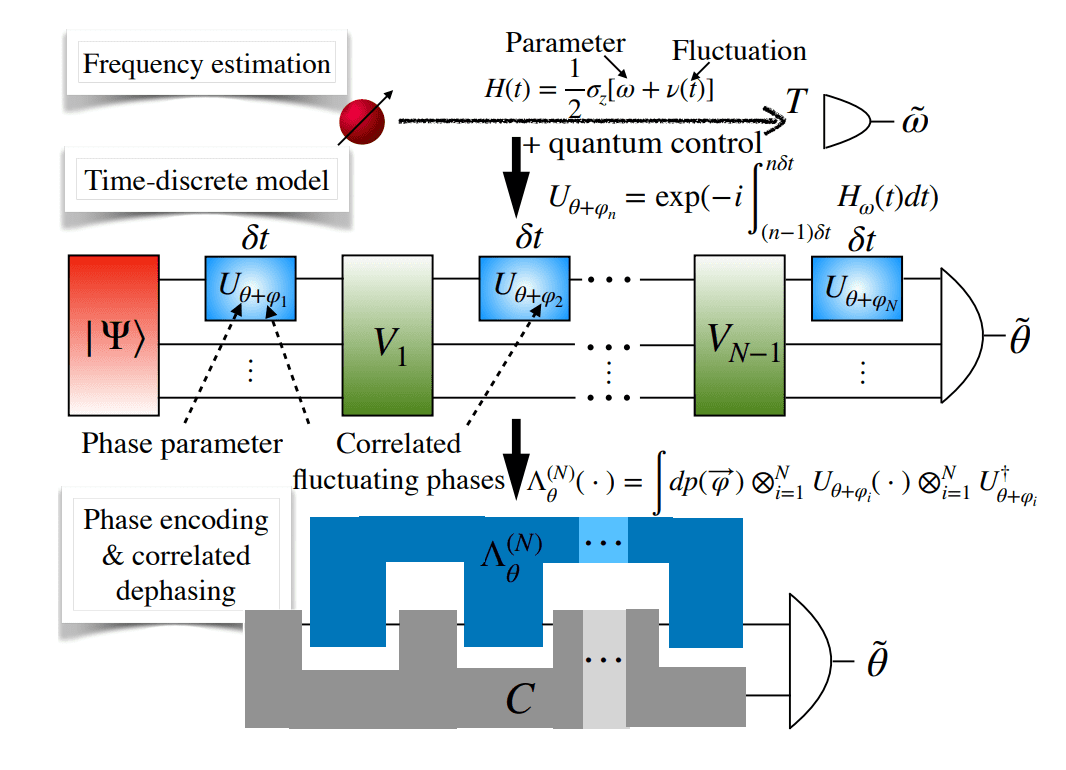
Precise phase estimation underpins numerous technologies, from atomic clocks to gravitational wave detectors, but real-world systems inevitably suffer from noise that degrades performance. Srijon Ghosh, Arkadiusz Kobus, Stanisław Kurdziałek, and Rafał Demkowicz-Dobrzański, all from the Faculty of Physics at the University of Warsaw, now demonstrate how to optimise phase estimation strategies when noise causes correlated fluctuations. Their work investigates the effectiveness of established techniques like spin-squeezed states alongside novel protocols designed using advanced numerical methods, revealing that while spin-squeezing excels when fluctuations are positive, adaptive strategies outperform it when fluctuations become negatively correlated. This discovery significantly advances the field by identifying conditions where previously favoured techniques fall short and paving the way for more robust and accurate sensing technologies.
Scientists are continually refining techniques to minimize unwanted interference, known as noise, in quantum systems, ultimately enhancing the precision of measurements. Recent work focuses on understanding and mitigating correlated noise, where fluctuations in a system’s environment are linked rather than random, impacting the accuracy of phase estimation, a crucial process in many quantum technologies. Researchers employed sophisticated computational methods, utilizing tensor networks, to design optimal measurement protocols and benchmark their performance against established theoretical limits.
Quantum Estimation, Networks and Foundational Theory
This compilation represents a comprehensive overview of research related to quantum metrology, noise, and estimation, spanning foundational theoretical work to recent advancements and software tools. It encompasses core concepts of quantum metrology, including foundational works which lay the groundwork for understanding quantum detection and estimation. The list also highlights the importance of squeezed states, a crucial resource for enhancing precision in metrology, as explored in early investigations into improving frequency standards using quantum entanglement and squeezing. A significant portion of the research addresses correlated noise, a key area of current investigation as it presents greater challenges than uncorrelated noise.
The importance of memory effects, where past fluctuations influence present behavior, is also prominent. Advanced techniques, such as tensor networks, provide powerful tools for dealing with complex noise correlations. Adaptive estimation strategies further improve performance in noisy environments, and software packages like Qmetro++ highlight the importance of computational tools for practical applications. The research also extends to specific applications, such as atomic magnetometry and frequency standards. Classical mathematical tools underpin the calculations, while techniques facilitate approximations and manage large datasets. This compilation demonstrates a clear shift from focusing on uncorrelated noise to tackling the more realistic challenges of correlated noise and memory effects, with tensor networks emerging as essential tools for complex problems. The interdisciplinary nature of the research, spanning physics, mathematics, statistics, and computer science, reflects the collaborative effort driving advancements in quantum metrology.
Correlated Noise Enhances Quantum Phase Estimation
Scientists have achieved significant advances in precision measurement, specifically in estimating phases of quantum systems affected by correlated noise. This work investigates a model where fluctuations in the system’s environment are linked, influencing the accuracy of measurements. Researchers employed sophisticated tensor-network based numerical methods to design optimal measurement protocols, utilizing up to 30 quantum channels, and benchmarked their performance against established theoretical limits. The study reveals that while spin-squeezed states, a common technique for improving measurement precision, perform optimally when phase fluctuations are positively correlated, they can be surpassed by protocols optimized using tensor networks when the fluctuations are negatively correlated.
Experiments demonstrate that the tensor-network optimized strategies deliver superior performance in regimes where noise correlations are unfavorable for spin-squeezed states, highlighting the adaptability of these new protocols. To establish a rigorous benchmark, the team derived new upper bounds on achievable precision using both classical simulation methods and a recently developed quantum comb extension method. Measurements confirm the effectiveness of these optimized protocols, demonstrating their ability to approach fundamental limits on precision even in the presence of complex, correlated noise. This breakthrough delivers a versatile toolkit for tackling noise challenges in quantum sensing and estimation, with potential applications ranging from magnetic field sensing to gravitational wave detection.
Negative Correlation Boosts Phase Estimation Precision
This research presents a detailed investigation into optimal strategies for precise phase estimation in quantum systems, specifically when subjected to correlated dephasing noise. The team explored the performance of spin-squeezed states, alongside novel protocols optimized using advanced tensor-network numerical methods. Results demonstrate that while spin-squeezed states remain highly effective when phase fluctuations are positively correlated, the tensor-network optimized strategies can achieve superior performance in scenarios with negatively correlated fluctuations. The study establishes a benchmark for assessing the optimality of these protocols by deriving fundamental precision limits using both comb extension methods and classical simulations. By modelling a system subject to fluctuating magnetic fields, the researchers developed a framework for analyzing phase estimation under realistic noise conditions. This research provides valuable insights into the design of robust quantum sensors and contributes to the ongoing development of precision measurement technologies.
👉 More information
🗞 Optimal phase estimation in the presence of correlated dephasing
🧠 ArXiv: https://arxiv.org/abs/2511.07211

